


Key cautions
- Pregnancy and breastfeeding safety is not established by this traditional record. Do not self-prescribe medicinal preparations when pregnant, trying to conceive, or breastfeeding; obtain clinician review.
- The flower is distinct from safflower seed oil and from Crocus sativus saffron.
- WHO’s flower monograph contraindicates medicinal use during pregnancy and in haemorrhagic disorders or excessive menstruation.
What’s inside
The flowers contain red and yellow colour compounds. Seed-oil fatty acids and oil nutrition must not be assigned to flower material.
Uses in brief

- Flower colour for textiles, cosmetics and food.
- Traditional menstrual-use reference; medicinal use contraindicated in pregnancy.
History, folklore and reported uses
History, folklore and traditional uses
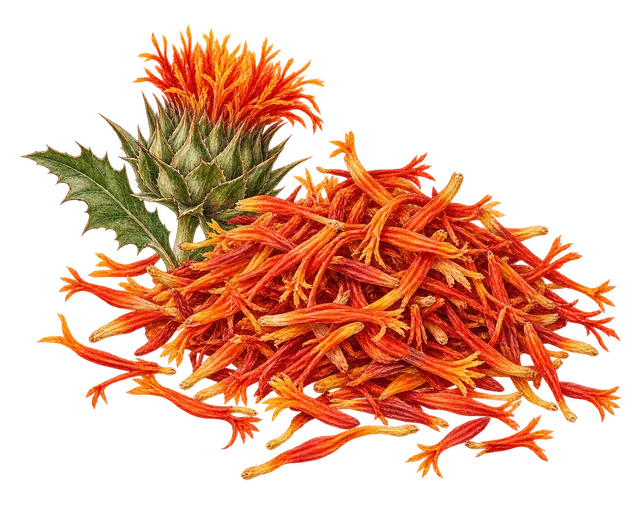
Hong hua is the dried safflower flower in Chinese medicine, traditionally placed among medicines for blood-stasis patterns. Its menstrual history belongs to the flower, not to ordinary safflower cooking oil.
Traditional, historical and reported uses
- menstruation
Traditional accountWhy this label?
The cited traditional record documents use, not clinical efficacy. No benefit for this single ingredient can be established from that source; multi-herb formula findings cannot be assigned to it.
Recorded for absent or painful menstruation and historical postpartum discomfort. The cited traditional record documents use, not clinical efficacy. No benefit for this single ingredient can be established from that source; multi-herb formula findings cannot be assigned to it.
- Textile and cosmetic colour
Traditional accountWhy this label?
Kew’s Flora of Oman account records safflower flower dye for cloth, wool and cosmetics. This broadens the flower’s history without claiming medicinal efficacy.
Kew’s Flora of Oman account records safflower flower dye for cloth, wool and cosmetics. This broadens the flower’s history without claiming medicinal efficacy.
- Food colour and false saffron
Food or household practiceWhy this label?
Kew describes safflower flowers as a cheaper saffron substitute in some traditional recipes, including early Spanish-colonial Rio Grande cooking. Safflower and Crocus sativus remain different plants with different flavours and evidence.
Kew describes safflower flowers as a cheaper saffron substitute in some traditional recipes, including early Spanish-colonial Rio Grande cooking. Safflower and Crocus sativus remain different plants with different flavours and evidence.
Coverage reflects verified sources, without a minimum use quota.
Women’s Health: traditions, evidence and cautions
Historical use does not establish benefit or safety. Pregnancy, breastfeeding and fertility care require particular caution: food, tea, essential oil and concentrated extract are not interchangeable. These records are not treatment, dosing or pregnancy-management instructions. Discuss supplements with a qualified clinician or pharmacist; do not delay evaluation of persistent symptoms.
Safflower flower / hong hua
Carthamus tinctorius L.
- Plant part / material
- Dried florets (Carthami Flos)
- Preparation studied or reported
- Traditional flower decoctions and compound medicinal products; not the pressed seed oil.
One exact-material card. Traditional flower decoctions and compound medicinal products; not the pressed seed oil.. Keep preparations distinct; do not transfer findings from a named extract to every tea or powder.
Hong hua is the dried safflower flower in Chinese medicine, traditionally placed among medicines for blood-stasis patterns. Its menstrual history belongs to the flower, not to ordinary safflower cooking oil.
menstruation
Traditional account
Reported or traditional useRecorded for absent or painful menstruation and historical postpartum discomfort. The cited traditional record documents use, not clinical efficacy. No benefit for this single ingredient can be established from that source; multi-herb formula findings cannot be assigned to it.
What the evidence supportsThe cited traditional record documents use, not clinical efficacy. No benefit for this single ingredient can be established from that source; multi-herb formula findings cannot be assigned to it.
Pregnancy and breastfeeding safety is not established by this traditional record. Do not self-prescribe medicinal preparations when pregnant, trying to conceive, or breastfeeding; obtain clinician review. The flower is distinct from safflower seed oil and from Crocus sativus saffron. WHO’s flower monograph contraindicates medicinal use during pregnancy and in haemorrhagic disorders or excessive menstruation. Do not use the flower to bring on a period when pregnancy is possible. Anticoagulant or antiplatelet medicines need professional review.
Textile and cosmetic colour
Traditional account
Reported or traditional useKew’s Flora of Oman account records safflower flower dye for cloth, wool and cosmetics. This broadens the flower’s history without claiming medicinal efficacy.
What the evidence supportsKew’s Flora of Oman account records safflower flower dye for cloth, wool and cosmetics. This broadens the flower’s history without claiming medicinal efficacy.
Pregnancy and breastfeeding safety is not established by this traditional record. Do not self-prescribe medicinal preparations when pregnant, trying to conceive, or breastfeeding; obtain clinician review. The flower is distinct from safflower seed oil and from Crocus sativus saffron. WHO’s flower monograph contraindicates medicinal use during pregnancy and in haemorrhagic disorders or excessive menstruation. Do not use the flower to bring on a period when pregnancy is possible. Anticoagulant or antiplatelet medicines need professional review.
Food colour and false saffron
Food or household practice
Reported or traditional useKew describes safflower flowers as a cheaper saffron substitute in some traditional recipes, including early Spanish-colonial Rio Grande cooking. Safflower and Crocus sativus remain different plants with different flavours and evidence.
What the evidence supportsKew describes safflower flowers as a cheaper saffron substitute in some traditional recipes, including early Spanish-colonial Rio Grande cooking. Safflower and Crocus sativus remain different plants with different flavours and evidence.
Pregnancy and breastfeeding safety is not established by this traditional record. Do not self-prescribe medicinal preparations when pregnant, trying to conceive, or breastfeeding; obtain clinician review. The flower is distinct from safflower seed oil and from Crocus sativus saffron. WHO’s flower monograph contraindicates medicinal use during pregnancy and in haemorrhagic disorders or excessive menstruation. Do not use the flower to bring on a period when pregnancy is possible. Anticoagulant or antiplatelet medicines need professional review.
One exact-material card. Traditional flower decoctions and compound medicinal products; not the pressed seed oil.. Keep preparations distinct; do not transfer findings from a named extract to every tea or powder.
- Pregnancy and breastfeeding safety is not established by this traditional record. Do not self-prescribe medicinal preparations when pregnant, trying to conceive, or breastfeeding; obtain clinician review.
- The flower is distinct from safflower seed oil and from Crocus sativus saffron.
- WHO’s flower monograph contraindicates medicinal use during pregnancy and in haemorrhagic disorders or excessive menstruation.
- Do not use the flower to bring on a period when pregnancy is possible.
- Anticoagulant or antiplatelet medicines need professional review.
- Hong Kong Baptist University: Safflower (Hong hua)
- Kew POWO: Carthamus tinctorius uses, Flora of Oman
- Royal Botanic Gardens Kew: Safflower
- WHO monographs volume3: Flos Carthami, pp117–123
Read the complete historical reference and its material distinctions
Identity & detailed reference
Identity
Carthamus tinctorius L.; Dried florets (Carthami Flos).
Ingredient details, preparation and research
Also known as: hong hua; Carthami Flos; dyer’s saffron
Source plant or material
Carthamus tinctorius L. — Dried florets (Carthami Flos)
Plant family / material: Asteraceae (daisy family)
Forms and route
Traditional flower decoctions and compound medicinal products; not the pressed seed oil.
Vitamins and minerals
No nutrient quantities or daily-value claims are assigned to this medicinal material. Do not borrow the food nutrient profile of another plant part or use an extract as a dietary substitute.
Absorption and preparation
Preparation and route matter. A tea, whole powder, alcohol extract and isolated constituent can give different exposures. No food pairing or absorption-enhancement technique is established by the sources reviewed.
Traditional and reported uses
- Recorded for absent or painful menstruation and historical postpartum discomfort. The cited traditional record documents use, not clinical efficacy. No benefit for this single ingredient can be established from that source; multi-herb formula findings cannot be assigned to it.
- Kew’s Flora of Oman account records safflower flower dye for cloth, wool and cosmetics. This broadens the flower’s history without claiming medicinal efficacy.
- Kew describes safflower flowers as a cheaper saffron substitute in some traditional recipes, including early Spanish-colonial Rio Grande cooking. Safflower and Crocus sativus remain different plants with different flavours and evidence.
Contraindications and cautions
- Pregnancy and breastfeeding safety is not established by this traditional record. Do not self-prescribe medicinal preparations when pregnant, trying to conceive, or breastfeeding; obtain clinician review.
- The flower is distinct from safflower seed oil and from Crocus sativus saffron.
- WHO’s flower monograph contraindicates medicinal use during pregnancy and in haemorrhagic disorders or excessive menstruation.
- Do not use the flower to bring on a period when pregnancy is possible.
- Anticoagulant or antiplatelet medicines need professional review.
Similar items and how they compare
- Safflower oil
Existing card67, same plant
Pressed seed triglyceride oil is a different part/preparation.
- Saffron
Existing card134, similar colour role
Crocus sativus stigmas are not safflower florets.
Identity and composition
Carthamus tinctorius L.; Dried florets (Carthami Flos). The flowers contain red and yellow colour compounds. Seed-oil fatty acids and oil nutrition must not be assigned to flower material.
menstruation: what evidence can say
The cited traditional record documents use, not clinical efficacy. No benefit for this single ingredient can be established from that source; multi-herb formula findings cannot be assigned to it. Do not use medicinal flower preparations to bring on a period if pregnancy is possible. Pregnancy/lactation safety is not established; bleeding disorders or anticoagulants require review.
Exact material and preparation boundaries
One exact-material card. Traditional flower decoctions and compound medicinal products; not the pressed seed oil.. Keep preparations distinct; do not transfer findings from a named extract to every tea or powder.
Medicines, pregnancy and breastfeeding
WHO reports no established clinical drug interaction but recommends caution with anticoagulant/antiplatelet medicines because flower extracts inhibit platelet aggregation in experimental work. It contraindicates pregnancy use; lactation safety is not established. Culinary colouring history is not permission to take medicinal-strength flowers.
Source-supported safety summary
Pregnancy and breastfeeding safety is not established by this traditional record. Do not self-prescribe medicinal preparations when pregnant, trying to conceive, or breastfeeding; obtain clinician review. The flower is distinct from safflower seed oil and from Crocus sativus saffron. WHO’s flower monograph contraindicates medicinal use during pregnancy and in haemorrhagic disorders or excessive menstruation. Do not use the flower to bring on a period when pregnancy is possible. Anticoagulant or antiplatelet medicines need professional review.
Evidence limits
- This is a focused educational source review, not a systematic review or a treatment plan.
- Traditional use documents a practice; it does not establish clinical benefit. Laboratory findings and multi-ingredient trials cannot establish a single ingredient’s effects.
- WHO source is a historic government monograph, not a new clinical review; its safety warning is included without copying doses.
Entry sources
- Hong Kong Baptist University: Safflower (Hong hua)
- Kew POWO: Carthamus tinctorius uses, Flora of Oman
- Royal Botanic Gardens Kew: Safflower
- WHO monographs volume3: Flos Carthami, pp117–123
Reference entry 537 · Recorded content review: 2026-10-11 · Review scope and dates