


Key cautions
- Keep seed oil separate from flower extracts and CLA supplements
- Avoid a known allergen; use only food-labeled oil orally
- A small-area cosmetic tolerance test is not an allergy diagnosis.
- Paint and varnish oils may contain metal driers, solvents or other additives. Keep them separate from food and body-care products; the historical industrial experiments are not recipes for household use.
- The reported blemish-prone-skin and scalp uses do not establish treatment benefits for acne or hair loss.
- Store tightly closed away from heat and light. Discard rancid oil, avoid allowing it to smoke, and do not repeatedly reuse cooking oil. Follow the particular product’s cooking directions rather than assigning every safflower oil one heat limit.
What’s inside
High-linoleic oil is rich in linoleic acid, a polyunsaturated omega-6 fat; high-oleic oil is richer in oleic acid, a monounsaturated fat. These names describe the oil’s fatty-acid balance, not its extraction method, food grade or proof of a health benefit.
Yilmaz et al. (2023): Development periods and safflower oil composition · USDA FoodData Central: High-linoleic and high-oleic safflower oil reference records
Identity, plant part and cultivar
Kew accepts Carthamus tinctorius in Asteraceae. The fixed seed oil is distinct from petals used as pigments or herbal preparations. High-linoleic and high-oleic cultivars shift the dominant fatty acid. A 2023 six-variety study found changes with maturation, predominantly alpha-tocopherol among tocopherols and beta-sitosterol among sterols. A seed-oil label is more informative than the plant name alone.
Kew Plants of the World Online: Carthamus tinctorius · Yilmaz et al. (2023): Development periods and safflower oil composition
Dietary portion and vitamin E
The raw USDA SR Legacy records each specify a 13.6 g tablespoon. Scaling the recorded 34.1 mg alpha-tocopherol/100 g gives 4.6376 mg per tablespoon. The same reference vitamin E figure appears in both records; cultivar studies show real variation. Neither oil is a meaningful protein, fiber or mineral source, and topical use does not count toward dietary requirements.
USDA FoodData Central: High-linoleic and high-oleic safflower oil reference records · NIH Office of Dietary Supplements: Vitamin E
Oil, seed and minor constituents
The food-reference measurements concern extracted oil, not whole seeds or flowers. Percentages of seed oil yield, percentages of total fatty acids and milligrams of a constituent per 100 g of oil have different denominators. A phytosterol is not a vitamin or evidence of a human hormone effect; an oil analysis is not a clinical trial.
Yilmaz et al. (2023): Development periods and safflower oil composition · USDA FoodData Central: High-linoleic and high-oleic safflower oil reference records
Uses in brief

- Food-grade oil for cooking and dressings
- Cosmetic carrier and skin/hair conditioning
History, folklore and reported uses
Flower color before the oil bottle
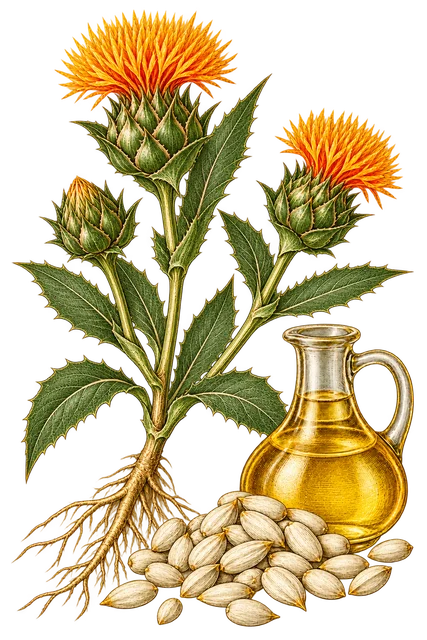
Safflower’s older fame was brilliantly coloured. Its thistle-like flower heads supplied red and yellow dyes long before a pale bottle of seed oil became its most familiar form. Kew records safflower dye in Egyptian textiles from the twelfth dynasty and its later life as a less costly colouring substitute for saffron. Early Spanish colonial cooks along New Mexico’s Rio Grande also used the flowers in this way. The name ‘false saffron’ remembers a trade in colour and kitchen ingenuity, not a botanical relationship to the crocus that produces true saffron.
A crop with two material histories
The seeds tell another part of the plant’s story. Kew describes a shift from cultivation for pigments toward cultivation for oil-bearing fruits. Modern safflower oil moves into dressings, cooking fats and skin- or hair-care products, while flowers retain their own dyeing and herbal traditions. The two materials deserve separate histories: a medicinal claim attached to a red flower preparation does not automatically follow the pale fixed oil pressed from its seeds.
Kew Plants of the World Online: Carthamus tinctorius · Kew: Safflower, plant history and uses
Moisturizing skin
Kew records safflower seed oil in moisturizing skin products. This pale fixed oil has a contemporary body-care role separate from the strongly colored flower preparations.
Natural care for blemish-prone skin
Kew also describes interest in safflower seed oil for acne-prone skin. This is a reported cosmetic purpose of the oil, not a transfer of Chinese medicinal claims for safflower flowers.
Hair and scalp conditioning
The Kew profile describes seed-oil products intended to smooth hair cuticles and hydrate the scalp. These are grooming applications of the extracted fat.
Massage with a smooth-gliding carrier
Rose Chard’s NAHA teaching specifically favors safflower oil for its glide in massage. It is used as the carrier portion of an aromatic body oil.
Cooking, dressings and household food fats
Kew records safflower seed oil in cooking, salad dressings and margarine. Its food use should not be confused with the flower’s older role as a saffron-colored seasoning.
Drying oil for paints and varnishes
In 1958, Mohammad Aslam at Pakistan’s scientific and industrial research laboratories tested safflower seed oils from Sind-grown varieties for paints and resin varnishes. The study documents an industrial film-forming use of the seed oil, separate from safflower-petal dyes.
Mohammad Aslam (1958): Safflower oil for paints and varnishes
Established food and cosmetic roles
COSMILE lists safflower seed oil as skin conditioning and as an excipient in fragrance preparations; this does not mean it is an aromatic essential oil or a disease treatment. Culinary use is compatible with the AHA advice to replace some solid fats with liquid unsaturated oils. Avoid converting this practical food substitution into a claim that taking extra oil causes weight loss.
COSMILE Europe: Carthamus tinctorius seed oil · American Heart Association: Healthy cooking oils
Cultivar and processing are separate choices
High-oleic and high-linoleic describe composition; pressed and refined describe processing. Neither pair tells you whether a bottle is intended for food, massage or industrial manufacture. Read the intended-use label and any added ingredients as well as the oil type.
Yilmaz et al. (2023): Development periods and safflower oil composition · COSMILE Europe: Carthamus tinctorius seed oil · Allergy UK incorporating Anaphylaxis UK: Plant-based oils · Mohammad Aslam (1958): Safflower oil for paints and varnishes
Identity & detailed reference
Identity
Carthamus tinctorius L.; fixed triglyceride oil from the seeds. Conventional high-linoleic and high-oleic cultivars are chemically different products. Neither is a safflower-flower extract or a volatile essential oil.
Ingredient details, preparation and research
Source plant or material
Carthamus tinctorius L., an annual oilseed crop; the seed lipid is the material discussed here, not the colored flower material.
Plant family / material: Asteraceae (daisy family).
Forms and route
Food-grade pressed or refined cooking/salad oil; separately labeled cosmetic carrier oil, creams and hair products. High-linoleic and high-oleic oils should be identified on the label. Conjugated linoleic acid (CLA) supplements manufactured from vegetable oils are a separate substance.
Food sources
Look for a food-grade safflower seed oil labeled for its intended cooking use; high-linoleic and high-oleic products are not interchangeable composition references. Whole seeds, petals and extracts have different constituents.
Vitamins and minerals
USDA gives 1 tablespoon = 13.6 g for both reference types: about 120 kcal, 13.6 g fat and 4.64 mg alpha-tocopherol (31% of the 15 mg vitamin E Daily Value). High-linoleic oil supplies about 10.1 g linoleic acid and 0.84 g saturated fat; high-oleic oil about 10.2 g total monounsaturates, 1.73 g linoleic acid and 1.03 g saturated fat. These are reference estimates, not every bottle’s analysis. Protein, fiber and listed major minerals are negligible.
Absorption and preparation
Edible safflower oil is digested with other meal fats: bile and digestive enzymes assist breakdown, and the intestine absorbs the products. Vitamin E uses fat-absorption pathways. High oleic versus high linoleic describes composition, not a verified ranking of skin penetration; no universal absorbed percentage is assigned.
Practical preparation
Use a measured food portion in dressing or cooking, following the product’s heat guidance. Keep closed in a cool, dark place and discard deteriorated oil. For skin/hair use, choose a labeled topical preparation and test tolerance on a small area; no homemade essential-oil recipe or medicinal oral dose is assigned.
Combination notes
A culinary oil can be part of a vegetable-containing meal. No evidence here establishes a special oil blend or supplement “stack.” A carrier does not remove the allergy or irritation risk of added perfume or essential oils. Safflower-derived CLA is not ordinary safflower oil.
Traditional and reported uses
- Food use: a liquid cooking or salad fat; replacing some solid saturated fat is more relevant than adding oil on top of an unchanged diet.
- Cosmetic use: skin conditioning and a vehicle in formulated products; hair oiling primarily lubricates and softens the fiber.
- Human metabolic research is preliminary and population-specific. Studies of flowers, isolated pigments, or CLA do not establish benefits of plain seed oil.
Contraindications and cautions
- Use food-labeled oil for eating; cosmetic or fragranced blends are not edible preparations.
- Avoid with a known reaction to safflower or the product. Refining may lower protein exposure but is not an individual allergy guarantee.
- Do not use oil supplements instead of prescribed diabetes, blood-pressure or lipid treatment. The cited trials do not establish a comprehensive drug-interaction profile for medicinal-dose use.
- Do not automatically transfer safflower-flower pregnancy/bleeding warnings to ordinary food seed oil, or assume flower preparations are safe because the oil is edible.
- Stop a cosmetic that causes persistent irritation; ordinary oil is not a treatment for infected wounds, burns or persistent scalp disease.
- A small-area cosmetic tolerance test is not an allergy diagnosis.
- Paint and varnish oils may contain metal driers, solvents or other additives. Keep them separate from food and body-care products; the historical industrial experiments are not recipes for household use.
- The reported blemish-prone-skin and scalp uses do not establish treatment benefits for acne or hair loss.
- Store tightly closed away from heat and light. Discard rancid oil, avoid allowing it to smoke, and do not repeatedly reuse cooking oil. Follow the particular product’s cooking directions rather than assigning every safflower oil one heat limit.
Similar items and how they compare
- Grapeseed oil
Another commonly linoleic-rich edible and cosmetic carrier oil.
Its minor constituents differ, and it is not a substitute for high-oleic safflower in a composition comparison.
- Olive oil
An oleic-rich comparator for high-oleic safflower.
Olive oil comes from fruit and virgin products have a distinct phenolic profile; equal oleic content does not imply identical clinical effects.
- CLA supplements
Sometimes marketed with a safflower source claim.
Conjugated linoleic acid is chemically different from the ordinary linoleic acid in seed oil; study results and cautions must remain separate.
Small diabetes trial and a related publication
A 2009 double-masked crossover study enrolled 55 obese postmenopausal women with type 2 diabetes; 35 completed both 16-week periods, separated by four weeks. Participants received 8 g/day safflower oil or CLA oil. Safflower changed trunk fat, lean mass and fasting glucose, but did not reduce BMI or total fat mass. The 2011 glycemia/inflammation report comes from this same experiment, not an independent replication. Attrition, a narrow population and the active-oil comparator limit generalization. The study amount is not a home-use prescription.
Metabolic-syndrome research
A 2021 randomized trial assigned 67 patients to 8 g/day safflower oil or placebo for 12 weeks. Several measures, including waist circumference, blood pressure and fasting glucose, improved relative to placebo. These short-term risk markers are not evidence of fewer heart attacks, long-term diabetes remission or benefit for every consumer. Medication changes should not be inferred from the findings.
Heart outcomes require wider context
A 2013 recovered-data analysis of the 1966–1973 Sydney Diet Heart Study found higher mortality in an intervention group advised to replace saturated fats with high-linoleic safflower oil and a safflower-oil margarine. The 458 participants were men with a recent coronary event; incomplete historical product/diet information limits interpretation. This is not a trial of all modern seed oils or high-oleic safflower. Current AHA advice still supports unsaturated cooking oils and omega-6 fats within a healthy eating pattern.
Absorption, adverse effects and boundaries
Digestion of food oil is different from applying a cosmetic to the skin. Evidence cited here does not establish exceptional transdermal nutrient delivery or a complete supplement interaction profile. Use the labeled route; a known safflower reaction is a reason to avoid exposure. Flower-extract and CLA research cannot supply the missing safety evidence for a particular seed-oil product.
Entry sources
- Kew Plants of the World Online: Carthamus tinctorius, accepted name and Asteraceae
- COSMILE Europe: Carthamus tinctorius seed oil, skin-conditioning ingredient
- Yilmaz et al. (2023): Development, fatty acids, sterols and tocopherols in six safflower varieties
- Norris et al. (2009): Safflower oil versus conjugated linoleic acid in postmenopausal women with diabetes
- Asp et al. (2011): Time-dependent glycemia, inflammation and lipid results from the same safflower/CLA crossover trial
- Safflower oil in metabolic syndrome (2021): Randomized 12-week trial in 67 patients
- Ramsden et al. (2013): Recovered Sydney Diet Heart Study data and linoleic-acid intervention analysis
- American Heart Association (2024; corrected 2025): Seed oils and the place of omega-6 fats in a healthy diet
- American Heart Association: Healthy cooking oils, food substitution and storage guidance
- Anaphylaxis UK: Plant-based oils, refining and food-allergy cautions
- American Academy of Dermatology: How to test skin-care products
- NIDDK: Your digestive system and how it works
- USDA FoodData Central SR Legacy: high-linoleic safflower oil FDC 171026 and high-oleic safflower oil FDC 171027; nutrient and food-portion records
- NIH Office of Dietary Supplements: Vitamin E, alpha-tocopherol, absorption and Daily Values
- Mohammad Aslam (1958), Pakistan Council of Scientific and Industrial Research: Safflower oil in paints
Reference entry 67 · Recorded content review: 2026-10-05 · Review scope and dates