


Key cautions
- Distinct from European angelica (Angelica archangelica).
- Avoid pregnancy/breastfeeding; review anticoagulants and hormone-sensitive conditions.
- Avoid medicinal use during pregnancy or breastfeeding.
What’s inside
Root preparations contain a complex mixture including volatile constituents and phenolic compounds. No constituent level or therapeutic dose is assigned across products.
Uses in brief

- Chinese compound-formula history for menstrual complaints.
- A single-root menopause trial found no benefit over placebo.
History, folklore and reported uses
History, folklore and traditional uses
In Chinese medicine, dang gui is a root medicine used in menstrual formulas, including Si Wu Tang. Its blood-nourishing terminology belongs to the traditional medical framework and does not mean that it corrects a diagnosed blood disorder.
Traditional, historical and reported uses
- menstruation; menopause
Traditional accountWhy this label?
WHO records historical menstrual use and calls for controlled trials. A 71-person placebo-controlled trial found dong quai alone no better than placebo for menopausal symptoms.
Historical uses include absent or painful periods and menstrual discomfort. WHO records historical menstrual use and calls for controlled trials. A 71-person placebo-controlled trial found dong quai alone no better than placebo for menopausal symptoms.
- Si Wu Tang formula heritage
Historical recordWhy this label?
HKBU records dang gui among the four ingredients of Si Wu Tang, a traditional formula for blood-deficiency and stagnation patterns. Its historical associations include menstrual complaints and other pattern-based symptoms; formula findings cannot be assigned to dong quai alone.
HKBU records dang gui among the four ingredients of Si Wu Tang, a traditional formula for blood-deficiency and stagnation patterns. Its historical associations include menstrual complaints and other pattern-based symptoms; formula findings cannot be assigned to dong quai alone.
Coverage reflects verified sources, without a minimum use quota.
Story sources
- WHO monographs on selected medicinal plants, volume 2: Radix Angelicae Sinensis
- HKBU: Four Substances Decoction / Si Wu Tang
- Memorial Sloan Kettering: Dong Quai
- Hirata et al. (1997): dong quai in postmenopausal women
- Hirata et al. 1997: Dong quai placebo-controlled trial
- Hong Kong Department of Health: Radix Angelicae Sinensis standard
Women’s Health: traditions, evidence and cautions
Historical use does not establish benefit or safety. Pregnancy, breastfeeding and fertility care require particular caution: food, tea, essential oil and concentrated extract are not interchangeable. These records are not treatment, dosing or pregnancy-management instructions. Discuss supplements with a qualified clinician or pharmacist; do not delay evaluation of persistent symptoms.
Dong quai / dang gui
Angelica sinensis (Oliv.) Diels
- Plant part / material
- Dried root
- Preparation studied or reported
- Traditional oral root decoctions and compound formulas; manufactured extracts are different preparations.
One exact-material card. Traditional oral root decoctions and compound formulas; manufactured extracts are different preparations.. Keep preparations distinct; do not transfer findings from a named extract to every tea or powder.
In Chinese medicine, dang gui is a root medicine used in menstrual formulas, including Si Wu Tang. Its blood-nourishing terminology belongs to the traditional medical framework and does not mean that it corrects a diagnosed blood disorder.
menstruation; menopause
Traditional account
Reported or traditional useHistorical uses include absent or painful periods and menstrual discomfort. WHO records historical menstrual use and calls for controlled trials. A 71-person placebo-controlled trial found dong quai alone no better than placebo for menopausal symptoms.
What the evidence supportsWHO records historical menstrual use and calls for controlled trials. A 71-person placebo-controlled trial found dong quai alone no better than placebo for menopausal symptoms.
Distinct from European angelica (Angelica archangelica). Avoid pregnancy/breastfeeding; review anticoagulants and hormone-sensitive conditions. Avoid medicinal use during pregnancy or breastfeeding. Warfarin or other bleeding-risk medicines need professional review; do not self-manage abnormal bleeding. Review hormone-sensitive cancers and possible photosensitivity concerns.
Si Wu Tang formula heritage
Historical record
Reported or traditional useHKBU records dang gui among the four ingredients of Si Wu Tang, a traditional formula for blood-deficiency and stagnation patterns. Its historical associations include menstrual complaints and other pattern-based symptoms; formula findings cannot be assigned to dong quai alone.
What the evidence supportsHKBU records dang gui among the four ingredients of Si Wu Tang, a traditional formula for blood-deficiency and stagnation patterns. Its historical associations include menstrual complaints and other pattern-based symptoms; formula findings cannot be assigned to dong quai alone.
Distinct from European angelica (Angelica archangelica). Avoid pregnancy/breastfeeding; review anticoagulants and hormone-sensitive conditions. Avoid medicinal use during pregnancy or breastfeeding. Warfarin or other bleeding-risk medicines need professional review; do not self-manage abnormal bleeding. Review hormone-sensitive cancers and possible photosensitivity concerns.
One exact-material card. Traditional oral root decoctions and compound formulas; manufactured extracts are different preparations.. Keep preparations distinct; do not transfer findings from a named extract to every tea or powder.
- Distinct from European angelica (Angelica archangelica).
- Avoid pregnancy/breastfeeding; review anticoagulants and hormone-sensitive conditions.
- Avoid medicinal use during pregnancy or breastfeeding.
- Warfarin or other bleeding-risk medicines need professional review; do not self-manage abnormal bleeding.
- Review hormone-sensitive cancers and possible photosensitivity concerns.
- WHO monographs on selected medicinal plants, volume 2: Radix Angelicae Sinensis
- HKBU: Four Substances Decoction / Si Wu Tang
- Memorial Sloan Kettering: Dong Quai
- Hirata et al. (1997): dong quai in postmenopausal women
- Hirata et al. 1997: Dong quai placebo-controlled trial
- Hong Kong Department of Health: Radix Angelicae Sinensis standard
Read the complete historical reference and its material distinctions
Identity & detailed reference
Identity
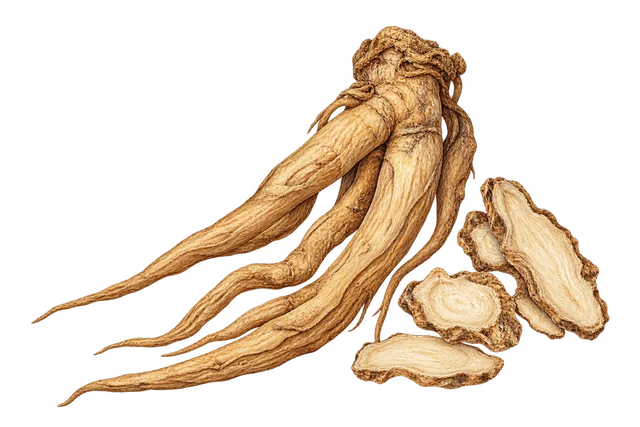
Angelica sinensis (Oliv.) Diels; Dried root.
Ingredient details, preparation and research
Also known as: dang gui; Angelica sinensis root; Radix Angelicae Sinensis
Source plant or material
Angelica sinensis (Oliv.) Diels — Dried root
Plant family / material: Apiaceae (carrot family)
Forms and route
Traditional oral root decoctions and compound formulas; manufactured extracts are different preparations.
Vitamins and minerals
No nutrient quantities or daily-value claims are assigned to this medicinal material. Do not borrow the food nutrient profile of another plant part or use an extract as a dietary substitute.
Absorption and preparation
Preparation and route matter. A tea, whole powder, alcohol extract and isolated constituent can give different exposures. No food pairing or absorption-enhancement technique is established by the sources reviewed.
Traditional and reported uses
- Historical uses include absent or painful periods and menstrual discomfort. WHO records historical menstrual use and calls for controlled trials. A 71-person placebo-controlled trial found dong quai alone no better than placebo for menopausal symptoms.
- HKBU records dang gui among the four ingredients of Si Wu Tang, a traditional formula for blood-deficiency and stagnation patterns. Its historical associations include menstrual complaints and other pattern-based symptoms; formula findings cannot be assigned to dong quai alone.
Contraindications and cautions
- Distinct from European angelica (Angelica archangelica).
- Avoid pregnancy/breastfeeding; review anticoagulants and hormone-sensitive conditions.
- Avoid medicinal use during pregnancy or breastfeeding.
- Warfarin or other bleeding-risk medicines need professional review; do not self-manage abnormal bleeding.
- Review hormone-sensitive cancers and possible photosensitivity concerns.
Similar items and how they compare
- European angelica
Existing card 232
Angelica archangelica is a different species with different food and medicinal parts.
- Chuanxiong
Another aromatic Apiaceae ingredient in Si Wu Tang
Chuanxiong is a rhizome material; it is not dong-quai root.
Identity and composition
Angelica sinensis (Oliv.) Diels; Dried root. Root preparations contain a complex mixture including volatile constituents and phenolic compounds. No constituent level or therapeutic dose is assigned across products.
- WHO monographs on selected medicinal plants, volume 2: Radix Angelicae Sinensis
- HKBU: Four Substances Decoction / Si Wu Tang
- Memorial Sloan Kettering: Dong Quai
- Hirata et al. (1997): dong quai in postmenopausal women
- Hirata et al. 1997: Dong quai placebo-controlled trial
- Hong Kong Department of Health: Radix Angelicae Sinensis standard
menstruation; menopause: what evidence can say
WHO records historical menstrual use and calls for controlled trials. A 71-person placebo-controlled trial found dong quai alone no better than placebo for menopausal symptoms. Avoid in pregnancy and breastfeeding. It may increase bleeding with warfarin; hormone-sensitive conditions and other medicines require review.
Exact material and preparation boundaries
One exact-material card. Traditional oral root decoctions and compound formulas; manufactured extracts are different preparations.. Keep preparations distinct; do not transfer findings from a named extract to every tea or powder.
- WHO monographs on selected medicinal plants, volume 2: Radix Angelicae Sinensis
- HKBU: Four Substances Decoction / Si Wu Tang
- Memorial Sloan Kettering: Dong Quai
- Hirata et al. (1997): dong quai in postmenopausal women
- Hirata et al. 1997: Dong quai placebo-controlled trial
- Hong Kong Department of Health: Radix Angelicae Sinensis standard
Medicines, pregnancy and breastfeeding
MSK reports a warfarin potentiation case and cautions about anticoagulant combinations, pregnancy and breastfeeding. Hormone-sensitive disease warrants review because laboratory/animal findings and limited human evidence do not establish safety. A negative menopause trial does not remove interaction concerns.
- WHO monographs on selected medicinal plants, volume 2: Radix Angelicae Sinensis
- HKBU: Four Substances Decoction / Si Wu Tang
- Memorial Sloan Kettering: Dong Quai
- Hirata et al. (1997): dong quai in postmenopausal women
- Hirata et al. 1997: Dong quai placebo-controlled trial
- Hong Kong Department of Health: Radix Angelicae Sinensis standard
Clinical test of a single-root preparation
A randomized study in 71 postmenopausal women found no significant benefit over placebo for hot flashes or other measured menopause outcomes. It also did not show estrogen-like changes in the examined vaginal/endometrial measures.
Source-supported safety summary
Distinct from European angelica (Angelica archangelica). Avoid pregnancy/breastfeeding; review anticoagulants and hormone-sensitive conditions. Avoid medicinal use during pregnancy or breastfeeding. Warfarin or other bleeding-risk medicines need professional review; do not self-manage abnormal bleeding. Review hormone-sensitive cancers and possible photosensitivity concerns.
- WHO monographs on selected medicinal plants, volume 2: Radix Angelicae Sinensis
- HKBU: Four Substances Decoction / Si Wu Tang
- Memorial Sloan Kettering: Dong Quai
- Hirata et al. (1997): dong quai in postmenopausal women
- Hirata et al. 1997: Dong quai placebo-controlled trial
- Hong Kong Department of Health: Radix Angelicae Sinensis standard
Evidence limits
- This is a focused educational source review, not a systematic review or a treatment plan.
- Traditional use documents a practice; it does not establish clinical benefit. Laboratory findings and multi-ingredient trials cannot establish a single ingredient’s effects.
- WHO historic monograph is retained from the prior source audit, not claimed as a newly read full PDF. Current safety page and original-trial abstract were rechecked.
Entry sources
- WHO monographs on selected medicinal plants, volume 2: Radix Angelicae Sinensis
- HKBU: Four Substances Decoction / Si Wu Tang
- Memorial Sloan Kettering: Dong Quai
- Hirata et al. (1997): dong quai in postmenopausal women
- Hirata et al. 1997: Dong quai placebo-controlled trial
- Hong Kong Department of Health: Radix Angelicae Sinensis standard
Reference entry 532 · Recorded content review: 2026-10-11 · Review scope and dates