


Key cautions
- Choose explicitly food-grade shea for cooking; never eat a cosmetic blend. Stop topical use if irritation or a rash develops.
- Avoid treating burns, infected skin or persistent rashes with shea alone. A finished cosmetic’s preservative system and other ingredients also affect safety.
What’s inside
Triglycerides containing chiefly stearic and oleic fatty acids, with other fatty acids and a variable unsaponifiable fraction. Provenance and processing affect texture and composition.
Uses in brief

- Regional cooking fat
- Confectionery ingredient
- Skin and hair emollient
History, folklore and reported uses
History, folklore and traditional uses
Native and traditional processing: West African shea belt, including Mali.
A closer look at its history
A savanna fat made through skilled collective work
Shea belongs to the comparatively dry savanna economy, where rainfall is insufficient for the oil palm. FAO’s processing monograph describes a Malian village method in which women crushed dried kernels together, worked the paste, separated the fat with water and heat, and wrapped the finished butter in leaves for storage or sale. Its account, drawing on technical reports from the 1970s and 1980s, makes clear that a lump of butter embodied coordinated labor, fuel and equipment as well as harvested nuts. Mechanical presses were investigated partly to reduce that workload and recover more fat.
Cooking, soap and rain-resistant walls
The same FAO account records uses that extend well beyond the modern cosmetic jar: shea butter was a regional cooking fat, a soap ingredient and a coating applied to house walls to help them resist seasonal rain. Pressed residues could become fuel. Its ability to supply a cocoa-butter substitute connected this locally processed fat with confectionery manufacturing. These are distinct material histories: household butter, industrially refined ingredients and fractions selected for chocolate manufacture are not interchangeable descriptions of a single product.
Additional history reviewed 2026-10-09
Traditional, historical and reported uses
- Regional cooking fat
Food or household practiceWhy this label?
The source supports the named food, cosmetic or material practice; no treatment effect is inferred and the card’s form and safety limits remain attached.
FAO describes village processing and food use across the shea belt, including Mali. The edible fat contributes energy and texture; it does not function as a replacement for diverse foods.
- Confectionery ingredient
Food or household practiceWhy this label?
The source supports the named food, cosmetic or material practice; no treatment effect is inferred and the card’s form and safety limits remain attached.
FAO records refined shea and its fractions in international food manufacture, notably chocolate-type products. Fractionation produces ingredients different from whole unrefined butter.
- Skin and hair emollient
Food or household practiceWhy this label?
The source supports the named food, cosmetic or material practice; no treatment effect is inferred and the card’s form and safety limits remain attached.
FAO documents shea in moisturizing creams, lip products and hair preparations. This is a material/cosmetic use, not proof that it cures eczema, infections or scars.
3 sourced featured uses; cultural or material records are not clinical efficacy evidence.
Historical-use additions reviewed 2026-10-09
Regional reading paths
These sourced notes describe cultivation, trade, food traditions or material history. A regional connection does not claim exclusive origin.
Africa
Native and traditional processing: West African shea belt, including Mali.
Seed-derived solid fat used in food and cosmetics.
Identity & detailed reference
Identity
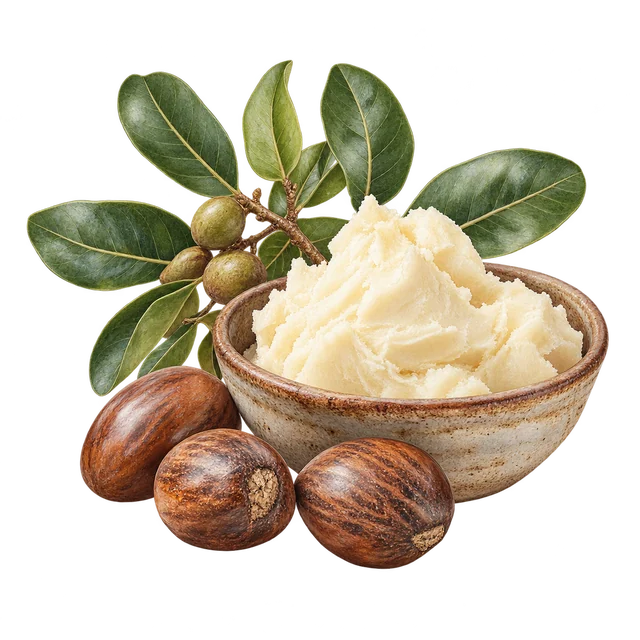
The extracted seed fat of Vitellaria paradoxa. Shea butter is a fixed vegetable fat, usually soft-solid, not dairy butter, fruit pulp or an essential oil.
Ingredient details, preparation and research
Source plant or material
Vitellaria paradoxa
Plant family / material: Sapotaceae
Forms and route
Unrefined and refined food-grade fat; separately formulated skin and hair products. Cosmetic grade, fragrances and other additives must not be assumed suitable for eating.
Vitamins and minerals
As a separated fat it supplies fat and energy rather than the protein and fiber of whole kernels. Refinement changes minor constituents; no universal vitamin value is claimed.
Absorption and preparation
Dietary fat is digested as part of a meal. Applying shea to skin does not supply nutritional fatty acids in the same way as eating food-grade fat.
Practical preparation
Keep the intended food or cosmetic container clean, closed and protected from heat. Use a finished labeled product for skin rather than assuming kitchen fat is a sterile dressing.
Traditional and reported uses
- Regional cooking fat
- Confectionery ingredient
- Skin and hair emollient
Contraindications and cautions
- Choose explicitly food-grade shea for cooking; never eat a cosmetic blend. Stop topical use if irritation or a rash develops.
- Avoid treating burns, infected skin or persistent rashes with shea alone. A finished cosmetic’s preservative system and other ingredients also affect safety.
Fat composition varies
A genetic and composition study found variation in shea fat content and fatty-acid profiles. Such data explain differences in consistency; they do not establish that one regional butter prevents disease.
Evidence limits
Food-material and cosmetic profile; no medicinal efficacy claim or home-formulation preservation assessment.
Entry sources
- FAO: Minor oil crops, shea nut monograph
- Genome-wide association study of shea fat content and fatty-acid composition
- FAO: Shea tree, Vitellaria paradoxa
Reference entry 297 · Recorded content review: 2026-10-09 · Review scope and dates