


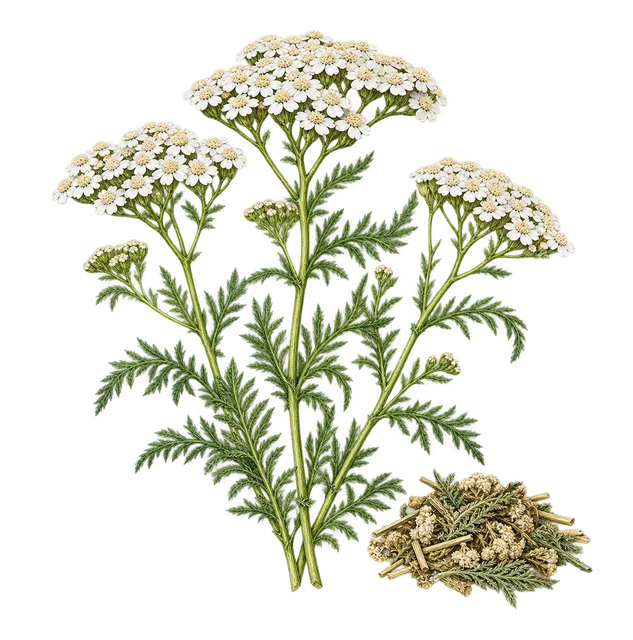
Key cautions
- Avoid with Asteraceae allergy. EMA does not recommend medicinal use in pregnancy or breastfeeding because safety is unestablished; fertility data are absent.
- Skin allergy can occur; avoid if allergic to yarrow or other Asteraceae.
- Do not apply to infected or serious wounds in place of medical care.
What’s inside
The herb contains a variable mixture of volatile and nonvolatile compounds; no laboratory constituent proves the whole herb effective in people.
Uses in brief

- Traditional minor menstrual-spasm and digestive uses.
- Traditional external use for small superficial wounds; not serious injuries.
History, folklore and reported uses
History, folklore and traditional uses
Yarrow’s European medicinal history spans digestive complaints, temporary loss of appetite, small superficial wounds and minor period cramps. EMA separates oral preparations from externally applied wound dressings; these uses are not interchangeable.
Yarrow attracts pollinators and is used for cut or dried flowers. NC State links its genus name to the Greek legend of Achilles treating battle wounds; this is a naming story, not evidence that a historical treatment worked.
Traditional, historical and reported uses
- menstruation
Traditional accountWhy this label?
EMA relies on long-standing use; clinical trials are insufficient. Laboratory spasm-relieving observations do not prove human reproductive benefit.
Traditional minor menstrual-spasm relief. EMA relies on long-standing use; clinical trials are insufficient. Laboratory spasm-relieving observations do not prove human reproductive benefit.
- Appetite and digestion
Traditional accountWhy this label?
EMA recognizes long-standing use for temporary appetite loss and mild digestive complaints such as bloating and gas. These are traditional-use conclusions rather than strong clinical-trial findings.
EMA recognizes long-standing use for temporary appetite loss and mild digestive complaints such as bloating and gas. These are traditional-use conclusions rather than strong clinical-trial findings.
- Small superficial wounds
Traditional accountWhy this label?
The EMA assessment records an externally applied infusion dressing for minor superficial wounds. This route is separate from oral use and is not a substitute for care of infected or deep wounds.
The EMA assessment records an externally applied infusion dressing for minor superficial wounds. This route is separate from oral use and is not a substitute for care of infected or deep wounds.
Coverage reflects verified sources, without a minimum use quota.
Women’s Health: traditions, evidence and cautions
Historical use does not establish benefit or safety. Pregnancy, breastfeeding and fertility care require particular caution: food, tea, essential oil and concentrated extract are not interchangeable. These records are not treatment, dosing or pregnancy-management instructions. Discuss supplements with a qualified clinician or pharmacist; do not delay evaluation of persistent symptoms.
Yarrow herb
Achillea millefolium
- Plant part / material
- above-ground herb
- Preparation studied or reported
- tea or specified aqueous dry extract for menstrual indication
Achillea millefolium; above-ground herb.
menstruation
Traditional account
Reported or traditional useTraditional minor menstrual-spasm relief. EMA relies on long-standing use; clinical trials are insufficient. Laboratory spasm-relieving observations do not prove human reproductive benefit.
What the evidence supportsEMA relies on long-standing use; clinical trials are insufficient. Laboratory spasm-relieving observations do not prove human reproductive benefit.
Avoid with Asteraceae allergy. EMA does not recommend medicinal use in pregnancy or breastfeeding because safety is unestablished; fertility data are absent. Skin allergy can occur; avoid if allergic to yarrow or other Asteraceae. Do not apply to infected or serious wounds in place of medical care.
Appetite and digestion
Traditional account
Reported or traditional useEMA recognizes long-standing use for temporary appetite loss and mild digestive complaints such as bloating and gas. These are traditional-use conclusions rather than strong clinical-trial findings.
What the evidence supportsEMA recognizes long-standing use for temporary appetite loss and mild digestive complaints such as bloating and gas. These are traditional-use conclusions rather than strong clinical-trial findings.
Avoid with Asteraceae allergy. EMA does not recommend medicinal use in pregnancy or breastfeeding because safety is unestablished; fertility data are absent. Skin allergy can occur; avoid if allergic to yarrow or other Asteraceae. Do not apply to infected or serious wounds in place of medical care.
Small superficial wounds
Traditional account
Reported or traditional useThe EMA assessment records an externally applied infusion dressing for minor superficial wounds. This route is separate from oral use and is not a substitute for care of infected or deep wounds.
What the evidence supportsThe EMA assessment records an externally applied infusion dressing for minor superficial wounds. This route is separate from oral use and is not a substitute for care of infected or deep wounds.
Avoid with Asteraceae allergy. EMA does not recommend medicinal use in pregnancy or breastfeeding because safety is unestablished; fertility data are absent. Skin allergy can occur; avoid if allergic to yarrow or other Asteraceae. Do not apply to infected or serious wounds in place of medical care.
One exact-material card. tea or specified aqueous dry extract for menstrual indication. Keep preparations distinct; do not transfer findings from a named extract to every tea or powder.
- Avoid with Asteraceae allergy. EMA does not recommend medicinal use in pregnancy or breastfeeding because safety is unestablished; fertility data are absent.
- Skin allergy can occur; avoid if allergic to yarrow or other Asteraceae.
- Do not apply to infected or serious wounds in place of medical care.
- EMA: millefolii-herba
- EMA: yarrow final monograph2020
- NC State Extension Plant Toolbox: achillea millefolium
Read the complete historical reference and its material distinctions
Identity & detailed reference
Identity
Achillea millefolium; above-ground herb.
Ingredient details, preparation and research
Also known as: milfoil; soldier’s woundwort; Achillea millefolium
Source plant or material
Achillea millefolium — above-ground herb
Plant family / material: Asteraceae (daisy family)
Forms and route
tea or specified aqueous dry extract for menstrual indication
Vitamins and minerals
No nutrient quantities or daily-value claims are assigned to this medicinal material. Do not borrow the food nutrient profile of another plant part or use an extract as a dietary substitute.
Absorption and preparation
Preparation and route matter. A tea, whole powder, alcohol extract and isolated constituent can give different exposures. No food pairing or absorption-enhancement technique is established by the sources reviewed.
Traditional and reported uses
- Traditional minor menstrual-spasm relief. EMA relies on long-standing use; clinical trials are insufficient. Laboratory spasm-relieving observations do not prove human reproductive benefit.
- EMA recognizes long-standing use for temporary appetite loss and mild digestive complaints such as bloating and gas. These are traditional-use conclusions rather than strong clinical-trial findings.
- The EMA assessment records an externally applied infusion dressing for minor superficial wounds. This route is separate from oral use and is not a substitute for care of infected or deep wounds.
Contraindications and cautions
- Avoid with Asteraceae allergy. EMA does not recommend medicinal use in pregnancy or breastfeeding because safety is unestablished; fertility data are absent.
- Skin allergy can occur; avoid if allergic to yarrow or other Asteraceae.
- Do not apply to infected or serious wounds in place of medical care.
Similar items and how they compare
- Raspberry leaf
Another traditional minor menstrual-spasm material
Raspberry is a leaf of Rubus idaeus, not a flowering Asteraceae herb.
- Yarrow essential oil
Same plant name
Concentrated oil is outside this herb card and must not inherit tea or dressing safety.
Identity and composition
Achillea millefolium; above-ground herb. The herb contains a variable mixture of volatile and nonvolatile compounds; no laboratory constituent proves the whole herb effective in people.
menstruation: what evidence can say
EMA relies on long-standing use; clinical trials are insufficient. Laboratory spasm-relieving observations do not prove human reproductive benefit. Avoid with Asteraceae allergy. EMA does not recommend medicinal use in pregnancy or breastfeeding because safety is unestablished; fertility data are absent.
Exact material and preparation boundaries
One exact-material card. tea or specified aqueous dry extract for menstrual indication. Keep preparations distinct; do not transfer findings from a named extract to every tea or powder.
Medicines, pregnancy and breastfeeding
The EMA monograph lists no reported interactions, not a comprehensive interaction study. Pregnancy and lactation use is not recommended because safety has not been established. Preparation-specific restrictions matter; the menstrual indication does not cover every yarrow extract.
Source-supported safety summary
Avoid with Asteraceae allergy. EMA does not recommend medicinal use in pregnancy or breastfeeding because safety is unestablished; fertility data are absent. Skin allergy can occur; avoid if allergic to yarrow or other Asteraceae. Do not apply to infected or serious wounds in place of medical care.
Evidence limits
- This is a focused educational source review, not a systematic review or a treatment plan.
- Traditional use documents a practice; it does not establish clinical benefit. Laboratory findings and multi-ingredient trials cannot establish a single ingredient’s effects.
- EMA’s page shows a 2026 call for data; the final revision-1 monograph remains the cited established document, not a newly completed 2026 review.
Entry sources
- EMA: millefolii-herba
- EMA: yarrow final monograph2020
- NC State Extension Plant Toolbox: achillea millefolium
Reference entry 524 · Recorded content review: 2026-10-11 · Review scope and dates