


Key cautions
- Fructan-sensitive people, including some with irritable bowel symptoms, may experience bloating or diarrhea.
- Do not substitute yacón leaf tea or extract for the edible root.
What’s inside
Fructooligosaccharides, other sugars, water and phenolic compounds; storage and processing influence their balance.
Uses in brief

- Fresh root food
- Prebiotic-ingredient investigation
History, folklore and reported uses
History, folklore and traditional uses
Yacón is documented among Andean roots maintained by farmers in Peru and Bolivia. Contemporary syrup marketing should preserve the distinction between this traditional crop and later concentrated products.
Traditional, historical and reported uses
- Fresh root food
Food or household practiceWhy this label?
Source documents this specific material, culinary use or attributed practice; no clinical efficacy is inferred.
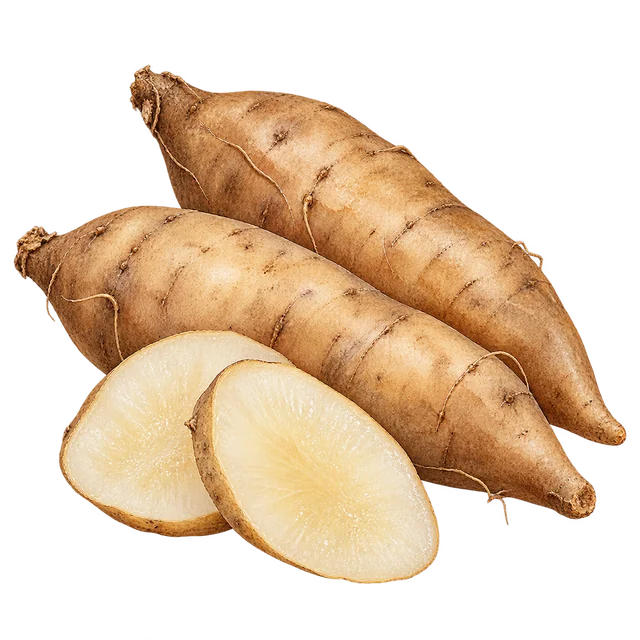
Regional agricultural records distinguish yacón from the starchier Andean tubers. Its crisp edible storage root is a food in its own right.
- Prebiotic-ingredient investigation
Laboratory/animal researchWhy this label?
This use entry describes a laboratory, pilot-scale or nonhuman experiment; it does not establish an ordinary household practice, clinical benefit or safe home protocol.
A primary study tested whether selected bacteria could ferment root-derived fructooligosaccharides. This concerns an ingredient and test system, not a guarantee about every fresh-root serving.
2 bounded uses; regional records do not establish treatment effects.
Historical-use additions reviewed 2026-10-09
Regional reading paths
These sourced notes describe cultivation, trade, food traditions or material history. A regional connection does not claim exclusive origin.
South America
native and cultivated; Peru, Bolivia
Edible storage roots.
Identity & detailed reference
Identity
Smallanthus sonchifolius; the edible storage root of Smallanthus sonchifolius; leaves, syrups and concentrated extracts are distinct materials.
Ingredient details, preparation and research
Also known as: Smallanthus sonchifolius
Source plant or material
Smallanthus sonchifolius
Plant family / material: Asteraceae
Forms and route
Fresh food-grade roots, prepared slices, dried ingredients and separately labeled syrup.
Vitamins and minerals
A sweet taste does not mean sugar-free. Syrup and powder concentrate components differently from fresh root, so they cannot share a universal nutrient profile.
Absorption and preparation
Some fructooligosaccharides reach the colon and are fermented by microbes. This can also produce gas; laboratory fermentation is not proof of a clinical benefit for every consumer.
Practical preparation
Select sound identified produce, wash before peeling and prepare hygienically. Introduce unfamiliar foods in ordinary portions; follow storage directions for packaged syrup or dried root.
Traditional and reported uses
- Fresh root food
- Prebiotic-ingredient investigation
Contraindications and cautions
- Fructan-sensitive people, including some with irritable bowel symptoms, may experience bloating or diarrhea.
- Do not substitute yacón leaf tea or extract for the edible root.
Processing and biological context
Studies examining root components and prebiotic effects use defined materials. They do not establish that arbitrary syrup amounts, leaf preparations or extracts have the same effect or tolerance.
Evidence limits
This is a food-form review, not a treatment recommendation. Composition and laboratory findings apply to the material actually studied; no medicinal dose, universal nutrient ranking or preservation guarantee is inferred.
Entry sources
- FAO: La mujer campesina y las semillas andinas
- Yacon-root fructooligosaccharides and bacterial fermentation
- Prebiotic effects investigated using yacon
Reference entry 453 · Recorded content review: 2026-10-09 · Review scope and dates