


Key cautions
- Buy food-grade oil from a reliable producer and discard rancid material. Red color is not proof of purity, nutrient content or safe handling.
- Palm oil contains substantial saturated fat. Consider it within the overall diet and follow individualized dietary advice; carotenoids do not cancel that consideration.
What’s inside
Fatty acids including palmitic and oleic acids; the red color is associated with carotenoids. Tocopherols and tocotrienols occur, but processing and storage affect minor constituents.
Uses in brief

- Savory cooking
History, folklore and reported uses
History, folklore and traditional uses
Native and traditional processing: West/Central Africa, including Nigeria and Sierra Leone.
FAO documents village and small-scale extraction alongside industrial production. This explains different market forms; a historical processing account is not quality certification for every bottle.
Traditional, historical and reported uses
- Savory cooking
Food or household practiceWhy this label?
The source supports the named food, cosmetic or material practice; no treatment effect is inferred and the card’s form and safety limits remain attached.
FAO describes red palm oil as a longstanding ingredient in West African cuisine. It adds color, richness and characteristic flavor to cooked foods.
1 sourced featured uses; cultural or material records are not clinical efficacy evidence.
Historical-use additions reviewed 2026-10-09
Regional reading paths
These sourced notes describe cultivation, trade, food traditions or material history. A regional connection does not claim exclusive origin.
Africa
Native and traditional processing: West/Central Africa, including Nigeria and Sierra Leone.
Fruit-mesocarp cooking oil; distinct from palm-kernel oil.
Identity & detailed reference
Identity
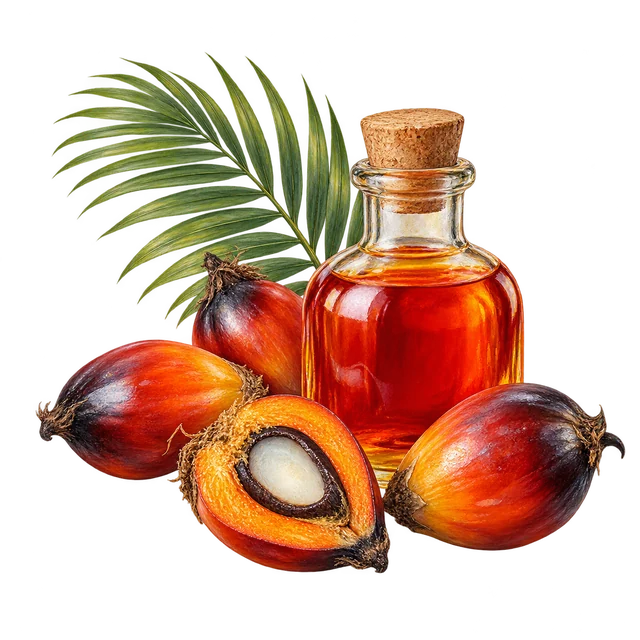
The red-orange fixed oil obtained from the fruit mesocarp of Elaeis guineensis. Palm-kernel oil comes from the seed and has a different fatty-acid profile; the two should not be conflated.
Ingredient details, preparation and research
Source plant or material
Elaeis guineensis
Plant family / material: Arecaceae
Forms and route
Traditionally processed or commercial food-grade red palm oil. Refined, bleached and deodorized palm oil and separated olein/stearin fractions are distinct forms.
Vitamins and minerals
This is predominantly fat, not a source of fruit fiber or protein. Carotenoid and vitamin-E-family content varies, and a red oil cannot be assigned a universal vitamin dose.
Absorption and preparation
Fat helps disperse carotenoids, but conversion of provitamin-A carotenoids depends on food processing and the person. Red palm oil is not interchangeable with prescribed vitamin A.
Practical preparation
Use a labeled culinary oil in the quantity required by the dish. Store closed away from strong light and heat, and avoid repeated prolonged overheating.
Traditional and reported uses
- Savory cooking
Contraindications and cautions
- Buy food-grade oil from a reliable producer and discard rancid material. Red color is not proof of purity, nutrient content or safe handling.
- Palm oil contains substantial saturated fat. Consider it within the overall diet and follow individualized dietary advice; carotenoids do not cancel that consideration.
Processing changes the product
FAO details purification and processing stages. WHO’s dietary-fat guidance concerns total patterns of intake; neither the oil’s traditional status nor laboratory antioxidant measures establishes a disease-treatment effect.
Evidence limits
No sustainability certification, brand purity or current production ranking is inferred. This card does not cover palm-kernel oil.
Entry sources
- FAO: Small-scale palm oil processing in Africa, Oil Palm
- FAO: Palm oil processing
- WHO: Saturated fatty-acid and trans-fatty-acid guideline summary
Reference entry 298 · Recorded content review: 2026-10-09 · Review scope and dates