


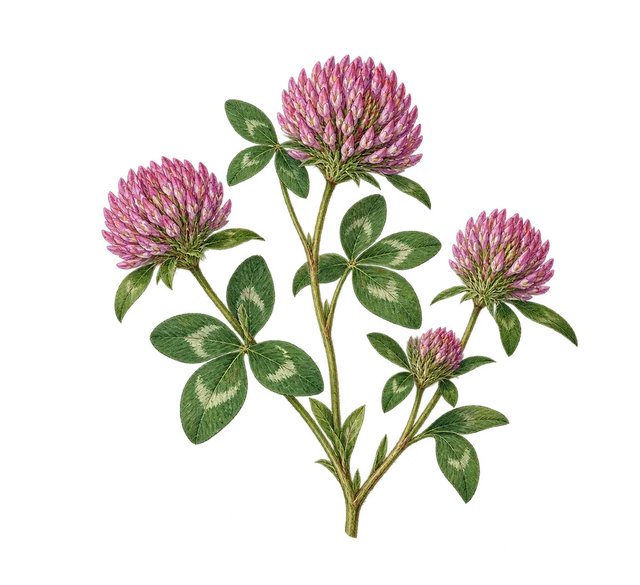
Key cautions
- Supplements may be unsafe during pregnancy or breastfeeding. Estrogen-like activity is relevant to hormone-sensitive conditions; discuss supplements with the treating clinician.
- Clinical tolerance over limited study periods does not establish safety for every product or long-term use.
What’s inside
Isoflavones include estrogen-like plant compounds; their presence does not establish a clinical hormone-replacement effect.
Uses in brief

- Menopause supplements studied; no conclusive benefit established.
- Leaf and flower food history (food or household practice; distinct from medicinal extracts).
History, folklore and reported uses
History, folklore and traditional uses
A legume native to Europe, central Asia and northern Africa, red clover now appears in women’s-health supplements. Its isoflavones explain modern research interest; the cited authority does not establish an ancient, region-specific menopause tradition.
University of Minnesota Extension identifies red clover as a nitrogen-contributing cover crop that suppresses weeds and attracts beneficial insects when allowed to flower. Agricultural use concerns the growing plant, not a supplement.
Traditional, historical and reported uses
- menopause
Human researchWhy this label?
Hot-flash trial results are inconsistent and some studies carry high bias risk. No conclusive benefit has been established.
Modern herbal promotion for menopausal symptoms, rather than a verified ancient menopause tradition. Hot-flash trial results are inconsistent and some studies carry high bias risk. No conclusive benefit has been established.
- Leaf and flower food history
Food or household practiceWhy this label?
Institutional account explicitly documents the same aerial plant parts as food; this is a distinct food exposure, not evidence of medicinal efficacy or supplement safety.
NC State Extension records red-clover foliage and flowerheads as food, distinct from the standardized isoflavone extracts studied for menopause. This food history does not establish the safety or effectiveness of concentrated supplements, particularly during pregnancy or breastfeeding.
Coverage reflects verified sources, without a minimum use quota.
Women’s Health: traditions, evidence and cautions
Historical use does not establish benefit or safety. Pregnancy, breastfeeding and fertility care require particular caution: food, tea, essential oil and concentrated extract are not interchangeable. These records are not treatment, dosing or pregnancy-management instructions. Discuss supplements with a qualified clinician or pharmacist; do not delay evaluation of persistent symptoms.
Red clover
Trifolium pratense
- Plant part / material
- aerial parts
- Preparation studied or reported
- isoflavone-containing extracts
Trifolium pratense; aerial parts. Do not attach to white clover, Trifolium repens, doc176.
menopause
inconclusive clinical evidence
Reported or traditional useModern herbal promotion for menopausal symptoms, rather than a verified ancient menopause tradition.
What the evidence supportsHot-flash trial results are inconsistent and some studies carry high bias risk. No conclusive benefit has been established.
Supplements may be unsafe during pregnancy or breastfeeding. Estrogen-like activity is relevant to hormone-sensitive conditions; discuss supplements with the treating clinician.
Leaf and flower food history
food or household practice
Reported or traditional useNC State Extension records red-clover foliage and flowerheads as food, distinct from the standardized isoflavone extracts studied for menopause. This food history does not establish the safety or effectiveness of concentrated supplements, particularly during pregnancy or breastfeeding.
What the evidence supportsDocumented food context for these aerial parts. No medicinal benefit or concentrated-product safety follows from food use.
Food history does not establish medicinal pregnancy or breastfeeding safety. Do not use this decorative card for plant identification.
One exact-material card. isoflavone-containing extracts. Keep preparations distinct; do not transfer findings from a named extract to every tea or powder.
- Supplements may be unsafe during pregnancy or breastfeeding. Estrogen-like activity is relevant to hormone-sensitive conditions; discuss supplements with the treating clinician.
- Clinical tolerance over limited study periods does not establish safety for every product or long-term use.
Read the complete historical reference and its material distinctions
Identity & detailed reference
Identity
Trifolium pratense; aerial parts. Do not attach to white clover, Trifolium repens, doc176.
Ingredient details, preparation and research
Also known as: Trifolium pratense; meadow clover
Source plant or material
Trifolium pratense — aerial parts
Plant family / material: Fabaceae (pea family)
Forms and route
isoflavone-containing extracts
Vitamins and minerals
No nutrient quantities or daily-value claims are assigned to this medicinal material. Do not borrow the food nutrient profile of another plant part or use an extract as a dietary substitute.
Absorption and preparation
Preparation and route matter. A tea, whole powder, alcohol extract and isolated constituent can give different exposures. No food pairing or absorption-enhancement technique is established by the sources reviewed.
Traditional and reported uses
- Modern herbal promotion for menopausal symptoms, rather than a verified ancient menopause tradition. Hot-flash trial results are inconsistent and some studies carry high bias risk. No conclusive benefit has been established.
- Leaf and flower food history: NC State Extension records red-clover foliage and flowerheads as food, distinct from the standardized isoflavone extracts studied for menopause. This food history does not establish the safety or effectiveness of concentrated supplements, particularly during pregnancy or breastfeeding.
Contraindications and cautions
- Supplements may be unsafe during pregnancy or breastfeeding. Estrogen-like activity is relevant to hormone-sensitive conditions; discuss supplements with the treating clinician.
- Clinical tolerance over limited study periods does not establish safety for every product or long-term use.
Similar items and how they compare
- White clover
Similar common name and growth habit
Trifolium repens, card 176, is a different species.
- Soy isoflavones
Related class of phytoestrogen research
Food soy, soy protein and isolated isoflavones have different preparations and evidence.
Identity and composition
Trifolium pratense; aerial parts. Do not attach to white clover, Trifolium repens, doc176. Isoflavones include estrogen-like plant compounds; their presence does not establish a clinical hormone-replacement effect.
menopause: what evidence can say
Hot-flash trial results are inconsistent and some studies carry high bias risk. No conclusive benefit has been established. Supplements may be unsafe during pregnancy or breastfeeding. Estrogen-like activity is relevant to hormone-sensitive conditions; discuss supplements with the treating clinician.
Exact material and preparation boundaries
One exact-material card. isoflavone-containing extracts. Keep preparations distinct; do not transfer findings from a named extract to every tea or powder.
Medicines, pregnancy and breastfeeding
Review supplements with the treating clinician when using medicines or managing a hormone-sensitive condition. The reviewed NIH summary does not establish a specific clinically proven interaction; do not describe theoretical risks as demonstrated interactions. Supplements may be unsafe in pregnancy or breastfeeding.
Beyond hot flashes: research questions
Trials have also explored cholesterol and bone density in postmenopausal women, but findings are too inconsistent or limited to establish a dependable benefit.
Source-supported safety summary
Supplements may be unsafe during pregnancy or breastfeeding. Estrogen-like activity is relevant to hormone-sensitive conditions; discuss supplements with the treating clinician. Clinical tolerance over limited study periods does not establish safety for every product or long-term use.
Evidence limits
- This is a focused educational source review, not a systematic review or a treatment plan.
- Traditional use documents a practice; it does not establish clinical benefit. Laboratory findings and multi-ingredient trials cannot establish a single ingredient’s effects.
Entry sources
- NCCIH: Red Clover
- NIH: menopausal symptoms
- Geller et al. randomized trial: aerial-part red-clover extract
- University of Minnesota Extension: Cover crop selection
- NC State Extension: Trifolium pratense morphology
Reference entry 521 · Recorded content review: 2026-10-11 · Review scope and dates