


Key cautions
- Avoid medicinal use in pregnancy; the clinical safety resource reports developmental concerns from animal work.
- Possible additive blood-sugar lowering warrants clinician review with diabetes medicines.
What’s inside
A reliable composition profile for the exact preparation was not established in this review; chemistry from another plant part is not transferred.
Uses in brief

- Reproductive-care history (traditional account).
- Other vine traditions (traditional account).
History, folklore and reported uses
History, folklore and traditional uses
The Trinidad survey carefully separates plant parts and records this material as a vine. Its local illness terms should be preserved rather than transformed into modern diagnoses.
Traditional, historical and reported uses
- Reproductive-care history
Traditional accountWhy this label?
The source is retained with its design and preparation limits; reported use is not upgraded to clinical effectiveness.
Vine stems and leaves were reported for womb infection and afterbirth care. This is a practice report, not proof of infection clearance or safe placental management.
- Other vine traditions
Traditional accountWhy this label?
The source is retained with its design and preparation limits; reported use is not upgraded to clinical effectiveness.
The same survey records the vine in cooling or cleansing beliefs and metabolic complaints. Those concepts do not establish detoxification or diabetes treatment.
Includes only uses and context documented for this material. Historical reporting is not proof of benefit; no use-count quota is applied.
Women’s Health: traditions, evidence and cautions
Historical use does not establish benefit or safety. Pregnancy, breastfeeding and fertility care require particular caution: food, tea, essential oil and concentrated extract are not interchangeable. These records are not treatment, dosing or pregnancy-management instructions. Discuss supplements with a qualified clinician or pharmacist; do not delay evaluation of persistent symptoms.
Bitter melon vine / caraille
Momordica charantia L.
- Plant part / material
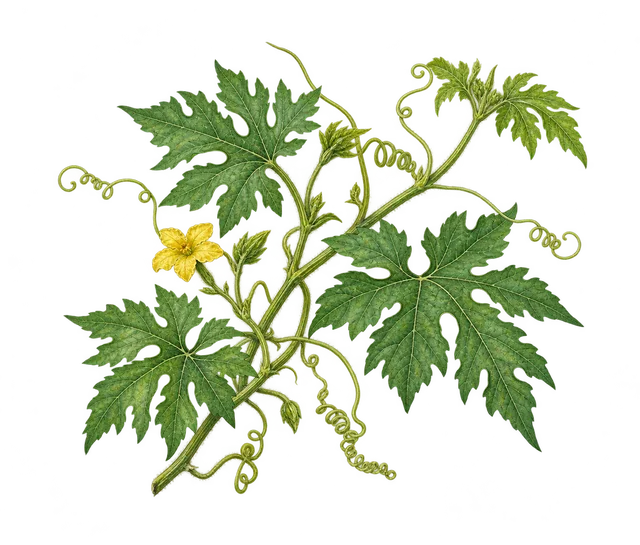
- Vine stems and leaves
- Preparation studied or reported
- Traditional vine decoction as reported in rural Trinidad. Cooked immature fruit, seeds, juice and concentrated commercial extracts are excluded.
Caraille here is the stem-and-leaf vine of Momordica charantia. It is not the immature bitter-melon fruit used as a vegetable; the edible-fruit card remains a comparison only.
Reproductive-care history
Traditional account
Reported or traditional useVine stems and leaves were reported for womb infection and afterbirth care. This is a practice report, not proof of infection clearance or safe placental management.
What the evidence supportsThe source is retained with its design and preparation limits; reported use is not upgraded to clinical effectiveness.
Avoid medicinal use in pregnancy; the clinical safety resource reports developmental concerns from animal work. Possible additive blood-sugar lowering warrants clinician review with diabetes medicines. Breastfeeding safety of this vine preparation is not established. Postpartum infection or retained placenta needs prompt clinical assessment; a decoction must not delay care.
Other vine traditions
Traditional account
Reported or traditional useThe same survey records the vine in cooling or cleansing beliefs and metabolic complaints. Those concepts do not establish detoxification or diabetes treatment.
What the evidence supportsThe source is retained with its design and preparation limits; reported use is not upgraded to clinical effectiveness.
Avoid medicinal use in pregnancy; the clinical safety resource reports developmental concerns from animal work. Possible additive blood-sugar lowering warrants clinician review with diabetes medicines. Breastfeeding safety of this vine preparation is not established. Postpartum infection or retained placenta needs prompt clinical assessment; a decoction must not delay care.
Only the exact part and formulation described here; related existing cards do not inherit these claims.
- Avoid medicinal use in pregnancy; the clinical safety resource reports developmental concerns from animal work.
- Possible additive blood-sugar lowering warrants clinician review with diabetes medicines.
- Breastfeeding safety of this vine preparation is not established.
- Postpartum infection or retained placenta needs prompt clinical assessment; a decoction must not delay care.
- Clement, Baksh-Comeau and Seaforth 2015: Trinidad medicinal-plant survey
- Memorial Sloan Kettering: Bitter Melon
Read the complete historical reference and its material distinctions
Identity & detailed reference
Identity
Caraille here is the stem-and-leaf vine of Momordica charantia. It is not the immature bitter-melon fruit used as a vegetable; the edible-fruit card remains a comparison only.
Ingredient details, preparation and research
Also known as: caraille vine
Source plant or material
Momordica charantia L.; Vine stems and leaves
Plant family / material: Cucurbitaceae
Forms and route
Traditional vine decoction as reported in rural Trinidad. Cooked immature fruit, seeds, juice and concentrated commercial extracts are excluded.
Absorption and preparation
No absorption-enhancement directions are established for this material. An extract, food, infusion and isolated chemical can deliver different substances; study results do not establish a home preparation.
Traditional and reported uses
- Reproductive-care history: Vine stems and leaves were reported for womb infection and afterbirth care. This is a practice report, not proof of infection clearance or safe placental management.
- Other vine traditions: The same survey records the vine in cooling or cleansing beliefs and metabolic complaints. Those concepts do not establish detoxification or diabetes treatment.
Contraindications and cautions
- Avoid medicinal use in pregnancy; the clinical safety resource reports developmental concerns from animal work.
- Possible additive blood-sugar lowering warrants clinician review with diabetes medicines.
- Breastfeeding safety of this vine preparation is not established.
- Postpartum infection or retained placenta needs prompt clinical assessment; a decoction must not delay care.
Similar items and how they compare
- Bitter melon vegetable fruit
Same plant, commonly recognized food.
Fruit nutrition or extract research does not establish stem-and-leaf decoction safety or efficacy.
Identity and exact material
Caraille here is the stem-and-leaf vine of Momordica charantia. It is not the immature bitter-melon fruit used as a vegetable; the edible-fruit card remains a comparison only. Traditional vine decoction as reported in rural Trinidad. Cooked immature fruit, seeds, juice and concentrated commercial extracts are excluded.
Evidence and preparation boundaries
The survey is not a trial. Laboratory or clinical findings for fruit, seed or concentrated extracts cannot validate this vine preparation. Broad bitter-melon safety guidance warns about pregnancy and possible additive glucose lowering; the risk for a particular traditional vine preparation has not been quantified. Uncertainty is not a reason to recommend it.
Safety and uncertainty
Avoid medicinal use in pregnancy; the clinical safety resource reports developmental concerns from animal work. Possible additive blood-sugar lowering warrants clinician review with diabetes medicines. Breastfeeding safety of this vine preparation is not established. Postpartum infection or retained placenta needs prompt clinical assessment; a decoction must not delay care.
Evidence limits
- This is a focused source review, not a systematic clinical review. A traditional indication or laboratory result does not establish an effective or safe treatment.
- A lack of reported adverse effects is not proof of safety. No therapeutic dose or preparation is recommended.
Entry sources
- Clement, Baksh-Comeau and Seaforth 2015: Trinidad medicinal-plant survey
- Memorial Sloan Kettering: Bitter Melon
Reference entry 555 · Recorded content review: 2026-10-11 · Review scope and dates