


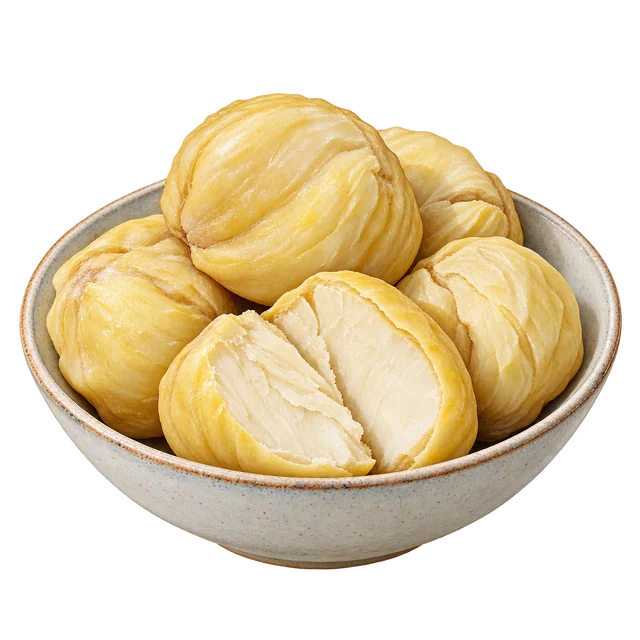
Key cautions
- Use authenticated seeds and an established cooked preparation.
- The tree’s common name does not imply equivalence to temperate chestnut or absence of allergy.
What’s inside
The large kernel is a starchy food. No universal mineral, protein or medicinal constituent profile is supplied across locations and preparations.
Uses in brief

- Cooked seed food
- Home-garden food tree
History, folklore and reported uses
History, folklore and traditional uses
The Flora of Guam records the species in Pacific food history under the older name I. edulis. The tree also occurs in traditional home-garden and agroforestry settings, where shade and food production can coexist.
Traditional, historical and reported uses
- Cooked seed food
Food or household practiceWhy this label?
Sources document this named food or material use; no therapeutic outcome is claimed.
The Flora of Guam describes kernels eaten after boiling or roasting. The named species and cooked food form are central to this record.
- Home-garden food tree
Food or household practiceWhy this label?
Sources document this named food or material use; no therapeutic outcome is claimed.
PROSEA records the tree in Pacific home gardens, supplying a locally available food resource alongside shade and other tree uses. This is a food-system role rather than a second medicinal claim.
2 narrowly supported uses; no clinical efficacy or universal preparation is inferred.
Historical-use additions reviewed 2026-10-09
Regional reading paths
These sourced notes describe cultivation, trade, food traditions or material history. A regional connection does not claim exclusive origin.
Australia & Oceania
cultivated; Polynesia and Micronesia, including Guam
Cooked starchy seed.
Identity & detailed reference
Identity
Inocarpus fagifer, historically Inocarpus edulis; Tahitian/Polynesian chestnut, a legume-tree seed rather than a Castanea chestnut.
Ingredient details, preparation and research
Source plant or material
Inocarpus fagifer, historically Inocarpus edulis; Tahitian/Polynesian chestnut, a legume-tree seed rather than a Castanea chestnut.
Plant family / material: Fabaceae
Forms and route
Authenticated cooked kernels and established regional seed dishes.
Vitamins and minerals
A common-name resemblance to chestnut does not justify copying a Castanea nutrition table. The actual cooked seed and serving are required.
Absorption and preparation
Cooking softens the edible kernel; no special nutrient-absorption or medicinal effect is inferred from a traditional preparation.
Practical preparation
Use identified food seeds with established cooking guidance. Do not eat unknown Inocarpus fruit or transfer uses from related species; the outer fruit structures are not the same as the kernel.
Traditional and reported uses
- The Flora of Guam describes kernels eaten after boiling or roasting. The named species and cooked food form are central to this record.
- PROSEA records the tree in Pacific home gardens, supplying a locally available food resource alongside shade and other tree uses. This is a food-system role rather than a second medicinal claim.
Contraindications and cautions
- Use authenticated seeds and an established cooked preparation.
- The tree’s common name does not imply equivalence to temperate chestnut or absence of allergy.
Historical names need reconciliation
I. edulis and I. fagifer appear in different generations of literature. The card retains the modern anchor and flags the older name so historical records can be found without creating duplicate catalog species.
No genus-wide edibility
The specialist crop account distinguishes related Inocarpus material. This is one reason the simple label Tahitian chestnut is insufficient for wild-food identification or for transferring preparation instructions to another tree.
Evidence limits
Two botanical/crop accounts and one scholarly synthesis establish this bounded food history. No therapeutic outcome or quantitative nutrient comparison is made.
Entry sources
- Benjamin Stone: Flora of Guam, Inocarpus
- PROSEA: Inocarpus fagifer crop account
- Inocarpus fagifer: Asia-Pacific agroforestry and food review
Reference entry 511 · Recorded content review: 2026-10-09 · Review scope and dates