


Key cautions
- Do not identify food from the English word sycamore alone: maples and plane trees share that name.
- The edible-fruit tradition does not establish the safety of swallowing latex or taking bark, root or leaf remedies.
What’s inside
Fresh fruit contains water, carbohydrate, small amounts of protein and fat, and variable minerals and vitamin C. Species-specific composition records exist but are limited and variable. Older tables report crude fiber, which must not be relabeled as modern total dietary fiber.
Uses in brief

- Use only correctly identified ripe fruit obtained through a reliable food source.
- Documented food traditions include fresh, stewed and stored dried fruit.
In the King James Bible
In the King James Bible
Named material
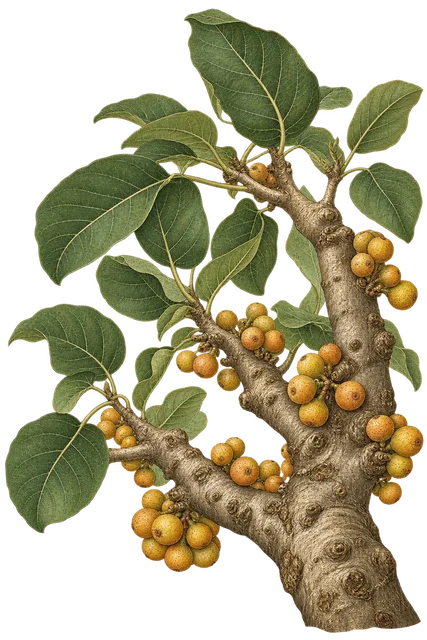
The sycomore fruit named in Amos and the sycomore tree climbed by Zacchaeus are conventionally identified as Ficus sycomorus. This is a fig species, not the common fig Ficus carica, a maple called sycamore, or a plane tree. Fruit, foliage, bark and latex have different uses.
Then answered Amos, and said to Amaziah, I was no prophet, neither was I a prophet’s son; but I was an herdman, and a gatherer of sycomore fruit:
Amos 7:14 (KJV)
And he ran before, and climbed up into a sycomore tree to see him: for he was to pass that way.
Luke 19:4 (KJV)
Scripture and identification sources
Words & their stories
WORDS & THEIR STORIES
The name behind the KJV
Biblical Hebrew · Amos 7:14 (KJV)
שִׁקְמִיםšiqmīm
Sycomores, the trees or fruit with which Amos worked.
Dictionary form: שִׁקְמָה · šiqmāh
The plural follows a participle rendered “gatherer” by the KJV; the noun itself names the sycomore.
Koine Greek · Luke 19:4 (KJV)
συκομωραίανsykomōraían
A sycomore tree, climbed by Zacchaeus.
Dictionary form: συκομωραία · sykomōraía
Accusative singular. Scrivener’s KJV-linked text has this spelling; other Greek editions print συκομορέαν (sykomoréan), under the lemma συκομορέα.
What the language reveals
Fruit work behind “gatherer”
Musselman describes cutting developing sycomore figs to help them ripen, providing agricultural context for Amos’s occupation.
A spelling difference worth keeping
The longer spelling in the Textus Receptus and the shorter spelling in other editions refer to the same tree term; they are not two botanical identifications.
The conventional identification is Ficus sycomorus, distinct from the common fig and from maple or plane trees called sycamore in modern English.
Language and identification bibliography
- Hebrew text: Amos 7:14 (Mechon-Mamre)
- Brown–Driver–Briggs: שִׁקְמָה, sycomore (H8256; Bible Hub transcription)
- Greek text: Luke 19:4, Scrivener’s Textus Receptus 1894 (Bible Hub)
- Thayer’s Greek Lexicon: συκομορέα / συκομωραία, sycomore tree (G4809; Bible Hub transcription)
- Lytton John Musselman, Old Dominion University: Sycomore Fig
History, folklore and reported uses
History, folklore and traditional uses
Amos identifies himself with herding and gathering sycomore fruit, placing this tree within ordinary work rather than royal luxury. Luke presents a sycomore as the tree Zacchaeus climbs. The large spreading fig is therefore remembered through both its harvest and its physical place in a lived landscape; the modern maple or plane tree called sycamore is a different plant.
Musselman’s botanical account describes fruit borne on older wood and records having eaten fruit sold in Gaza. It also discusses the historical tending of developing figs. Across African food traditions, World Agroforestry records ripe fruit eaten fresh, stewed or dried for later use. Regional importance varies: one Zambian extension account calls it a fallback food, so a single description should not be imposed on every community.
The broad tree supported life around it as well as feeding people. Its workable wood furnished household objects and beehives; inner bark supplied cordage; leaves and fruit fed animals. World Agroforestry also records marketplaces and social gatherings beneath its shade. These are distinct practical roles of a multipurpose tree, kept separate from claims about the medical effects of its fruit.
Traditional, historical and reported uses
- Gathered and locally traded fruit
Food or household practiceWhy this label?
Gathered fruit used and traded as food, with scriptural context.
Amos 7:14 names sycomore fruit in the prophet’s account of his work. Musselman also records personally encountering the fruit for sale in Gaza, linking the ancient name with an observed food.
- Stewing and drying for later food
Food or household practiceWhy this label?
Culinary stewing and drying for food storage.
World Agroforestry records ripe figs eaten fresh or stewed and dried for storage. A separate Zambian account describes a fallback-food role, highlighting regional variation in the fruit’s importance.
- Wood for useful household objects
Food or household practiceWhy this label?
Workable timber used for household and transport objects.
The species profile records its workable wood used for objects including mortars, stools, beehives and canoes. This material history is separate from the edible fruit.
- Cordage from inner bark
Food or household practiceWhy this label?
Inner bark used for rope-making.
Strong rope made from inner bark is a recorded use. It preserves a craft role of the tree without turning bark into a food or home remedy.
- Communal shade and fodder
Food or household practiceWhy this label?
Tree used for communal shade and animal feed.
The large canopy provides gathering space at marketplaces; leaves and fruits are also used as animal feed. These social and farm services help explain the value of retaining mature trees.
Regional reading paths
These sourced notes describe cultivation, trade, food traditions or material history. A regional connection does not claim exclusive origin.
Africa
Food and agroforestry traditions: World Agroforestry documents this African fig tree across eastern and southern Africa, including fruit, shade and useful-wood roles.
Ripe figs eaten fresh, stewed or dried; the source tree also supplies shade and craft materials.
Identity & detailed reference
Identity
The sycomore fruit named in Amos and the sycomore tree climbed by Zacchaeus are conventionally identified as Ficus sycomorus. This is a fig species, not the common fig Ficus carica, a maple called sycamore, or a plane tree. Fruit, foliage, bark and latex have different uses.
Ingredient details, preparation and research
Also known as: sycomore fruit; sycomore tree
Source plant or material
Ficus sycomorus L.; Correctly identified Ficus sycomorus ripe fruit; other trees called sycamore and other Ficus species are excluded.
Plant family / material: Moraceae (mulberry family)
Forms and route
Correctly identified ripe sycomore figs, eaten fresh, stewed or dried in documented regional food traditions. Fresh fruit is the nutritional basis here. Bark, latex, leaves and extracts are separate materials; the name sycamore alone is not a safe food identification.
Vitamins and minerals
Species-specific historical food-table example: a weighed 100 g portion of fresh edible sycomore fig fruit, a small-bowl amount for which no validated cup or fruit-count conversion is supplied, is listed at about 61 kcal, 13.4 g available carbohydrate, 1.0 g protein, 0.8 g fat, 118 mg calcium, 5.2 mg iron and 13 mg vitamin C in the 1993 ORSTOM/CNEVA/CIQUAL/INRA table, code 13562 (printed page 121; PDF page 145). The table reports 2.6 g crude fiber, not total dietary fiber. Calcium ranged from 15 to 250 mg/100 g across four samples, so these are limited reference values, not a guaranteed serving. The later World Agroforestry combined record gives different averages. No Ficus carica values are substituted.
Absorption and preparation
Measured mineral content is not the same as the amount absorbed. No human sycomore-fruit absorption study or special preparation that reliably improves uptake was established in this review. A varied meal and vitamin-C-rich foods support general nonheme-iron nutrition, but the high and variable iron values in some historical samples should not be treated as a predictable therapeutic dose. Dried analytical powders are not equivalent to fresh fruit.
Traditional and reported uses
- Use only correctly identified ripe fruit obtained through a reliable food source.
- Documented food traditions include fresh, stewed and stored dried fruit.
- The tree also supplied wood, fiber, fodder and community shade; these uses concern different materials.
Contraindications and cautions
- Do not identify food from the English word sycamore alone: maples and plane trees share that name.
- The edible-fruit tradition does not establish the safety of swallowing latex or taking bark, root or leaf remedies.
- Published composition varies considerably by source and sample; do not rely on this uncommon fruit to treat a nutrient deficiency.
- Wash sound ripe fruit, discard spoiled specimens, and avoid unverified foraging or medicinal preparations.
Similar items and how they compare
- Common fig
Another edible Ficus species named in biblical contexts.
Ficus carica has separate food-composition tables and clinical research; those results do not transfer automatically.
- Sycamore maple
Shares an English common name.
Acer pseudoplatanus is not this fig and is not a substitute for its edible fruit.
- Plane tree
Also called sycamore in some regions.
Platanus species are botanically different and do not produce the sycomore figs discussed here.
A separate species with explicit fruit wording
Amos names sycomore fruit; Luke names the tree. Conventional identification is Ficus sycomorus, not Ficus carica, Acer or Platanus. The two scriptural uses should not be collapsed into a claim that both verses describe eating it.
Why the nutrient figures carry a limitation
The original 1993 fruit table specifically names Ficus sycomorus and reports fresh-fruit values with substantial sample variation. The later World Agroforestry record combines several data sources and reports different means. Crude fiber is not equivalent to total dietary fiber; missing nutrient values are not zeros.
Dry analytical samples do not define a fresh bowl
A 2023 Ethiopian study measured selected metals in oven-dried fruit and seed samples. That is species-specific analytical evidence, but its dry-weight measurements cannot simply be relabeled as nutrients in 100 g fresh fruit or used to assert treatment benefits.
Historical plant uses remain material-specific
Fodder, wood, bark fiber and shade document the wider tree’s utility. They do not validate oral bark or latex products, and clinical evidence for an ordinary sycomore-fruit treatment was not established here.
Evidence limits
- Explicit KJV tree and fruit; conventional species identification
- Sycomore fig is distinct from the common fig and the maples or plane trees called sycamore today.
Entry sources
- World Agroforestry, Orwa et al. (2009): Ficus sycomorus species profile
- Lytton John Musselman, Old Dominion University: Sycomore Fig
- World Agroforestry: Agroforestry Extension Manual, Ficus sycomorus fact sheet
- Tafere and Teshager (2023): Essential metals in Ficus sycomorus fruit and seed, oven-dried Ethiopian samples
- FDA: Selecting and Serving Produce Safely
- Favier et al., ORSTOM/CNEVA/CIQUAL/INRA (1993): African gathered-fruit composition, Ficus sycomorus, code 13562
- World Agroforestry (2019): Priority Food Tree and Crop Food Composition Database, F0061, Ficus sycomorus raw fruit
- NIH Office of Dietary Supplements: Vitamin C, Health Professional Fact Sheet
- Amos 7:14 (King James Version)
- Luke 19:4 (King James Version)
Reference entry 159 · Recorded content review: 2026-10-06 · Review scope and dates