


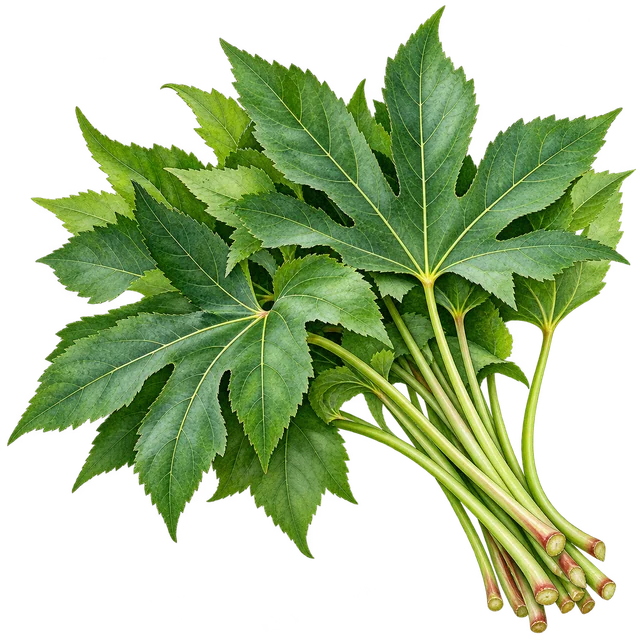
Key cautions
- Authenticate the food species and avoid contaminated or chemically treated leaves.
- Food use does not establish safety of concentrated extracts or every plant part.
What’s inside
Leaves contain vegetable fibre, protein and mucilaginous compounds. No flower-extract or pharmaceutical constituent standard is assigned to the food leaf.
Uses in brief

- Cooked leafy vegetable
- Marketed fresh leaf ingredient
History, folklore and reported uses
History, folklore and traditional uses
SPC describes aibika as a major traditional vegetable in Melanesia, with diversity in Papua New Guinea, Solomon Islands, Vanuatu and New Caledonia. Its spread into other island food systems is a cultivation history, not evidence of one uniform recipe.
Traditional, historical and reported uses
- Cooked leafy vegetable
Food or household practiceWhy this label?
Sources document this named food or material use; no therapeutic outcome is claimed.
SPC records the leaves as an extensively grown food vegetable. This is the central culinary use and should not be padded with unrelated medicinal applications.
- Marketed fresh leaf ingredient
Food or household practiceWhy this label?
Sources document this named food or material use; no therapeutic outcome is claimed.
Australian biosecurity documentation specifically considers imported A. manihot leaves and leaf stems from Pacific countries, establishing a distinct food-trade material.
2 narrowly supported uses; no clinical efficacy or universal preparation is inferred.
Historical-use additions reviewed 2026-10-09
Regional reading paths
These sourced notes describe cultivation, trade, food traditions or material history. A regional connection does not claim exclusive origin.
Australia & Oceania
cultivated; Papua New Guinea, Fiji, Solomon Islands, Vanuatu and Samoa
Cooked leafy vegetable.
Identity & detailed reference
Identity
Abelmoschus manihot; bele/aibika/slippery cabbage, a cultivated leafy vegetable distinct from okra fruit and Brassica cabbage.
Ingredient details, preparation and research
Source plant or material
Abelmoschus manihot; bele/aibika/slippery cabbage, a cultivated leafy vegetable distinct from okra fruit and Brassica cabbage.
Plant family / material: Malvaceae
Forms and route
Food-grade leaves and tender leaf stems, normally prepared as a cooked vegetable.
Vitamins and minerals
Composition depends on cultivar, maturity and cooking. No precise iron, vitamin or protein contribution is assigned to an unspecified bowl.
Absorption and preparation
Boiling, draining and recipe ingredients affect the consumed food. Neither mucilage nor membership of Malvaceae establishes a clinical absorption effect.
Practical preparation
Buy or grow an identified food cultivar in clean conditions, and follow an established cooked-leaf preparation. Do not substitute ornamental hibiscus or medicinal flower powders.
Traditional and reported uses
- SPC records the leaves as an extensively grown food vegetable. This is the central culinary use and should not be padded with unrelated medicinal applications.
- Australian biosecurity documentation specifically considers imported A. manihot leaves and leaf stems from Pacific countries, establishing a distinct food-trade material.
Contraindications and cautions
- Authenticate the food species and avoid contaminated or chemically treated leaves.
- Food use does not establish safety of concentrated extracts or every plant part.
Cultivar diversity
The Fiji crop guide lists local leaf forms and cultivation information. Differences in leaf appearance or texture need not mean a different food species, but the botanical identification still matters for sourcing.
Do not transfer extract evidence
Abelmoschus manihot is also discussed in research on other plant parts. A study of concentrated flower extract would not establish the efficacy, composition or safety of an ordinary cooked serving of Pacific vegetable leaves.
Evidence limits
This is a food/material reference, not evidence of disease treatment. Geographic and customary-use records do not establish a medicinal dose. Nutrient quantities are omitted unless a matching food form and serving have been verified.
Entry sources
- SPC: Vulnerability of Pacific agriculture to climate change, aibika
- Fiji Ministry of Agriculture: Crop Farmers Guide, bele
- DAFF: Pacific island cabbage leaf import risk analysis
Reference entry 509 · Recorded content review: 2026-10-09 · Review scope and dates