


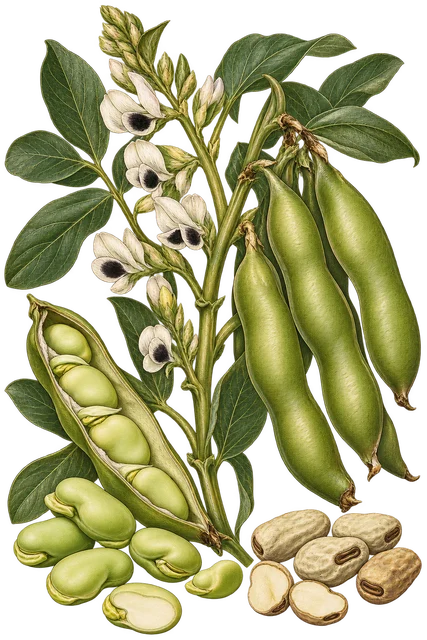
Key cautions
- People with G6PD deficiency should avoid fava/broad beans and fava-protein foods. Cooking does not make them reliably safe: favism can cause dangerous destruction of red blood cells.
- After fava exposure, dark urine, jaundice, marked weakness or breathing difficulty needs prompt medical assessment, especially with known or possible G6PD deficiency.
What’s inside
Protein, starch, fiber, folate and minerals; also vicine and convicine, compounds relevant to favism in people with G6PD deficiency. Fresh and mature seeds differ.
Uses in brief

- Cooked mature beans in ful, stews, purees and grain-and-pulse meals.
- Ground fava beans in properly cooked fritters and other traditional foods.
In the King James Bible
In the King James Bible
Probable botanical identification
The KJV names beans in 2 Samuel 17:28 and Ezekiel 4:9. Fava/broad bean is the conventional probable identification, not a statement about every plant called a bean today. In 2 Samuel, corn means grain, not specifically modern maize. Ezekiel’s mixture belongs to a siege-ration sign-act, not a medical prescription.
Brought beds, and basons, and earthen vessels, and wheat, and barley, and flour, and parched corn, and beans, and lentiles, and parched pulse,
2 Samuel 17:28 (KJV)
Take thou also unto thee wheat, and barley, and beans, and lentiles, and millet, and fitches, and put them in one vessel, and make thee bread thereof, according to the number of the days that thou shalt lie upon thy side, three hundred and ninety days shalt thou eat thereof.
Ezekiel 4:9 (KJV)
Scripture and identification sources
Words & their stories
WORDS & THEIR STORIES
The name behind the KJV
Biblical Hebrew · 2 Samuel 17:28 (KJV)
וּפוֹלūpōl
“And beans,” among supplies brought to David’s people.
Dictionary form: פּוֹל · pōl
Ū- means “and.” Pōl is a collective noun, although the KJV uses the English plural.
Biblical Hebrew · Ezekiel 4:9 (KJV)
וּפוֹלūpōl
“And beans,” included in the mixed bread ingredients.
Dictionary form: פּוֹל · pōl
The same collective form occurs in both passages.
What the language reveals
Two scenes of need
In Samuel, friends bring provisions; in Ezekiel, the food belongs to an enacted siege warning.
A collective food name
The Hebrew does not add a plural ending here. A collective crop or food noun can still be rendered “beans” in English.
Broad or fava bean is the conventional probable identification. The ancient collective term does not cover every modern plant called a bean.
Language and identification bibliography
History, folklore and reported uses
History, folklore and traditional uses
The beans brought to David’s company in 2 Samuel sit among grain, flour, lentils and household provisions. They are part of hospitality and survival, not an exotic remedy. Vicia faba, the broad or fava bean, is the probable Old World crop behind this wording; reading it as any modern supermarket bean would erase important differences in origin and safety. Both young green beans and storable mature seed became foods, but the dry pulse is the useful comparison for a provision list.
The bean’s later cultural life is equally varied. Ful remains a familiar breakfast in Egypt and the Levant, while ground beans can become fritters and roasted seeds can become snacks. FAO also records broad beans in Roman festival offerings. These uses show how a single crop could be ordinary food and a symbol of community at the same time. Its nutritional value should be described alongside, rather than apart from, its unusual favism risk.
Traditional, historical and reported uses
- Ful for breakfast
Food or household practiceWhy this label?
Regional breakfast dish of cooked broad beans.
FAO describes broad-bean ful as a typical breakfast in Egypt, Lebanon and Syria. The long-cooked pulse offers a savory base for a meal rather than merely a garnish.
- Ground-bean fritters
Food or household practiceWhy this label?
Ground-bean culinary fritter preparation.
Mature fava beans are ground for falafel-type foods, including the Egyptian fava-bean tradition. Grinding and frying change the preparation substantially from a boiled-bean stew.
- Roasted seed snacks
Food or household practiceWhy this label?
Roasted seeds used as snacks.
The Feedipedia crop account records mature fava seeds roasted and eaten as snacks in India. Snack portions and added oil or salt should not borrow the values for plain boiled beans.
- Roman festival offerings
Food or household practiceWhy this label?
Ritual food offering of broad beans.
FAO records broad beans offered to the gods at the Roman feast of Fabaria. This is a ritual and cultural use of the crop, separate from a nutritional or medicinal claim.
- Ration bread in Ezekiel’s sign-act
Historical recordWhy this label?
Specific Ezekiel passage documents mixed bread within a siege sign-act.
Ezekiel 4:9 names beans in a mixed grain-and-pulse bread. The surrounding scene depicts measured food and water during siege, not a recommended wellness loaf.
Regional reading paths
These sourced notes describe cultivation, trade, food traditions or material history. A regional connection does not claim exclusive origin.
Africa
Cultivated and culinary: FAO records broad beans in ancient Egyptian food history and in the modern Egyptian breakfast dish ful.
Cooked broad beans as a pulse, including ful. People with G6PD deficiency need to avoid fava beans because of favism risk.
Identity & detailed reference
Identity
Edible young beans or mature dried seeds of Vicia faba. The biblical bean is probably fava/broad bean; this does not identify New World Phaseolus beans such as kidney or haricot beans.
Ingredient details, preparation and research
Also known as: Fava beans; Faba beans; Broad beans; Biblical beans (probable identification)
Source plant or material
Vicia faba L.; Edible young beans or mature dried seeds of Vicia faba. The biblical bean is probably fava/broad bean; this does not identify New World Phaseolus beans such as kidney or haricot beans.
Plant family / material: Fabaceae (pea and bean family)
Forms and route
Fresh shelled beans, mature dried whole or split beans, canned cooked beans, flour and cooked dishes such as ful and fava-bean fritters. The portion below uses mature dried beans after boiling, without salt.
Vitamins and minerals
Modern food reference: 1/2 US cup mature fava beans, boiled without salt, about 85 g, provides approximately 94 kcal, 6.5 g protein, 16.7 g carbohydrate, 4.6 g fiber, 88 micrograms folate and 1.3 mg iron. Calculated from USDA SR28 NDB 16053 (1 cup = 170 g; report pages 229–231). These are cooked mature beans, not fresh green beans, dry seed, salted cans or fried fritters.
Absorption and preparation
A serving alongside cooked wheat or another cereal adds different amino-acid contributions to a varied diet; there is no need for a rigid same-meal protein formula. Lemon and vitamin-C-rich vegetables can help the meal’s plant-iron absorption. Soaking and thorough cooking make dried beans usable and may reduce gas, but neither removes the need to avoid fava beans in G6PD deficiency.
Traditional and reported uses
- Cooked mature beans in ful, stews, purees and grain-and-pulse meals.
- Ground fava beans in properly cooked fritters and other traditional foods.
Contraindications and cautions
- People with G6PD deficiency should avoid fava/broad beans and fava-protein foods. Cooking does not make them reliably safe: favism can cause dangerous destruction of red blood cells.
- After fava exposure, dark urine, jaundice, marked weakness or breathing difficulty needs prompt medical assessment, especially with known or possible G6PD deficiency.
- Fava beans can also cause food allergy, which is different from favism. Follow an individual allergy plan rather than assuming all legumes have the same risk.
- Soak dried whole beans as directed and cook thoroughly; preparation may improve tolerance but must not be used as a way around the G6PD warning.
Similar items and how they compare
- Lentils (KJV lentiles)
Both are Old World pulses named in the KJV.
Lentils cook differently and are not the fava bean responsible for the specific favism warning.
- Wheat
Cereal and pulse foods are often eaten together.
Wheat supplies a different balance of nutrients and contains gluten; it is not a bean.
Identification and food form
Vicia faba is an Old World bean crop; common American beans in Phaseolus are a different lineage. The young vegetable, cooked mature pulse, flour and protein concentrate are separate foods.
Favism is the key specific precaution
Vicine and convicine can trigger hemolytic anemia in susceptible people with G6PD deficiency. The Singapore Food Agency advises avoidance and warns that cooking does not eliminate this problem; exposure in protein ingredients and mixed dishes matters too.
Preparation and allergy
Cook dried pulses thoroughly and match the method to whole or split seed. A legume allergy is an immune reaction and is distinct from the inherited enzyme deficiency involved in favism.
Food portion and nutrition
Modern food reference: 1/2 US cup mature fava beans, boiled without salt, about 85 g, provides approximately 94 kcal, 6.5 g protein, 16.7 g carbohydrate, 4.6 g fiber, 88 micrograms folate and 1.3 mg iron. Calculated from USDA SR28 NDB 16053 (1 cup = 170 g; report pages 229–231). These are cooked mature beans, not fresh green beans, dry seed, salted cans or fried fritters.
Preparation and meal pairing
A serving alongside cooked wheat or another cereal adds different amino-acid contributions to a varied diet; there is no need for a rigid same-meal protein formula. Lemon and vitamin-C-rich vegetables can help the meal’s plant-iron absorption. Soaking and thorough cooking make dried beans usable and may reduce gas, but neither removes the need to avoid fava beans in G6PD deficiency.
Evidence limits
- The Bible does not establish the cultivar, maturity or exact bean preparation.
- Nutrition values cannot be applied to fresh green favas or fava-protein meat substitutes.
Entry sources
- Michael Zohary: Plants of the Bible
- FAO: For the love of pulses!
- Feedipedia (INRAE, CIRAD, AFZ and FAO): Faba bean, Vicia faba
- Singapore Food Agency: The Arch Enemy of G6PD-Deficient Individuals, Fava Beans
- North West Allergy Network: Allergy to Legumes & Pulses
- MedlinePlus: Healthy food trends, beans and legumes
- USDA Standard Reference 28 (2015): legumes and legume products, food group 16
- NIH Office of Dietary Supplements: Iron, Health Professional Fact Sheet
- FAO: Nature’s nutritious seeds, 10 reasons why you should opt for pulses
- King James Bible: Project Gutenberg eBook 10
Reference entry 143 · Recorded content review: 2026-10-06 · Review scope and dates