


Key cautions
- Food-grade identification and clean provenance matter; not all seaweeds are interchangeable.
- People advised to limit iodine should seek individualized guidance rather than assume a safe generic serving.
What’s inside
Seaweed tissue includes fibre-like polysaccharides, protein and minerals. Species, season, site and drying affect measured composition, especially mineral concentrations.
Uses in brief

- Dried seasoning and food
- Contemporary shared dishes
History, folklore and reported uses
History, folklore and traditional uses
Ngāi Tahu’s Te Karaka records karengo preparation and sharing at Ōnuku, providing a specific community voice alongside Te Ara’s broader history. Those accounts should stay attributed rather than be turned into a generic Māori recipe.
Traditional, historical and reported uses
- Dried seasoning and food
Traditional accountWhy this label?
Sources document this named food or material use; no therapeutic outcome is claimed.
Te Ara records drying karengo and using it in food after reconstitution. The dried texture and flavour differ from freshly gathered blades.
- Contemporary shared dishes
Food or household practiceWhy this label?
Sources document this named food or material use; no therapeutic outcome is claimed.
The Ōnuku account describes karengo in foods such as filo preparations, illustrating a living culinary practice rather than a fixed historical menu.
2 narrowly supported uses; no clinical efficacy or universal preparation is inferred.
Historical-use additions reviewed 2026-10-09
Regional reading paths
These sourced notes describe cultivation, trade, food traditions or material history. A regional connection does not claim exclusive origin.
Australia & Oceania
native; New Zealand coasts
Dried or cooked edible red seaweed.
Identity & detailed reference
Identity
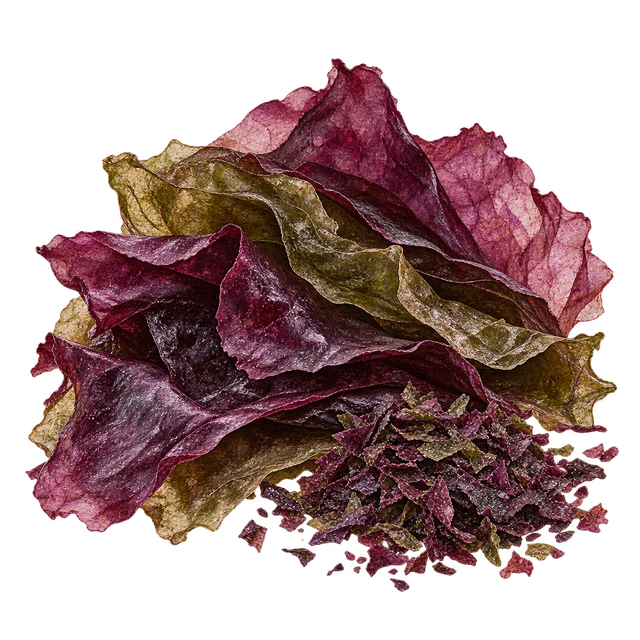
Karengo/parengo comprises edible Pyropia and Porphyra sensu lato red seaweeds; a regional food group, not wakame or all shoreline algae.
Ingredient details, preparation and research
Source plant or material
Karengo/parengo comprises edible Pyropia and Porphyra sensu lato red seaweeds; a regional food group, not wakame or all shoreline algae.
Plant family / material: Bangiaceae; red-algal group
Forms and route
Authenticated edible blades, dried flakes and cooked/reconstituted food preparations.
Vitamins and minerals
No universal iodine dose is assigned. A dried seasoning portion cannot be equated with the same weight of wet seaweed or with kelp supplements.
Absorption and preparation
Soaking and cooking change the consumed portion and soluble constituents; they do not guarantee removal of contaminants or a precise iodine exposure.
Practical preparation
Buy traceable food-grade seaweed and follow the product’s storage and preparation instructions. Respect local harvest authority and avoid polluted or unidentified shoreline material.
Traditional and reported uses
- Te Ara records drying karengo and using it in food after reconstitution. The dried texture and flavour differ from freshly gathered blades.
- The Ōnuku account describes karengo in foods such as filo preparations, illustrating a living culinary practice rather than a fixed historical menu.
Contraindications and cautions
- Food-grade identification and clean provenance matter; not all seaweeds are interchangeable.
- People advised to limit iodine should seek individualized guidance rather than assume a safe generic serving.
A culturally important marine resource
NIWA’s ecosystem-services assessment recognizes seaweeds as taonga and highlights engagement with mana whenua and mana moana. Commercial interest does not replace those relationships or establish harvest permission.
Taxonomy and nutrition boundaries
Older sources often use Porphyra broadly; modern work may use Pyropia. A local food name should not be forced into a single species or supplied with a universal mineral panel without identifying the actual product.
Evidence limits
This is a food/material reference, not evidence of disease treatment. Geographic and customary-use records do not establish a medicinal dose. Nutrient quantities are omitted unless a matching food form and serving have been verified.
Entry sources
- Te Ara: Traditional use of seaweeds
- Te Rūnanga o Ngāi Tahu: Te Karaka 51, karengo at Ōnuku
- NIWA: Stocktake and characterisation of seaweed ecosystem services
Reference entry 503 · Recorded content review: 2026-10-09 · Review scope and dates