


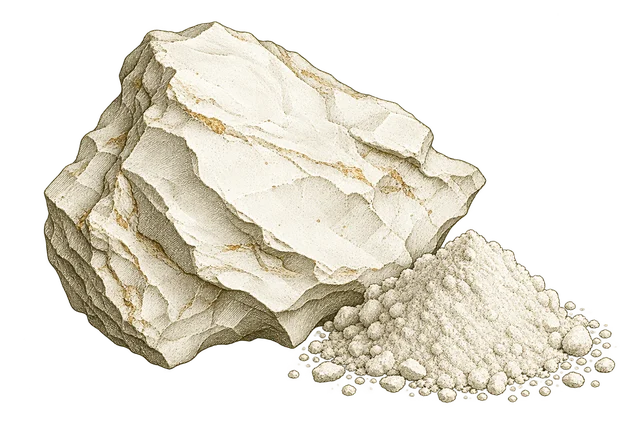
Key cautions
- Do not improvise oral clay doses; edible labeling does not prove contaminant safety
- Ingestion can bind medicines/nutrients or cause constipation; avoid inhaling powder
What’s inside
Kaolinite, Al2Si2O5(OH)4, is a hydrated aluminum silicate and the main mineral in kaolin. Its chemical formula describes a mineral structure, not an available dose of dietary aluminum, silicon or other nutrients.
CDC/NIOSH: Kaolin identity, kaolinite composition and occupational dust hazards
Material identity, geological origin and grade
Kaolinite commonly develops through chemical weathering of feldspars, with loss of more mobile elements. Kaolin is the mined, kaolinite-rich material rather than a guarantee of a single pure mineral. Whiteness is not a purity test: accompanying minerals and trace contaminants depend on the deposit and processing. Industrial filler, pottery clay, cosmetic powder and pharmaceutical ingredient specifications serve different purposes. No botanical family or plant-derived active fraction applies.
USGS: Kaolinite, geological formation and mineral distribution · CDC/NIOSH: Kaolin identity, kaolinite composition and occupational dust hazards · USGS: Environmental characteristics of clays and clay mineral deposits
Processing changes the material
British Geological Survey describes separating fine kaolinite from coarser material and controlling particle size. Particle shape and size affect opacity, flow and handling, helping explain its uses in paper and ceramics. These industrial performance properties do not certify a powder for skin care or ingestion.
Uses in brief

- Surface-oil absorption in rinse-off cosmetics; selected labeled skin-protectant uses
- Geophagy and kaolin-pectin medicines are documented historical uses
History, folklore and reported uses
Gaoling, Jingdezhen and the porcelain trade
Kaolin's name preserves a Chinese landscape. The USC Pacific Asia Museum connects it with the Gaoling mountains, a source of the pale clay used in porcelain. At Jingdezhen during the Yuan dynasty, potters refined their clay mixtures with kaolin and improved firing methods, helping create the brilliant blue-and-white wares described by the Victoria and Albert Museum. Before a jar of white clay became a beauty-counter ingredient, this material already belonged to a highly skilled culture of mining, preparation, kilns and international trade.
USC Pacific Asia Museum: Ceramic Secrets, kaolin and Gaoling · Victoria and Albert Museum: Chinese blue-and-white ceramics, Yuan-dynasty Jingdezhen
Ayilo and geophagy in Ho, Ghana
A different history surrounds clay eating, or geophagy, whose meanings vary with place and material. A 2019 study by Nii Korley Kortei and colleagues among pregnant women in Ho, Ghana, recorded the locally traded clay known as ayilo and other names. Participants described its appealing smell and taste, cravings, and hoped-for relief from nausea; family and friends were important sources of knowledge. These accounts preserve individual experience and a living social practice, rather than one universal 'healing clay' tradition. The researchers also found metals and microorganisms in sampled material, so documenting the practice is not advice to eat cosmetic or mined clay.
A separate pharmacy history
Kaolin also entered manufactured digestive remedies, including earlier kaolin-containing Kaopectate formulations discussed in Gerald Callahan's historical essay. That pharmacy history is distinct from both porcelain and local earth-eating traditions.
Callahan (2003), CDC Emerging Infectious Diseases: Eating Dirt, cultural and historical context
Nausea and pregnancy-associated geophagy
Kortei and colleagues recorded women in Ho, Ghana, consuming locally traded ayilo clay in hopes of relieving morning sickness, as well as for cravings and taste. The sampled clay contained metals and microorganisms, so this cultural record is not a safe nausea remedy.
Historical diarrhea medicines
Kaolin entered manufactured intestinal-adsorbent medicines, including earlier kaolin-containing Kaopectate preparations, as Callahan’s historical account describes. This pharmacy use does not justify eating cosmetic clay or replacing rehydration during diarrhea.
Callahan (2003), CDC Emerging Infectious Diseases: Eating Dirt, cultural and historical context
Oil-absorbing facial masks
Kaolin is used in formulated clay masks to absorb excess surface oil and leave skin feeling cleaner. A modern mixed-clay product study documents this cosmetic practice; its formulation included other ingredients as well as kaolin.
Zhang et al. (2023): Uncontrolled assessment of a formulated clay mask; full participant flow
Protective preparations for irritated skin
The U.S. skin-protectant monograph permits specified kaolin products for uses including diaper-rash protection and drying weeping poison-ivy-type eruptions. These are labeled topical formulations; loose powder poses an inhalation risk and is not for broken skin.
FDA: OTC Monograph M016, skin-protectant ingredients, indications and warnings
Bleeding-control dressings
Modern sterile hemostatic dressings such as QuikClot incorporate kaolin for local bleeding management. This carefully manufactured medical-device use is distinct from putting mined or cosmetic clay into a wound.
Teleflex/Z-Medica: QuikClot kaolin-containing hemostatic dressing, instructions for use
China clay in porcelain
Kaolin, also called china clay, is one of the raw materials of hard-paste porcelain. The Victoria and Albert Museum traces the Chinese craft and its later European adoption, showing how this white clay helped make fine tableware and decorative ceramics.
Victoria and Albert Museum: An A–Z of Ceramics, H is for hard-paste
Making and coating paper
The British Geological Survey records processed kaolin in papermaking, both as a filler within the sheet and as a coating pigment. This industrial craft history uses the clay’s material properties rather than its place in cosmetics or historical medicines.
Food permissions and practical boundaries
The U.S. kaolin provision at 21 CFR 186.1256 concerns an indirect ingredient used in food-contact paper and paperboard under manufacturing conditions. It is not a recommendation to eat a spoonful. Keep food, industrial, cosmetic and medicinal contexts separate. No edible serving, detox protocol, pregnancy remedy or home oral dose is assigned. A formulated rinse-off mask may have a cosmetic role, but persistent acne and gastrointestinal problems warrant condition-specific care.
eCFR: 21 CFR 186.1256, kaolin as an indirect ingredient in food-contact paper and paperboard · Portnoy et al. (1976): Randomized antidiarrheal-agent comparison in 80 children · American Academy of Dermatology: Acne skin-care habits that can worsen breakouts
Dust is a separate exposure route
NIOSH lists chronic lung fibrosis among kaolin dust hazards. That occupational warning concerns breathing dust, not evidence that a brief use of a finished wet mask has the same risk. Loose-powder handling and finished cosmetic use should not be treated as equivalent exposures.
CDC/NIOSH: Kaolin identity, kaolinite composition and occupational dust hazards
Regional reading paths
These sourced notes describe cultivation, trade, food traditions or material history. A regional connection does not claim exclusive origin.
Africa
Geological/traded: Cameroon, including Balengou and Yaoundé markets.
Regional clay-use reference; ingestion is not recommended because contamination is documented.
Asia
Geological/traditional processing: Jingdezhen, China, and its porcelain-making deposits.
Ceramic and manufactured external-use material; no ingestion recommendation.
Europe
Geological and traditional processing: Cornwall and Devon, UK.
Ceramic and other material uses; this regional listing does not recommend eating clay or using raw deposits on skin.
North America
Geological/mined: United States.
Industrial paper and refractory material; product grade governs any other use.
South America
geological; Brazil, Rio Capim
Industrial ceramics and paper; no ingestion endorsement.
Australia & Oceania
geological; Australia, New South Wales
Ceramic and industrial mineral material.
Antarctica
Identified in studied Antarctic soils.
Mineralogy research; not a source of edible clay.
Identity & detailed reference
Identity
Kaolin (china clay or white clay) is a mined material made mainly of kaolinite, a hydrated aluminum silicate. It is a geological material, not a botanical or an essential dietary mineral. The deposit, processing, testing and intended route matter more than the word natural.
Ingredient details, preparation and research
Source plant or material
Not applicable. Kaolinite commonly forms as feldspar-bearing rocks weather and their chemistry changes; deposits are mined and processed. There is no plant part.
Plant family / material: Not applicable: inorganic clay mineral material, not a plant.
Forms and route
Raw clay pieces or powder; processed cosmetic powders and rinse-off masks; pharmaceutical ingredients and labeled skin protectants. Industrial ceramics/paper grades, agricultural products, cosmetic grades and medicinal preparations are not interchangeable. Geophagic earths may contain kaolin but are not necessarily pure kaolinite.
Food sources
No dietary serving is recommended. Food-contact manufacturing permissions, historical food-processing uses and commercial edible-clay marketing are different questions from the safety of swallowing a particular clay.
Vitamins and minerals
No established vitamin contribution or dependable bioavailable iron/calcium serving. In a digestion/cell model, most tested earths/clays supplied little available iron, and some reduced uptake from a bean meal. This is laboratory evidence, not a measured effect size for every consumer product.
Absorption and preparation
The historical intestinal role is surface adsorption: substances bind to clay, rather than the clay acting as a readily absorbed nutrient. This can reduce availability of some medicines and dietary iron. Toxic contaminants may still be absorbed. No household absorption booster or oral clay dose is established here.
Practical preparation
Choose a finished product made for its intended external use and follow its application and rinse-off directions. Keep dry powder contained and away from the face. Do not use pottery or agricultural kaolin as skin care, prepare an oral clay drink, or prolong a facial mask overnight.
Combination notes
Results from kaolin/bentonite/panthenol masks or kaolin-pectin medicines belong to the complete formulation. Adding vinegar, essential oils or abrasive scrubbing creates an untested mixture; it does not establish better cleansing or acne treatment. For prescribed medicines, ask a pharmacist rather than choosing an arbitrary clay-spacing interval.
Traditional and reported uses
- Documented tradition: earth and clay eating (geophagy), including cultural, religious, taste-related and pregnancy-associated practices. The particular earth and its preparation vary greatly.
- Historical medicine: kaolin, often with pectin, was used as an intestinal adsorbent for diarrhea. Evidence does not support replacing rehydration or medical evaluation with household clay.
- Cosmetic use: absorbing excess surface oil in formulated rinse-off masks; human results concern mixed products and do not prove that kaolin alone treats acne.
- Labeled topical medicine: qualifying kaolin skin-protectant products have specific U.S. monograph indications, including drying weeping poison-ivy-type rashes and diaper-rash protection.
Contraindications and cautions
- Do not self-dose raw, industrial or cosmetic clay orally. An edible or food-grade claim does not establish that a batch is free of toxic metals or otherwise suitable for repeated ingestion.
- Lead and sometimes arsenic have been measured in calabash chalk products. These findings do not describe every kaolin product, but pregnancy, breastfeeding and childhood make self-directed clay eating particularly concerning.
- Ingestion can cause constipation or obstruction and can interfere with iron or medicine availability. Persistent cravings deserve a respectful nutritional/medical assessment, rather than more clay or a presumed iron supplement.
- Check any oral kaolin medicine with a pharmacist, especially with digoxin or other important medicines. Findings for one mixture and timing do not supply a universal spacing rule.
- Avoid dust inhalation and eye contact. Follow the exact external label; kaolin skin powders should not go on broken skin or near a child’s face. Stop a cosmetic mask if it burns or leaves persistent irritation.
- Severe abdominal pain, swelling, vomiting, or inability to pass stool or gas needs urgent assessment. Diarrhea with dehydration, blood or persistent symptoms also needs appropriate care.
Similar items and how they compare
- Bentonite clay
Another mined clay used in adsorbent products and masks.
Bentonite is predominantly smectite, commonly montmorillonite; its swelling, composition and evidence differ from kaolin.
- Modern U.S. Kaopectate products
The brand historically contained kaolin and pectin.
The verified soft-chew label contains bismuth subsalicylate, with different benefits and salicylate-related cautions. Check the exact product and country.
- Baking soda
Another nonbotanical household material sometimes used in skin preparations.
Sodium bicarbonate is a soluble alkaline salt; kaolin is an insoluble clay. Their pH behavior, ingestion risks and appropriate uses differ.
Geophagy and household history in context
Callahan’s historical/cultural essay in CDC’s journal describes earth eating on many continents, including religious traditions and uses of selected clays in food preparation, as condiments and during scarcity. Reported pregnancy or nausea-related use also appears in public-health records. These are diverse practices involving different earths, not a single kaolin recipe or clinical trial. Their cultural significance can be recorded respectfully without interpreting every practice as disease, or assuming safety for a modern product bought online.
Historical diarrhea medicines and their limits
A 1976 randomized study hospitalized 80 Guatemalan children aged 3–11 with acute diarrhea and compared kaolin, pectin, kaolin-pectin, another antidiarrheal or placebo for two days. Kaolin-pectin tended to make stools look more formed, but the agents did not improve stool frequency, water content or weight. This small old trial is useful for distinguishing stool appearance from recovery; it does not establish an effective household clay treatment. Current Kaopectate soft chews use a different active ingredient, bismuth subsalicylate.
What the cosmetic mask study actually tested
The 2023 L’Oréal-affiliated study tested a finished mask containing kaolin, bentonite, panthenol and other ingredients over four weeks, without a concurrent untreated or placebo group. Although its abstract says 75 were enrolled, the full participant flow reports 75 screened, 65 enrolled and 60 completing; 40 completers had clinical assessments and 20 questionnaires only. Oiliness and comedone measures improved, but the design cannot isolate kaolin, rule out other explanations, or establish raw clay as treatment for a deep inflamed pimple.
Defined external uses are product-specific
FDA’s M016 monograph includes kaolin at 4–20% in qualifying skin-protectant products. Its directions and warnings depend on formulation and indication. Cosmetic oil absorption is a different claim. Powder warnings include avoiding broken skin and inhalation, particularly near children. Follow the finished product’s label and stop for irritation rather than increasing exposure to obtain a stronger drying effect.
Contamination and gastrointestinal safety
Public Health England reported excessive lead and occasional arsenic in seized calabash chalk, and warned against its ingestion, especially in pregnancy and nursing. This is evidence about tested products, not proof that all clay contains the same amounts. Conversely, labels such as edible, natural or food-grade are not independent batch test results. Constipation and intestinal blockage are additional concerns. Baking or washing a clay at home does not establish removal of its metal contaminants.
Mineral content is not nutritional absorption
Seim and colleagues examined 12 geophagic earths and four clay-mineral samples using simulated digestion and Caco-2 cells. Eleven of 16 produced iron-uptake responses not significantly different from the blank; five reduced uptake from a white-bean meal, while none improved it. These laboratory results support caution with mineral-replacement claims, but are not direct human absorption measurements. A 2021 case report linked years of kaolin ingestion with iron-deficiency anemia. A case cannot settle whether cravings cause or follow deficiency in everyone.
Medicine binding: a measured interaction, not a universal rule
In the 1981 study of patients on chronic digoxin, simultaneous kaolin-pectin lowered peak digoxin concentration by 36% and 24-hour exposure by 15%. No interaction was detected under the study’s two-hour-separated schedule, and the authors considered the tested short exposure clinically inconsequential. This modest, formulation-specific result should neither be exaggerated nor converted into a universal safe interval for all medicines, supplements or repeated clay consumption.
Entry sources
- CDC/NIOSH: Kaolin identity, kaolinite composition and occupational dust hazards
- Public Health England: Lead and arsenic in calabash chalk; pregnancy and ingestion warning
- FDA: OTC Monograph M016, skin-protectant ingredients, indications and warnings
- Zhang et al. (2023): Uncontrolled assessment of a formulated clay mask; full participant flow
- Portnoy et al. (1976): Randomized antidiarrheal-agent comparison in 80 children
- USGS: Kaolinite, geological formation and mineral distribution
- USGS: Environmental characteristics of clays and clay mineral deposits
- Callahan (2003), CDC Emerging Infectious Diseases: Eating Dirt, cultural and historical context
- Attarha et al. (2021): Kaolin Clay Anemia, human case report
- Albert et al. (1981): Kaolin-pectin suspension and steady-state digoxin levels
- DailyMed: Kaopectate soft-chew label, bismuth subsalicylate rather than kaolin
- eCFR: 21 CFR 186.1256, kaolin as an indirect ingredient in food-contact paper and paperboard
- MedlinePlus: Pica, nutritional assessment and obstruction risk
- American Academy of Dermatology: Acne skin-care habits that can worsen breakouts
- Seim et al. (2013): Iron bioavailability in geophagic earths and clay minerals, digestion/Caco-2 experiment
- Victoria and Albert Museum: An A–Z of Ceramics, H is for hard-paste
- British Geological Survey (2021): User Guide: BGS Mineral Resources, kaolin resource description, p. 42
Reference entry 99 · Recorded content review: 2026-10-05 · Review scope and dates