


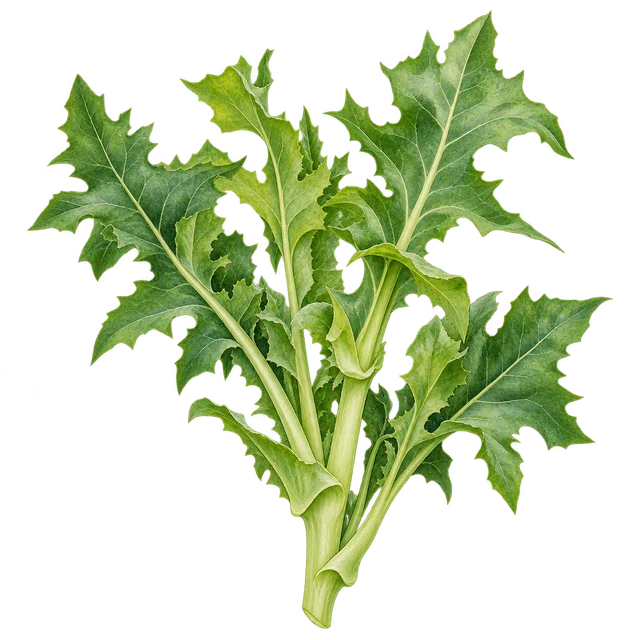
Key cautions
- Do not identify greens from a common name or broad resemblance to thistles.
- Do not use sap or concentrated preparations for bleeding, childbirth or wound treatment.
What’s inside
Leaf tissue contains fibre and ordinary vegetable constituents; species and growing conditions vary, so no shared medicinal-active profile is assigned.
Uses in brief

- Cooked vegetable
- Toroi ingredient
History, folklore and reported uses
History, folklore and traditional uses
Manaaki Whenua’s ethnobotanical record explicitly warns that uses filed under S. oleraceus may concern other Sonchus species. Māori food names can also have broader historical meanings, making local attribution important.
Traditional, historical and reported uses
- Cooked vegetable
Traditional accountWhy this label?
Sources document this named food or material use; no therapeutic outcome is claimed.
The ethnobotanical record describes the green tops and leaves as vegetables. Modern boil-up contexts pair pūhā with other foods; this is culinary use rather than a blood-purifying claim.
- Toroi ingredient
Food or household practiceWhy this label?
Sources document this named food or material use; no therapeutic outcome is claimed.
Te Ara describes pūhā in toroi with mussels and stock. The named mixed dish includes seafood and must not be presented as a purely plant-based fermented food.
2 narrowly supported uses; no clinical efficacy or universal preparation is inferred.
Historical-use additions reviewed 2026-10-09
Regional reading paths
These sourced notes describe cultivation, trade, food traditions or material history. A regional connection does not claim exclusive origin.
Australia & Oceania
introduced/native species mix; New Zealand
Cooked greens in Māori food traditions.
Identity & detailed reference
Identity
Pūhā is a local food-name group including Sonchus oleraceus and other identified Sonchus species; this is not every plant called thistle.
Ingredient details, preparation and research
Source plant or material
Pūhā is a local food-name group including Sonchus oleraceus and other identified Sonchus species; this is not every plant called thistle.
Plant family / material: Asteraceae
Forms and route
Identified food leaves and tender stems, commonly cooked as greens.
Vitamins and minerals
No nutrient values are copied between native and introduced Sonchus species or between raw and boiled leaves.
Absorption and preparation
Discarded cooking liquid and trimming affect what is eaten. Neither bitterness nor its removal establishes a nutritional or therapeutic absorption claim.
Practical preparation
Prefer identified food-grown greens and a trusted cooked preparation. Avoid roadside, contaminated or sprayed plants. Historical preparation descriptions are not a botanical-identification test.
Traditional and reported uses
- The ethnobotanical record describes the green tops and leaves as vegetables. Modern boil-up contexts pair pūhā with other foods; this is culinary use rather than a blood-purifying claim.
- Te Ara describes pūhā in toroi with mussels and stock. The named mixed dish includes seafood and must not be presented as a purely plant-based fermented food.
Contraindications and cautions
- Do not identify greens from a common name or broad resemblance to thistles.
- Do not use sap or concentrated preparations for bleeding, childbirth or wound treatment.
Names do not map one-to-one
Several local names and species appear in historical records. A card can preserve those relationships without implying that every use belongs to a single modern botanical taxon. Confirm the actual supplied species.
Exclude dangerous medicinal inference
Historical sources include reproductive and wound remedies. Those are not adopted as practical uses: food history does not establish safety for pregnancy complications, bleeding, infection or concentrated sap.
Evidence limits
This is a food/material reference, not evidence of disease treatment. Geographic and customary-use records do not establish a medicinal dose. Nutrient quantities are omitted unless a matching food form and serving have been verified.
Entry sources
- Manaaki Whenua: Sonchus oleraceus, rauriki and pūhā
- Charles Royal and Jenny Kaka-Scott, Te Ara: Māori foods, kai Māori
- Manaaki Whenua: Wild foods of New Zealand
Reference entry 502 · Recorded content review: 2026-10-09 · Review scope and dates