


Key cautions
- Do not identify or eat wild fungi using this card or a photograph.
- Use authenticated food material and hygienic rehydration/storage; discard compromised products.
What’s inside
Gelatinous fungal tissue contains polysaccharides and other food solids. No clinical or immune effect is inferred from that general composition.
Uses in brief

- Cooked food with other ingredients
- Dried export food
History, folklore and reported uses
History, folklore and traditional uses
Manaaki Whenua preserves records of hakeke as a Māori food and a nineteenth-century New Zealand export to China. Historical accounts differ in setting and preference; they should not become a statement that all Māori communities ate it in the same way.
A closer look at its history
More than a famine-food label
Manaaki Whenua preserves both a report of hakeke at a large feast and accounts describing its use during scarcity. Retaining both avoids reducing Māori food experience to a single colonial observer’s judgment about taste or hardship.
A nineteenth-century export fungus
The same archival compilation records collection for export to China from 1871 and a substantial late-nineteenth-century trade. Hakeke therefore connects local forest gathering with an international dried-fungus market; historical medicinal claims in that trade remain historical claims.
Additional history reviewed 2026-10-09
Traditional, historical and reported uses
- Cooked food with other ingredients
Traditional accountWhy this label?
Sources document this named food or material use; no therapeutic outcome is claimed.
The ethnobotanical database records cooking hakeke with greens or potatoes in some Māori accounts. This is attributed food history, not a universal modern recipe.
- Dried export food
Historical recordWhy this label?
Sources document this named food or material use; no therapeutic outcome is claimed.
Historical sources document dried fungus traded to China for cooked dishes. The export history explains an economic use distinct from local seasonal provision.
2 narrowly supported uses; no clinical efficacy or universal preparation is inferred.
Historical-use additions reviewed 2026-10-09
Features and lookalikes to study
Auricularia cornea, hakeke/hakeka in New Zealand records; distinct from the existing Auricularia heimuer black-wood-ear card.
Hakeke/hakeka and related Māori names are regionally rooted. “Wood ear” is a broad market term, while A. polytricha and A. auricula-judae in old New Zealand records may be misapplications rather than current species determinations.
Morphology described in sources
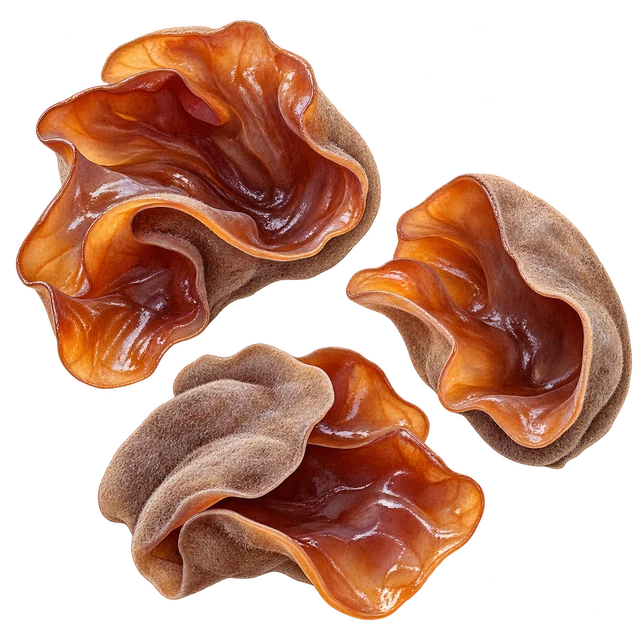
- New Zealand hakeke records describe tough gelatinous ear-like bodies on wood, with a hairy outer surface. A. cornea is the retained regional name here; older records often say A. polytricha.
- Habitat and substrate
- See the source-linked morphology and comparison notes below; a separate habitat summary has not been verified for this card.
- Geographic scope
- A complete regional range is not established here. Broad common names and commercial labels can span different species.
- Season in the cited region
- No region-specific fruiting season has been verified for this card. Do not infer a local season from trade availability.
Auricularia heimuer and related wood-ear fungi
Wood-ear species overlap in appearance and require microscopic assessment of hairs, medulla, basidia and spores, often supplemented by sequences.
Dried ears and market names cannot resolve the species. Hakeke must not silently inherit evidence for the distinct Chinese cultivated A. heimuer.
Auricularia novozealandica, a disputed segregate
A 2021 study described a New Zealand segregate with larger spores. Manaaki Whenua’s taxonomic note disputes the sufficiency of those differences and retains it within A. cornea pending better Pacific evidence.
This is an unresolved species-boundary issue, not a visual identification rule. Do not automatically rename every historical hakeke record A. novozealandica.
Limits and regional differences
- A local common name, old synonym or hairiness alone cannot authenticate a new collection. Expert microscopy and more comprehensive molecular work are relevant to the taxonomic boundary.
- Educational comparison only. Neither this card, an illustration, a photograph, a spore-print colour nor a checklist establishes that a wild collection is safe to eat. A qualified local mycologist must assess uncertain material; do not taste an unknown fungus. Cooking does not reliably eliminate mushroom toxins.
Regional reading paths
These sourced notes describe cultivation, trade, food traditions or material history. A regional connection does not claim exclusive origin.
Australia & Oceania
native; New Zealand
Documented Māori food fungus.
Identity & detailed reference
Identity
Auricularia cornea, hakeke/hakeka in New Zealand records; distinct from the existing Auricularia heimuer black-wood-ear card.
Ingredient details, preparation and research
Source plant or material
Auricularia cornea, hakeke/hakeka in New Zealand records; distinct from the existing Auricularia heimuer black-wood-ear card.
Fungal family: Auriculariaceae
Forms and route
Authenticated food fruiting bodies, fresh or dried and cooked; not an identification guide for wood-growing fungi.
Vitamins and minerals
Fresh and dried fungal material have different water content. No generic nutrient percentage is borrowed from A. heimuer or commercial mixtures labeled wood ear.
Absorption and preparation
Rehydration changes weight and texture; it does not increase nutrients by itself or neutralize every possible contamination.
Practical preparation
Use authenticated food products and follow safe storage, rehydration and cooking instructions. Do not leave soaking fungi warm for prolonged periods or attempt to identify edible mushrooms from this description.
Traditional and reported uses
- The ethnobotanical database records cooking hakeke with greens or potatoes in some Māori accounts. This is attributed food history, not a universal modern recipe.
- Historical sources document dried fungus traded to China for cooked dishes. The export history explains an economic use distinct from local seasonal provision.
Contraindications and cautions
- Do not identify or eat wild fungi using this card or a photograph.
- Use authenticated food material and hygienic rehydration/storage; discard compromised products.
Taxonomic boundary
Manaaki Whenua’s current name record anchors this card to A. cornea; older records often used A. polytricha. Commercial wood-ear names can encompass several species, so the source name should be checked rather than automatically mapped to A. heimuer.
Historical evidence is limited
Older comments about famine, preference or remedies reflect particular observers and periods. They do not define present-day Māori taste, prove treatment efficacy or certify the safety of a wild collection.
Evidence limits
This is a food/material reference, not evidence of disease treatment. Geographic and customary-use records do not establish a medicinal dose. Nutrient quantities are omitted unless a matching food form and serving have been verified.
Entry sources
- Manaaki Whenua: Auricularia cornea
- Manaaki Whenua Ngā Rauropi Whakaoranga: Hakeke food records
- Manaaki Whenua Virtual Mycota: Auricularia cornea
Reference entry 499 · Recorded content review: 2026-10-09 · Review scope and dates