


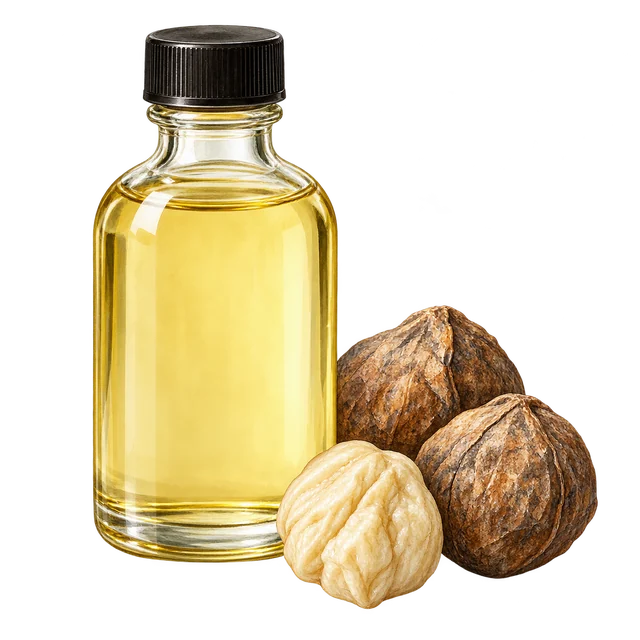
Key cautions
- Do not ingest cosmetic kukui oil or raw candlenuts.
- Use labeled external products; stop if skin irritation occurs and keep away from children.
What’s inside
The seed contains substantial oil. This card does not assign one fatty-acid profile or medicinal-active concentration across refinements and manufacturers.
Uses in brief

- Historical lighting
- External-product material
History, folklore and reported uses
History, folklore and traditional uses
University of Hawaiʻi describes kukui as a pre-Western introduction in Hawaiʻi and other Pacific islands. NTBG discusses its connection with enlightenment and multiple cultural uses; these meanings belong to specific traditions rather than generic wellness marketing.
Traditional, historical and reported uses
- Historical lighting
Historical recordWhy this label?
Sources document this named food or material use; no therapeutic outcome is claimed.
Cultural plant records identify kukui as a source of lamp oil. The record explains the candlenut name without serving as a fire-making or indoor-burning guide.
- External-product material
Food or household practiceWhy this label?
Sources document this named food or material use; no therapeutic outcome is claimed.
NTBG describes cosmetic uses among the tree’s applications. This supports a non-food material association, not an efficacy claim for any present-day bottle.
2 narrowly supported uses; no clinical efficacy or universal preparation is inferred.
Historical-use additions reviewed 2026-10-09
Regional reading paths
These sourced notes describe cultivation, trade, food traditions or material history. A regional connection does not claim exclusive origin.
Australia & Oceania
introduced/traded; Hawaiʻi, Polynesian introduction
Historical lighting oil; separate cosmetic oil products.
Identity & detailed reference
Identity
Aleurites moluccanus seed oil, also published as A. moluccana; kukui or candlenut fixed oil, not the prepared edible condiment or raw nuts.
Ingredient details, preparation and research
Source plant or material
Aleurites moluccanus seed oil, also published as A. moluccana; kukui or candlenut fixed oil, not the prepared edible condiment or raw nuts.
Plant family / material: Euphorbiaceae
Forms and route
Commercial fixed oil and separately formulated external products; historical lighting material.
Vitamins and minerals
No oral serving is recommended. A traditional cooked-nut condiment does not establish that a cosmetic oil or raw seed is an edible food.
Absorption and preparation
External oil handling does not demonstrate nutritional absorption; a skin-conditioning product has its own formulation and safety specification.
Practical preparation
Use only clearly labeled products for their intended non-food purpose. Do not extract, burn or consume homemade oil based on this cultural account. Avoid transferring oil into drink containers.
Traditional and reported uses
- Cultural plant records identify kukui as a source of lamp oil. The record explains the candlenut name without serving as a fire-making or indoor-burning guide.
- NTBG describes cosmetic uses among the tree’s applications. This supports a non-food material association, not an efficacy claim for any present-day bottle.
Contraindications and cautions
- Do not ingest cosmetic kukui oil or raw candlenuts.
- Use labeled external products; stop if skin irritation occurs and keep away from children.
Keep oil and food apart
Kukui appears in records of both condiment and oil use. Those preparations are not interchangeable: the existence of a carefully prepared food tradition is not permission to swallow raw nuts or oil sold for skin care.
Naming and provenance
The university profile places the species in Euphorbiaceae and records its Pacific introduction history. Material specifications should preserve the species despite the differing grammatical endings found in botanical sources.
Evidence limits
This is a food/material reference, not evidence of disease treatment. Geographic and customary-use records do not establish a medicinal dose. Nutrient quantities are omitted unless a matching food form and serving have been verified.
Entry sources
- University of Hawaiʻi CTAHR: Polynesian cultural plant introductions
- University of Hawaiʻi CTAHR: Aleurites moluccana
- National Tropical Botanical Garden: Spring 2025 Bulletin, kukui
Reference entry 496 · Recorded content review: 2026-10-09 · Review scope and dates