


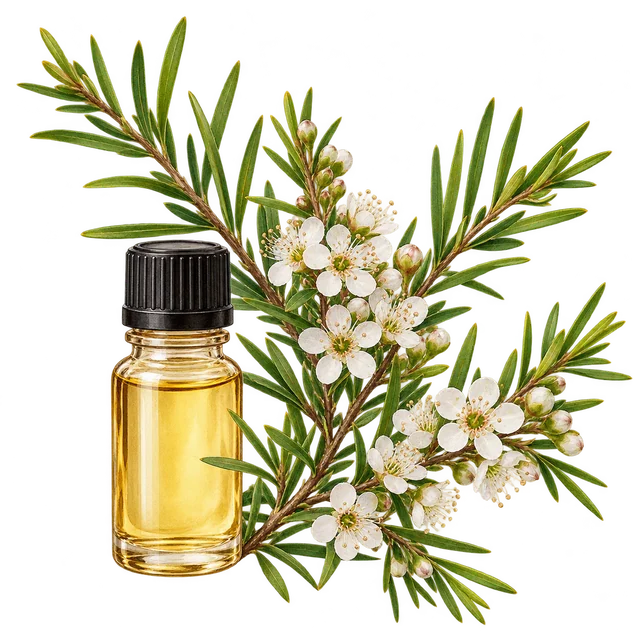
Key cautions
- Do not ingest this essential oil.
- Require source-species information and follow the finished product’s route and cautions.
What’s inside
Alpha-pinene is prominent in studied kānuka oils, with other terpenes varying by source. A genus-level name is not a uniform chemical standard.
Uses in brief

- Fragrance and natural-product ingredient
- Formulated soaps and balms
History, folklore and reported uses
History, folklore and traditional uses
MPI’s kānuka report highlights both a developing New Zealand industry and uncertainty created by historical species naming. This is an important practical distinction when comparing older research with a modern bottle.
Traditional, historical and reported uses
- Fragrance and natural-product ingredient
Food or household practiceWhy this label?
Sources document this named food or material use; no therapeutic outcome is claimed.
MPI documents commercial sale of kānuka oil as a raw ingredient. The product category is aromatic oil, not an edible oil.
- Formulated soaps and balms
Food or household practiceWhy this label?
Sources document this named food or material use; no therapeutic outcome is claimed.
The report describes value-added products including soap and balms. Their existence records market use; it does not validate the ingredient as a treatment for disease.
2 narrowly supported uses; no clinical efficacy or universal preparation is inferred.
Historical-use additions reviewed 2026-10-09
Regional reading paths
These sourced notes describe cultivation, trade, food traditions or material history. A regional connection does not claim exclusive origin.
Australia & Oceania
native and cultivated; New Zealand
Commercial aromatic oil ingredient.
Identity & detailed reference
Identity
New Zealand Kunzea foliage essential oil, often published under Kunzea ericoides sensu lato; actual source species must be specified after modern taxonomic revision.
Ingredient details, preparation and research
Source plant or material
New Zealand Kunzea foliage essential oil, often published under Kunzea ericoides sensu lato; actual source species must be specified after modern taxonomic revision.
Plant family / material: Myrtaceae
Forms and route
Commercial kānuka distillate and finished aromatic/cosmetic products; not mānuka oil or kānuka honey.
Vitamins and minerals
No food nutrient contribution is assigned to this concentrated aromatic material. Honey and leaf-tea composition do not transfer to distilled oil.
Absorption and preparation
Skin or inhalation exposure is formulation-dependent. Chemical detection is not evidence of a therapeutic absorption target.
Practical preparation
Use a labeled finished product with traceable botanical source. No oral dose, neat-skin application, home blending or labor/childbirth use is recommended.
Traditional and reported uses
- MPI documents commercial sale of kānuka oil as a raw ingredient. The product category is aromatic oil, not an edible oil.
- The report describes value-added products including soap and balms. Their existence records market use; it does not validate the ingredient as a treatment for disease.
Contraindications and cautions
- Do not ingest this essential oil.
- Require source-species information and follow the finished product’s route and cautions.
Older taxonomic names need care
Research using K. ericoides before later taxonomic clarification may not identify the same material as a modern species-specific oil. Botanical provenance and analytical specifications should be compared before transferring conclusions.
Composition and test-tube activity
The primary comparative study characterized kānuka separately from mānuka. Antimicrobial assays are laboratory evidence, not proof that a home mixture is safe or effective on skin, wounds or respiratory illness.
Evidence limits
This is a food/material reference, not evidence of disease treatment. Geographic and customary-use records do not establish a medicinal dose. Nutrient quantities are omitted unless a matching food form and serving have been verified.
Entry sources
- MPI: Kānuka industry report
- Primary study: Chemical, physical and antimicrobial properties of Leptospermum and Kunzea oils
- Queensland Poisons Information Centre: Poisoning prevention
Reference entry 494 · Recorded content review: 2026-10-09 · Review scope and dates