


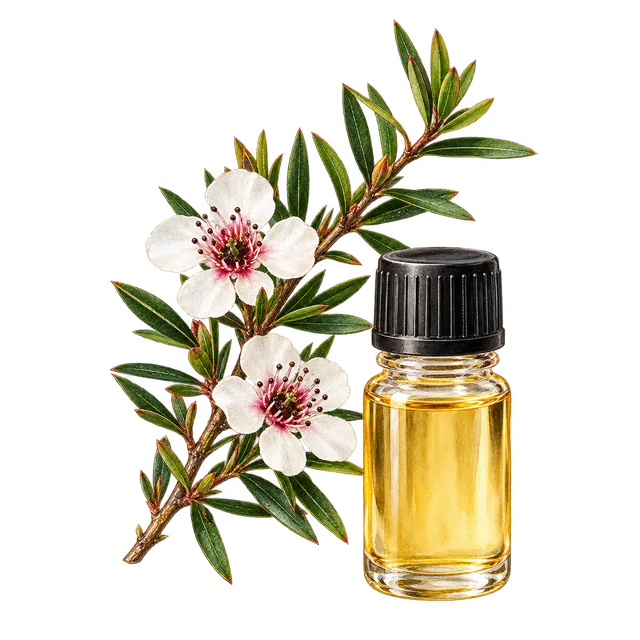
Key cautions
- Do not ingest the distillate or confuse it with edible honey.
- Follow finished-product labeling; essential oils require secure storage and can cause adverse exposure.
What’s inside
Volatile composition varies geographically and by plant type. Some mānuka oils contain characteristic triketones; not every commercial sample has the same profile.
Uses in brief

- Aromatic product ingredient
- Formulated personal-care use
History, folklore and reported uses
History, folklore and traditional uses
New Zealand industry work distinguishes mānuka and kānuka supply chains. The similar names and shared tea-tree label can obscure distinct plants, products and commercial specifications.
Traditional, historical and reported uses
- Aromatic product ingredient
Food or household practiceWhy this label?
Sources document this named food or material use; no therapeutic outcome is claimed.
MPI describes a commercial New Zealand oil industry supplying the natural-products market. The material is a distilled ingredient with a product-specific specification.
- Formulated personal-care use
Food or household practiceWhy this label?
Sources document this named food or material use; no therapeutic outcome is claimed.
Commercial value-added products are discussed in the industry report. Such use concerns the finished formula, not proof that neat mānuka oil treats infection.
2 narrowly supported uses; no clinical efficacy or universal preparation is inferred.
Historical-use additions reviewed 2026-10-09
Regional reading paths
These sourced notes describe cultivation, trade, food traditions or material history. A regional connection does not claim exclusive origin.
Australia & Oceania
native and cultivated; New Zealand
Commercial aromatic oil ingredient.
Identity & detailed reference
Identity
Leptospermum scoparium essential oil from specified foliage feedstock; mānuka oil is distinct from mānuka honey, kānuka oil and Australian tea-tree oil.
Ingredient details, preparation and research
Source plant or material
Leptospermum scoparium essential oil from specified foliage feedstock; mānuka oil is distinct from mānuka honey, kānuka oil and Australian tea-tree oil.
Plant family / material: Myrtaceae
Forms and route
Commercial distillate and formulated aromatic/personal-care products.
Vitamins and minerals
Not a food or vitamin/mineral supplement. Honey nutrition and honey-product evidence do not belong to the distilled oil.
Absorption and preparation
Neither the presence of a constituent nor activity in a test tube establishes useful absorption or clinical efficacy at a cosmetic exposure.
Practical preparation
Use only products labeled for the intended route. Do not drink the oil, apply it to wounds as a substitute for care, or assume a mānuka-honey instruction applies.
Traditional and reported uses
- MPI describes a commercial New Zealand oil industry supplying the natural-products market. The material is a distilled ingredient with a product-specific specification.
- Commercial value-added products are discussed in the industry report. Such use concerns the finished formula, not proof that neat mānuka oil treats infection.
Contraindications and cautions
- Do not ingest the distillate or confuse it with edible honey.
- Follow finished-product labeling; essential oils require secure storage and can cause adverse exposure.
Direct chemical comparison
A primary study compared commercial mānuka and kānuka oils and also found substantial differences among mānuka samples from different sites. The result supports batch characterization and cautions against universal composition claims.
Laboratory boundaries
The study included antimicrobial testing, but that experiment does not establish a treatment dose, a household disinfectant or efficacy in people. Ordinary fragrance or cosmetic use should not inherit a medical promise.
Evidence limits
This is a food/material reference, not evidence of disease treatment. Geographic and customary-use records do not establish a medicinal dose. Nutrient quantities are omitted unless a matching food form and serving have been verified.
Entry sources
- MPI: Kānuka industry report
- Primary study: Chemical, physical and antimicrobial properties of Leptospermum and Kunzea oils
- Queensland Poisons Information Centre: Poisoning prevention
Reference entry 493 · Recorded content review: 2026-10-09 · Review scope and dates