


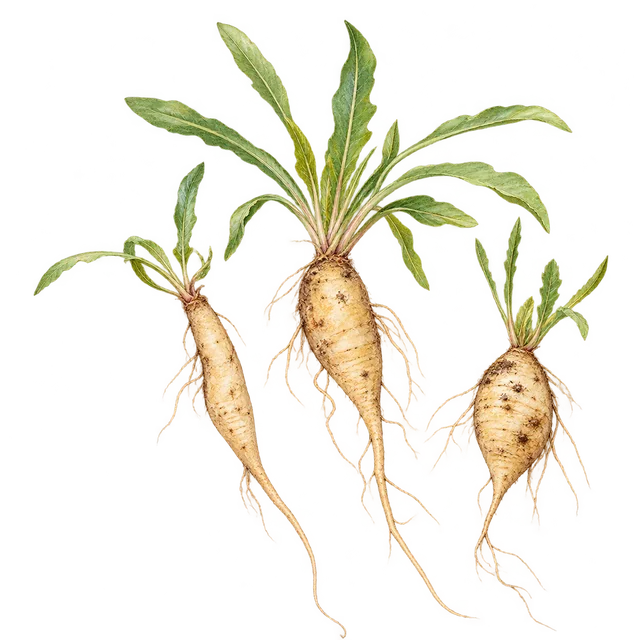
Key cautions
- Do not identify edible roots from flower colour or a common name alone.
- Respect conservation status, land access and local authority; prefer documented cultivation.
What’s inside
The storage root is a food carbohydrate source; a standardized starch, inulin or micronutrient profile is not established by the cultural sources used here.
Uses in brief

- Edible tuber food
- Cultivated food resource
History, folklore and reported uses
History, folklore and traditional uses
The City of Melbourne presents Wurundjeri and Bunurong accounts of murnong’s significance, while taxonomic work clarifies the name M. walteri. These connections show food production and care for Country, not merely opportunistic gathering.
Traditional, historical and reported uses
- Edible tuber food
Food or household practiceWhy this label?
Sources document this named food or material use; no therapeutic outcome is claimed.
Traditional Owner accounts describe murnong tubers as an important food in Kulin Country. The food identity here is the root, not all parts of any daisy.
- Cultivated food resource
Food or household practiceWhy this label?
Sources document this named food or material use; no therapeutic outcome is claimed.
The Yarra Ranges account records cultivation and food use. That distinguishes a managed food resource from a generic claim that every wild root is safe to eat.
2 narrowly supported uses; no clinical efficacy or universal preparation is inferred.
Historical-use additions reviewed 2026-10-09
Regional reading paths
These sourced notes describe cultivation, trade, food traditions or material history. A regional connection does not claim exclusive origin.
Australia & Oceania
native; Australia, Victoria and southern regions
Traditionally cultivated edible tuber.
Identity & detailed reference
Identity
Microseris walteri; this murnong card uses the current named taxon, while acknowledging older literature’s broader Microseris usage.
Ingredient details, preparation and research
Source plant or material
Microseris walteri; this murnong card uses the current named taxon, while acknowledging older literature’s broader Microseris usage.
Plant family / material: Asteraceae
Forms and route
Identified edible tubers from cultivated or otherwise authorized food supply.
Vitamins and minerals
No unsupported claim that murnong is several times more nutritious than potato is adopted. Species and cooked form must be matched before quantitative comparison.
Absorption and preparation
No special absorption or therapeutic effect is inferred from historical staple-food status.
Practical preparation
Use positively identified food material and an established culinary preparation. Do not dig wild plants or confuse superficially similar daisy roots; cultivation does not remove the need for correct identification.
Traditional and reported uses
- Traditional Owner accounts describe murnong tubers as an important food in Kulin Country. The food identity here is the root, not all parts of any daisy.
- The Yarra Ranges account records cultivation and food use. That distinguishes a managed food resource from a generic claim that every wild root is safe to eat.
Contraindications and cautions
- Do not identify edible roots from flower colour or a common name alone.
- Respect conservation status, land access and local authority; prefer documented cultivation.
Resolve older names carefully
Walsh’s taxonomic treatment explains the modern M. walteri name. Historical references to M. lanceolata or M. scapigera need interpretation rather than automatic synonym replacement, because those names also refer to distinguishable plants.
Preserve attribution
Traditional Owner accounts are stronger evidence for local meaning than generalized bush-food marketing. Publicly shared information does not authorize access to land or disclosure of knowledge not offered by its holders.
Evidence limits
This is a food/material reference, not evidence of disease treatment. Geographic and customary-use records do not establish a medicinal dose. Nutrient quantities are omitted unless a matching food form and serving have been verified.
Entry sources
- Yarra Ranges: Microseris walteri
- Walsh, Royal Botanic Gardens Victoria: A name for Murnong
- City of Melbourne: Yam daisy, with Traditional Owner accounts
Reference entry 489 · Recorded content review: 2026-10-09 · Review scope and dates