


Key cautions
- Mustard can cause serious allergy. Check sauces, spice mixtures, dressings and prepared foods if avoiding mustard.
- Do not apply homemade mustard plasters or heated mustard compresses: blistering, burns and persistent pigmentation have been reported.
What’s inside
Seed contains protein, fixed oil and glucosinolates. Black and brown mustard commonly contain sinigrin; yellow mustard commonly contains sinalbin. Crushing and moisture allow myrosinase to form pungent breakdown products, including isothiocyanates. Species and processing change the profile.
Uses in brief

- Use seed or prepared mustard as a condiment and seasoning, and food-grade mustard greens as a vegetable.
- Historical mustard plasters were used for aches and chest complaints; they can cause serious skin injury.
- The biblical seed is an image in parables and teaching, without a specified modern species or medicinal dose.
In the King James Bible
In the King James Bible
Named material
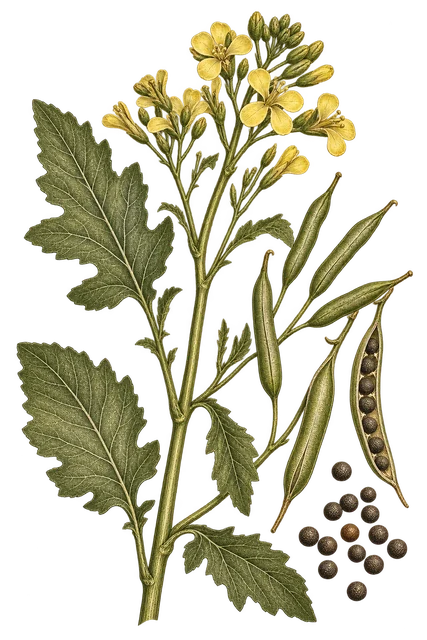
Jesus uses mustard seed in a parable about the kingdom of heaven and in his teaching about faith. Black mustard, Brassica nigra, is a leading regional identification among several candidates. The seed and growing plant supply the imagery, while the precise species remains unspecified.
Another parable put he forth unto them, saying, The kingdom of heaven is like to a grain of mustard seed, which a man took, and sowed in his field:
Matthew 13:31 (KJV)
And Jesus said unto them, Because of your unbelief: for verily I say unto you, If ye have faith as a grain of mustard seed, ye shall say unto this mountain, Remove hence to yonder place; and it shall remove; and nothing shall be impossible unto you.
Matthew 17:20 (KJV)
Scripture and identification sources
Words & their stories
WORDS & THEIR STORIES
The name behind the KJV
Koine Greek · Matthew 13:31; Matthew 17:20 (KJV)
σινάπεωςsinápeōs
Of mustard, in the expression “a grain of mustard seed.”
Dictionary form: σίναπι · sínapi
Sinápeōs is the genitive form of sínapi. The form is the same in both passages, checked in Scrivener’s Greek.
What the language reveals
A seed in two comparisons
Matthew 13 places the seed in a sowing parable; Matthew 17 uses the seed in a comparison about faith. Neither verse names a condiment or a medicinal preparation.
The mustard identification is conventional, but the Greek does not specify a modern species, cultivar, mustard oil or prepared sauce.
History, folklore and reported uses
History, folklore and traditional uses
Mustard is a vivid plant to meet in a parable: a small seed gives rise to a striking plant within a growing season. The KJV draws on that contrast in teaching about the kingdom of heaven and faith. Several mustards grow in the region, and botanical writers often favor black mustard, but the verses themselves do not settle the species. The familiar image can stand without forcing it into a modern product label.
Outside scripture, mustard’s pungency gave it a double career as food and as a forceful household remedy. Seed was ground into condiments, leafy forms were eaten, and older medical traditions used the heating sensation in plasters for aches and chest complaints. Pliny’s long mustard chapter already recognizes blistering. That sharpness remains desirable on a plate, while its ability to injure skin is a reason to preserve the poultice story as history rather than a home recipe.
Traditional, historical and reported uses
- Pungent seed condiment
Food or household practiceWhy this label?
Ground seed used as a food condiment.
Ground mustard seed has long supplied a pungent condiment. Ancient garden writers and later culinary practice treat mustard as a useful cultivated seed crop.
- Leafy food
Food or household practiceWhy this label?
Regional use of mustard plants as edible greens.
Musselman reports Palestinian and Jordanian use of mustard plants as edible greens, while noting that the biblical passages do not tell us exactly how ancient Hebrews ate them.
- Plasters for aches
Traditional accountWhy this label?
Folk plaster practice is the claim; a burn case supplies safety evidence.
Historical and continuing folk practice used mustard plasters for rheumatic, muscular and joint pain. Published burn reports document the associated harm.
- Chest and cough remedies
Mixed/contextual sourcesWhy this label?
Combines classical written remedies and later folk plaster practice.
Pliny and later folk practice describe mustard for chest complaints and phlegm; the later plaster tradition also included chest congestion.
- Digestive and appetite traditions
Historical recordWhy this label?
Pliny's classical text supplies the digestive-remedy record.
Classical accounts place mustard among stimulating stomach remedies, connecting its pungent taste with the old digestive-herb tradition.
- An Indian oilseed crop
Food or household practiceWhy this label?
Agricultural production of edible seed oil.
ICAR researchers describe Brassica juncea seed as a source of edible mustard oil in India and discuss newer low-erucic-acid varieties. This agricultural food-oil use is separate from mustard condiments and pungent mustard essential oil; it makes no claim about the biblical species.
- Seed-meal use after oil extraction
Food or household practiceWhy this label?
Agricultural use of de-oiled meal in animal feed.
The same ICAR account records de-oiled mustard seed meal used as animal and poultry feed. It also notes glucosinolate limitations, so this is an agricultural processing use rather than a home feeding formula.
Historical-use additions reviewed 2026-10-08
Story sources
- Lytton John Musselman, Old Dominion University: Mustard
- King James Bible, public-domain complete text, Project Gutenberg eBook 10
- Pliny the Elder: Natural History, Book XX; Bostock and Riley translation (1856), public-domain primary historical text
- Yabanoglu et al. Phytocontact dermatitis due to mustard seed mimicking burn injury: case report (2012)
- Taak and colleagues: INDOLA, development and utilization of quality mustard oil
Regional reading paths
These sourced notes describe cultivation, trade, food traditions or material history. A regional connection does not claim exclusive origin.
Europe
Cultivated and traditional processing: Burgundy, France; local seed-growing and mustard-making.
Ground seeds form pungent prepared mustard; mustard is a food allergen.
Identity & detailed reference
Identity
Culinary mustards are Brassicaceae plants, including black mustard (Brassica nigra), brown mustard (Brassica juncea) and white/yellow mustard (Sinapis alba). Biblical mustard is not specified to species; black mustard is a leading candidate.
Ingredient details, preparation and research
Also known as: Mustard seed; Black mustard; Brown mustard; White or yellow mustard; Mustard greens; Mustard seeds
Source plant or material
Culinary mustards are Brassicaceae plants, including black mustard (Brassica nigra), brown mustard (Brassica juncea) and white/yellow mustard (Sinapis alba). Biblical mustard is not specified to species; black mustard is a leading candidate. Parts used: Ripe seeds for spice and prepared mustard; edible leaves and young shoots of identified food cultivars. Pressed seed oil and volatile mustard oil are distinct from seed and greens.
Plant family / material: Brassicaceae (mustard or cabbage family)
Forms and route
Whole seed, ground mustard powder, prepared condiment and fresh or cooked greens. Seed oil, essential/volatile oil and mustard plasters are separate preparations with different risks.
Vitamins and minerals
USDA ground mustard seed: 1 teaspoon (2 g, 0.07 oz) provides about 10 kcal, 0.52 g protein, 0.72 g fat, 0.24 g fiber, 7.4 mg magnesium and 4.2 micrograms selenium. This spice portion is small. Prepared mustard is diluted and often salted; its label must be used instead. Mustard greens and pressed oil have separate nutrient profiles.
Absorption and preparation
Crushing seed and adding moisture triggers enzyme chemistry that creates pungency. Heat, acidity and storage affect this reaction; stronger pungency is not evidence of better health effects. No standard food combination is established here to optimize medicinal absorption. Seed nutrients cannot be assigned to an oil or strained preparation.
Practical preparation
Choose food-grade seed and accurately labeled condiment or greens. Mixing mustard powder with liquid develops its characteristic flavor; follow a culinary recipe. Avoid airborne powder and wash hands before touching eyes. Do not reproduce historical poultice recipes.
Combination notes
Seed and prepared mustard combine with vegetables, dressings and sauces for flavor. A moist preparation activates mustard chemistry, but no mustard-and-vinegar or mustard-and-honey mixture is offered as a treatment or absorption booster.
Traditional and reported uses
- Use seed or prepared mustard as a condiment and seasoning, and food-grade mustard greens as a vegetable.
- Historical mustard plasters were used for aches and chest complaints; they can cause serious skin injury.
- The biblical seed is an image in parables and teaching, without a specified modern species or medicinal dose.
Contraindications and cautions
- Mustard can cause serious allergy. Check sauces, spice mixtures, dressings and prepared foods if avoiding mustard.
- Do not apply homemade mustard plasters or heated mustard compresses: blistering, burns and persistent pigmentation have been reported.
- Do not use mustard powder or oil as an emetic, nasal remedy, eye treatment or improvised respiratory treatment.
- Prepared mustard may contain considerable sodium and other allergens; mustard oil products require their own food-use labeling and safety review.
Similar items and how they compare
- Mustard greens
Edible leaves of mustard crops.
A leafy-vegetable serving differs greatly from a teaspoon of seed in nutrients, texture and use.
- Horseradish
Another pungent Brassicaceae condiment with isothiocyanate chemistry.
Horseradish uses a root and has its own preparation and allergy considerations.
- Black cumin seed
Another small seed sometimes used on bread or in pickles.
Nigella sativa is unrelated botanically and should not be substituted in mustard-allergy labeling or biblical identification.
Botanical identity and the parable
Musselman and Medema discuss several regional mustard candidates, favoring black mustard while acknowledging uncertainty. The biblical imagery depends on a small sown seed and conspicuous growth. The teaching does not supply a species determination or establish mustard as the smallest seed in all botany.
Seed, greens, oil and condiment
Culinary mustard encompasses several species and plant parts. Whole or powdered seed, prepared table mustard, leafy greens and pressed oil have different compositions. A name shared with a concentrated volatile product does not make the products interchangeable.
Pungency is an enzyme reaction
The glucosinolates sinigrin and sinalbin differ across mustard types. Tissue disruption and water allow myrosinase-mediated formation of pungent products. This explains preparation-dependent flavor; it does not by itself demonstrate disease prevention or an optimal medicinal dose.
Traditional plasters and documented injury
Mustard plasters were used for muscular aches and chest congestion. A published case describes a second-degree burn after application for knee pain; another report describes persistent pigmentation following a heated chest compress. The important practical conclusion is to avoid homemade mustard applications on skin.
Food portion and allergy
A teaspoon of ground seed weighs 2 g in USDA’s record and contributes only modest amounts of nutrients. Prepared mustard needs its own label because dilution and salt alter the serving. Mustard allergy applies across seeds, powder and the condiment, including hidden ingredients in sauces.
Evidence limits
- USDA values describe ground seed, not greens, pressed oil or prepared condiment.
- Historical plasters and emetics carry real injury risks and are not home-use instructions.
Entry sources
- Lytton John Musselman, Old Dominion University: Mustard
- Kew Plants of the World Online: Sinapis alba L.
- Pliny the Elder: Natural History, Book XX; Bostock and Riley translation (1856), public-domain primary historical text
- Glucosinolates and Omega-3 Fatty Acids from Mustard Seeds: Phytochemistry and Pharmacology (2022)
- Biologically Active Compounds in Mustard Seeds: A Toxicological Perspective (2021)
- Yabanoglu et al. Phytocontact dermatitis due to mustard seed mimicking burn injury: case report (2012)
- UK Food Standards Agency: Safe Method, Food Allergies; mustard seeds, powder and prepared mustard
- USDA FoodData Central, SR Legacy: Spices, mustard seed, ground (FDC 170929)
- King James Bible, public-domain complete text, Project Gutenberg eBook 10
- King James Bible: Matthew 13:31
- King James Bible: Matthew 17:20
- Chronic hyperpigmentation from a heated mustard compress burn: case report (1996)
- Taak and colleagues: INDOLA, development and utilization of quality mustard oil
Reference entry 129 · Recorded content review: 2026-10-06 · Review scope and dates