


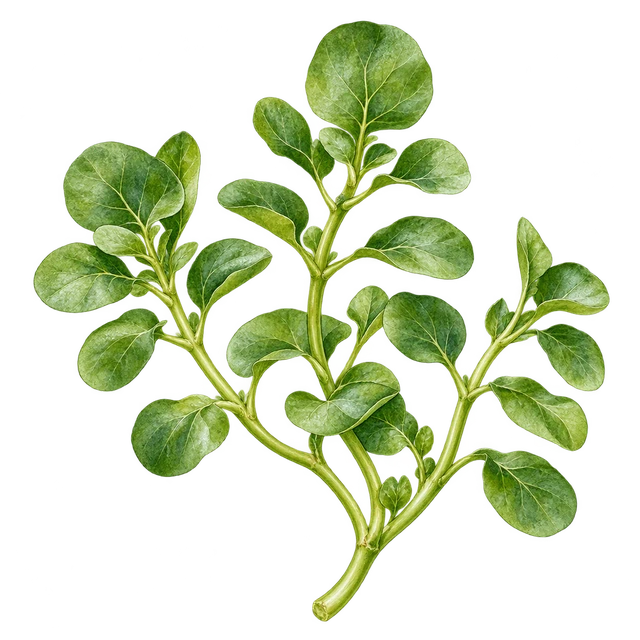
Key cautions
- Avoid wild collection: parasites and pollution.
- Buy food-grade cultivated watercress.
- Warfarin: keep vitamin K intake consistent.
What’s inside
Vitamins K and C, folate and carotenoids. Glucosinolates and their breakdown products contribute its peppery flavor. Gluconasturtiin is a precursor of phenethyl isothiocyanate (PEITC); preparation affects exposure to its breakdown products.
Uses in brief

- Cultivated salad greens
- Cooked soups and potatoes
- Butter or sauce flavoring
History, folklore and reported uses
History, folklore and traditional uses
Watercress has a strong northern-European market-garden history. The UK’s traditional-product specification describes commercial growing in Germany in the eighteenth century, southern England in the early nineteenth century and France’s spring-fed beds.
By the late nineteenth century, watercress traveled to urban markets by rail; the specification connects Hampshire’s Alresford route with London demand. Its peppery culinary identity persists in salads and cooked dishes. These crop-history records do not validate old medicinal claims.
A closer look at its history
A perishable green helped give a railway its identity
The Mid-Hants Railway opened in October 1865 through Hampshire’s agricultural countryside. Its fast transport helped establish commercial watercress growing around Alresford: the crop was highly perishable and needed to reach market quickly. The surviving heritage railway’s name, the Watercress Line, preserves this connection between a leafy vegetable, its growing district and Victorian transport.
The name is a botanical trap
True watercress belongs to the mustard family. Missouri’s conservation account explains that ornamental garden nasturtiums, Tropaeolum, received their common name because their peppery oil resembled watercress’s flavor; they belong to a different family. The shared everyday name does not make the plants interchangeable in a growing guide.
Additional history reviewed 2026-10-09
Traditional, historical and reported uses
- Peppery salad leaves
Food or household practiceWhy this label?
The cited source records a food preparation or cultural practice; no treatment effect is inferred. Relevant safety qualifications remain attached.
Utah State Extension records watercress in European-style salad mixtures. Use cultivated produce supplied for food and handle it safely; this culinary record is not permission to eat stream-collected greens.
- Cooked soup and potato dishes
Food or household practiceWhy this label?
The cited source records a food preparation or cultural practice; no treatment effect is inferred. Relevant safety qualifications remain attached.
Utah State lists soups and potato dishes among household uses. The leaves and tender stems add peppery flavor; this is a food preparation, not a therapeutic regimen.
- Chopped butter blends and fish sauces
Food or household practiceWhy this label?
The cited source records a food preparation or cultural practice; no treatment effect is inferred. Relevant safety qualifications remain attached.
Utah State records chopped watercress as a flavoring for butter blends and sauces for fish. Those mixed foods have their own salt and fat content, distinct from the raw-leaf composition reference.
3 supported featured uses; culinary and cultural records do not establish treatment benefits.
Historical-use additions reviewed 2026-10-09
Story sources
- Royal Horticultural Society: Nasturtium officinale
- NC State Extension: Tropaeolum (nasturtium)
- Utah State University Extension: How to Grow Watercress in Your Garden
- UK DEFRA: Watercress TSG product specification
- Japan MEXT food composition database: Watercress, stems and leaves, raw; food 06077
- CDC: Clinical Overview of Fasciola, prevention
- FDA: Selecting and Serving Produce Safely
- NIH ODS: Vitamin K, health-professional fact sheet
Growing notes
Nasturtium officinale, true watercress; excludes garden cress (Lepidium sativum), wintercress and ornamental nasturtium (Tropaeolum).
- Climate, season and habit
- A spreading aquatic perennial for cool-season harvests; RHS rates it H6 (−20 to −15°C) under UK conditions. Spring and fall flavor is best; heat above about 85°F reduces quality. A sheltered container’s winter survival depends on exposure, not the rating alone. [1] [2]
- Start safely
- Check local cultivation restrictions first. Buy identified seed or nursery starts; grow in a contained pot with drinking-quality water rather than introducing it into a stream. Never gather wild-stream plants for this crop: raw watercress can transmit liver flukes. [3] [2] [4] [5]
- Sun, medium, water and nutrition
- Use sun to partial shade and rich, consistently saturated medium; preferred pH is 6.5–7.5. Stand the pot in about 2 inches of water and refresh daily. Base garden fertilizer on soil testing; nutrient needs are modest. [1] [2] [5]
- Planting and harvest
- Sow shallowly in cool, moist conditions; transplant after frost, about 8 inches apart. Florida guidance suggests first cutting around three weeks after emergence in favorable conditions, not a universal deadline. Pick young leaves before flowering and leave about 4 inches for regrowth. [2] [6]
- Neighbors, pollination and wildlife
- Leaf harvest does not require flowering; insects help seed production. Give its wet-rooted growth a separate container; choose neighbors by matching light and water needs. Stems root at nodes and escape readily, so keep plants and trimmings out of natural waterways. [2] [7] [8] [5]
- Pests and disease
- Inspect for aphids, caterpillars, slugs and snails. Leaf spot and root rots can occur; avoid assuming an aquatic plant is disease-proof. [1]
Growing sources and regional guidance
- Royal Horticultural Society: Nasturtium officinale, common watercress
- Utah State University Extension: How to Grow Watercress in Your Garden
- Connecticut General Assembly: 2026 Supplement, Chapter 446i, Water Resources and Invasive Plants
- US Centers for Disease Control and Prevention: Clinical Overview of Fasciola, Prevention
- Garden Organic, Heritage Seed Library: Seed Saving Guidelines, Watercress (pp. 59–60)
- University of Florida IFAS Extension: Watercress—Nasturtium officinale, HS684 (James M. Stephens; reviewed 2009)
- University of Maryland Extension: Vegetable Succession and Companion Planting
- Missouri Department of Conservation: Watercress
- Watercress Line Heritage Railway Trust: Our History
Growing notes reviewed 2026-10-09
Regional reading paths
These sourced notes describe cultivation, trade, food traditions or material history. A regional connection does not claim exclusive origin.
Australia & Oceania
introduced/traded; New Zealand
Greens in modern Māori boil-up.
Identity & detailed reference
Identity
The edible leaves and tender stems of cultivated watercress, Nasturtium officinale. Despite the shared name, garden nasturtium (Tropaeolum) is a different plant; garden cress (Lepidium sativum) is also distinct.
Ingredient details, preparation and research
Also known as: Water cress; Common watercress; Nasturtium officinale; Rorippa nasturtium-aquaticum; Cresson de fontaine; Berros de agua
Source plant or material
Nasturtium officinale W.T.Aiton
Plant family / material: Brassicaceae
Forms and route
Fresh food-grade leaves and tender stems, used in cooked dishes or properly handled commercial salad greens. Wild stream plants, dried powders and concentrated extracts are not equivalent to this food serving.
Vitamins and minerals
MEXT food 06077 reports 190 micrograms vitamin K, 26 mg vitamin C and 150 micrograms folate per 100 g edible raw watercress stems and leaves. The 100 g amount is a comparison reference, not a required serving. A small garnish supplies proportionally less; cooked soup or an extract has a different composition.
Absorption and preparation
Vitamin K is fat-soluble, and some dietary fat supports its absorption. An ordinary mixed meal is sufficient context; no special oil or medicinal pairing is established.
Practical preparation
Buy fresh cultivated food-grade watercress and refrigerate promptly. Trim damaged material. Follow the label for prewashed ready-to-eat greens; otherwise rinse under safe running water, without soap. Use clean utensils and cook in soups or other dishes as desired. Do not attempt to rescue an unknown, contaminated or recalled harvest by washing.
Combination context
No pairing makes wild-collected watercress safe or establishes a medicinal benefit. A shared laboratory pathway is not evidence of recipe synergy; adding bladderwrack also introduces a separate iodine and product-quality assessment.
Combination notes
Use for peppery flavor in soups, potato dishes or sauces. For salad use, choose commercially cultivated greens intended for that purpose and follow safe produce handling.
Traditional and reported uses
- Salad greens
- Soup and potato dishes
- Chopped savory seasoning
Contraindications and cautions
- Do not gather watercress from the wild for eating. CDC links contaminated raw freshwater plants to Fasciola liver-fluke infection, especially in livestock-grazing areas; pollution is another concern. Clear running water does not prove a site is safe.
- Use commercially cultivated food-grade produce. Rinsing is not sterilization and does not turn an unsafe wild harvest into safe food. Avoid recalled products.
- Keep refrigerated, discard spoiled leaves, and prevent contact with raw meat and its juices. Follow ready-to-eat package instructions; otherwise wash under safe running water before preparation.
- If taking warfarin or another vitamin K antagonist, keep leafy-green intake consistent and consult your care team before major changes.
- This card and its illustration are not an identification guide. Garden nasturtium, garden cress and wild lookalikes must not be substituted on the strength of a common name.
Similar items and how they compare
- Garden nasturtium (Tropaeolum)
Shares the common name nasturtium and a peppery taste.
A different genus and family from watercress. The scientific name Nasturtium officinale does not refer to the familiar brightly flowered garden nasturtium.
- Garden cress (Lepidium sativum)
Another peppery edible cress.
A different species and crop; its sprouts and nutrient figures are not watercress stems and leaves.
Cultivation history and food-safety controls
The UK specification describes controlled flowing-water production with water-quality testing and protection from surface runoff. That supports a distinction between cultivated food production and casually collecting plants from a stream; it does not make every raw product risk-free.
Freshwater parasites are a specific concern
CDC identifies eating contaminated raw watercress and other freshwater plants as a route of Fasciola infection. Utah State separately discourages wild gathering because of pollutants. Washing alone is not a basis for declaring wild plants safe.
Nutrient data are not a health ranking
The MEXT values describe raw stems and leaves. They do not demonstrate that watercress is the healthiest vegetable, that more is always better or that extracts prevent disease. Vitamin K matters to people using vitamin K antagonist medicines.
Names need botanical context
RHS places Nasturtium officinale in Brassicaceae. NC State identifies ornamental nasturtiums as Tropaeolum in Tropaeolaceae. Similar common names and flavors cannot establish identical plants or interchangeable food forms.
PEITC: the food, the constituent and preparation
A small human uptake study detected a PEITC metabolite after four people ate watercress. A separate study in nine volunteers found variable isothiocyanate metabolite excretion after cooked watercress with inactive plant myrosinase. These are exposure studies, not treatment trials. Chopping, chewing and cooking affect the glucosinolate–isothiocyanate system; a raw or cooked meal is not a standardized PEITC dose.
NF-κB research is not a recipe outcome
Hsu and colleagues studied commercial PEITC in cultured human GBM 8401 glioblastoma cells and reported lower measured pro-inflammatory cytokines and NF-κB activity, along with cell death. The experiment did not test eating watercress or treating inflammation in people. It cannot establish that a watercress dish, or a pairing with bladderwrack, reproduces those effects.
What a whole-food human study measured
Gill and colleagues studied 60 adults in a randomized crossover trial using 85 g of raw watercress daily for eight weeks. Measured lymphocyte DNA damage decreased and plasma lutein and beta-carotene increased. This is human whole-food evidence, but those surrogate measurements do not prove prevention or treatment of cancer or inflammatory disease. The research amount is not a recommended daily dose.
Useful kitchen combinations, without a synergy claim
The practical case for watercress in a meal is its peppery flavor and ordinary leafy-vegetable nutrition. Utah State records soup and potato dishes among its uses. Those culinary pairings need not be presented as medicinal synergy; no cited study here tested a watercress–bladderwrack recipe. Cultivated-food sourcing and the existing vitamin K and food-safety cautions still apply.
Evidence limits
No treatment claim, extract dose, raw-foraging recommendation or universal nutrient ranking is made. Regional history is drawn from a traditional-product specification; ancient medicinal anecdotes in that document are not adopted as clinical evidence. Added PEITC and whole-food research distinguishes laboratory mechanisms, human exposure and surrogate biomarkers from clinical outcomes; no combined bladderwrack recipe was established.
Entry sources
- Royal Horticultural Society: Nasturtium officinale
- NC State Extension: Tropaeolum (nasturtium)
- Utah State University Extension: How to Grow Watercress in Your Garden
- UK DEFRA: Watercress TSG product specification
- Japan MEXT food composition database: Watercress, stems and leaves, raw; food 06077
- CDC: Clinical Overview of Fasciola, prevention
- FDA: Selecting and Serving Produce Safely
- NIH ODS: Vitamin K, health-professional fact sheet
- Chung et al. (1992): Human uptake of phenethyl isothiocyanate after a watercress meal
- Getahun and Chung (1999): Conversion of glucosinolates after cooked watercress
- Hsu et al. (2022): Phenethyl isothiocyanate and NF-κB signaling in cultured GBM 8401 cells
- Gill et al. (2007): Watercress supplementation and biomarkers in healthy adults
Reference entry 291 · Recorded content review: 2026-10-28 · Review scope and dates