


Key cautions
- Falling cones can be dangerous; do not gather beneath fruiting trees without local safety guidance.
- Respect land access and Traditional Owner authority; use authenticated edible seeds.
What’s inside
The seed is a starchy food material; no standardized vitamin, mineral or medicinal constituent profile is supplied here.
Uses in brief

- Seasonal seed food
- Cultural gathering food
History, folklore and reported uses
History, folklore and traditional uses
Queensland Parks and Queensland Museum describe bunya gatherings involving invited Aboriginal groups and seasonal seed abundance. The gathering includes social and cultural relationships; reducing it to an interchangeable commercial nut loses that context.
Traditional, historical and reported uses
- Seasonal seed food
Traditional accountWhy this label?
Sources document this named food or material use; no therapeutic outcome is claimed.
Bunya seeds were central to documented regional gatherings and feasts. This is a food-history statement rather than a blanket wild-harvesting recommendation.
- Cultural gathering food
Traditional accountWhy this label?
Sources document this named food or material use; no therapeutic outcome is claimed.
The seeds helped support gatherings bringing people together across parts of southeastern Queensland. The distinct use is social provision and exchange, not a second medicinal property.
2 narrowly supported uses; no clinical efficacy or universal preparation is inferred.
Historical-use additions reviewed 2026-10-09
Regional reading paths
These sourced notes describe cultivation, trade, food traditions or material history. A regional connection does not claim exclusive origin.
Australia & Oceania
native; Australia, Queensland
Food seeds with Aboriginal gathering traditions.
Identity & detailed reference
Identity
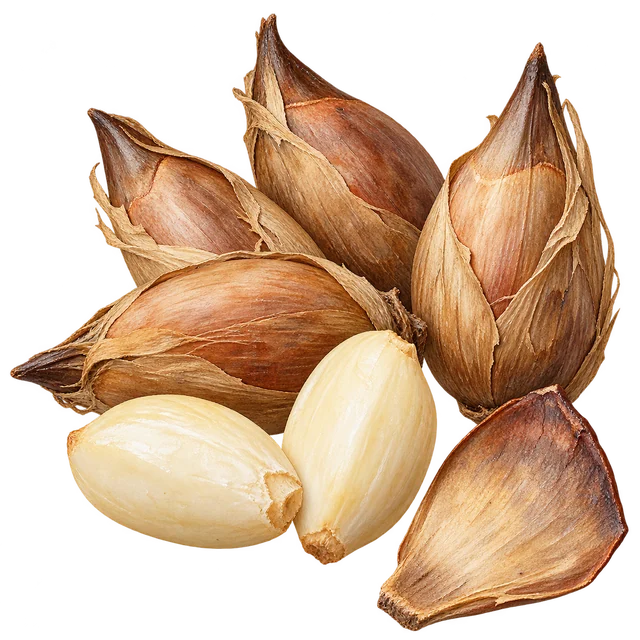
Araucaria bidwillii; bunya-pine seeds, not an ordinary pine nut and not every Araucaria seed.
Ingredient details, preparation and research
Source plant or material
Araucaria bidwillii; bunya-pine seeds, not an ordinary pine nut and not every Araucaria seed.
Plant family / material: Araucariaceae
Forms and route
Authenticated food seeds and prepared seed dishes.
Vitamins and minerals
A botanical seed is not nutritionally interchangeable with oily commercial pine nuts. Portion values must come from an identified bunya food preparation.
Absorption and preparation
The source record establishes food use, not a special absorption technique. Cooking descriptions should remain attached to the particular recipe and source.
Practical preparation
Use established food suppliers or locally authorized expertise, with appropriate culinary preparation. This is not a guide to gathering heavy cones, identifying wild trees or entering culturally controlled harvest areas.
Traditional and reported uses
- Bunya seeds were central to documented regional gatherings and feasts. This is a food-history statement rather than a blanket wild-harvesting recommendation.
- The seeds helped support gatherings bringing people together across parts of southeastern Queensland. The distinct use is social provision and exchange, not a second medicinal property.
Contraindications and cautions
- Falling cones can be dangerous; do not gather beneath fruiting trees without local safety guidance.
- Respect land access and Traditional Owner authority; use authenticated edible seeds.
Community context matters
Public museum and park accounts support the existence and importance of bunya gatherings. They do not transfer permission to reproduce restricted ceremonies or harvest on Country. Present-day access should be governed by landholders and Traditional Owners.
Identity and food form
The official botanic-garden trail names Araucaria bidwillii. The seed identity matters because the word pine covers many unrelated food and non-food plants; common naming is not an edible-species test.
Evidence limits
This is a food/material reference, not evidence of disease treatment. Geographic and customary-use records do not establish a medicinal dose. Nutrient quantities are omitted unless a matching food form and serving have been verified.
Entry sources
- Queensland Parks: Bunya Mountains nature, culture and history
- Queensland Museum: Giant pine nut
- Australian National Botanic Gardens: Aboriginal Plant Use Trail
Reference entry 487 · Recorded content review: 2026-10-09 · Review scope and dates