


Key cautions
- Check plant part and product quality; allergy can occur even to cooked root.
- Avoid self-directed urinary use with diuretics or fluid restriction. Medicinal pregnancy, breastfeeding and under-18 safety is insufficiently established.
What’s inside
Root chemistry includes inulin-type fructans, phenolic acids and polyacetylenes. Fruit and leaves have different chemical profiles, and a food portion cannot be inferred from a dry-root extract analysis.
EMA: Burdock root assessment report
Botany and plant-part boundaries
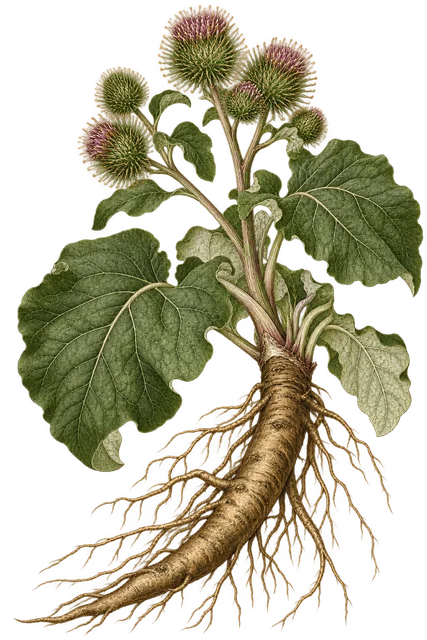
Arctium lappa L., greater burdock, in Asteraceae. Culinary/medicinal root, leaf and dry fruit sold as seed are distinct materials. This entry emphasizes root; related Arctium minus is a separate species. Root contains inulin-type fructans, caffeoylquinic/other phenolic acids, polyacetylenes and some lignans. Fruit is particularly associated with arctiin and arctigenin; leaf chemistry differs. Dry-root constituent percentages cannot be used as fresh cooked-food nutrient amounts.
EMA: Burdock root assessment report · USDA Agricultural Marketing Service: Burdock root (gobo) inspection instructions
Realistic food portion
USDA cooked, boiled, drained unsalted burdock root (FDC 170384): one-half cup of 1-inch pieces (62.5 g, about 63 g) supplies approximately 0.17 mg vitamin B6 (10% Daily Value), 24 mg magnesium (6%), 225 mg potassium (5%) and 1.1 g fibre (4%). It is not an especially rich vitamin-C or vitamin-A food. A strained root tea or tincture is not a vegetable serving. Database cup weights vary by food and processing: the raw-root record (169974) uses 118 g per cup, while the cooked record uses 125 g. Neither is a conversion to dry tea material.
USDA FoodData Central: Official SR Legacy downloadable composition and portion records · FDA: Daily Values on nutrition labels
Comparison with another cooked root
At the same 62.5 g cooked weight, unsalted boiled carrots (FDC 170394) provide about 0.096 mg B6, 6 mg magnesium and 1.9 g fibre, with about 533 micrograms RAE vitamin A; burdock has essentially no vitamin A in the record. Burdock supplies more B6 and magnesium in this comparison, while carrots supply more fibre and far more provitamin-A carotenoids.
USDA FoodData Central: Official SR Legacy downloadable composition and portion records
Uses in brief

- Food: cooked gobo root in vegetable dishes.
- Traditional root use: appetite, minor urinary and seborrhoeic skin complaints; clinical confirmation is limited.
History, folklore and reported uses
From wayside plant to kitchen and cupboard
Burdock has lived two very different public lives: an awkward burr-bearing wayside plant and a deliberately cultivated food. In Japan, its root is familiar as gobō. The same Arctium lappa appears in European herbal records, where root preparations became associated with appetite, urinary complaints and troublesome skin. Seen together, these traditions make burdock less an exotic cure-all than a plant that different communities learned to value in different ways: one through the meal, another through the medicinal cupboard.
EMA: Burdock root assessment report · Kew Medicinal Plant Names Services: Gobō identifies Arctium lappa
Burrs and the invention of hook-and-loop
Burdock burrs also gave rise to a famous invention. Velcro Companies dates the spark to 1941, when Swiss engineer George de Mestral noticed burrs attached to his clothes and his dog’s coat after a hunting trip. Under a microscope he saw the hooks that held them fast, and spent years turning that structure into a reusable hook-and-loop fastener. The company’s account names burdock without fixing the species. An irritating hitchhiker had become an engineering model: another way of seeing value in the same plant group that fed kitchens and supplied herbalists.
Velcro Companies: How George de Mestral invented the VELCRO Brand fastener
Species and the European root standard
This card focuses on greater burdock, Arctium lappa. The 2010 European root monograph’s material definition also permits roots of A. minus, A. tomentosum and related species or hybrids. That pharmacopoeial definition does not make the species identical or extend root evidence to their leaves, fruit or oils.
Troublesome skin and seborrhoea
European herbalists used burdock-root decoctions, powders and extracts for seborrhoeic skin complaints, acne and other eruptions. EMA also records external root-decoction washes in the historical literature.
Temporary appetite loss
The European root tradition includes bitter root teas and specified root extracts for a temporary lack of appetite. EMA preserves this as a distinct use alongside skin and urinary remedies.
Urinary flushing
Burdock-root teas and extracts were used in European herbal medicine to increase urine flow in minor urinary complaints. The root supplied both water-based drinks and concentrated pharmacy preparations.
Rheumatic and gouty complaints
British and continental herbal books cited by EMA describe root infusions, decoctions and tinctures for rheumatic complaints; French herbal literature also records a root decoction for gout.
Chinese throat and wind-heat remedies
In Chinese medicine, niu bang zi is the dried ripe fruit of Arctium lappa, rather than its root. Hong Kong’s official materia-medica guide records its use to disperse wind-heat and soothe the throat.
Hong Kong Department of Health: Fructus Arctii, identity and Chinese medicinal actions
Gobo as a root vegetable
Purdue Extension identifies Arctium lappa roots as edible vegetables valued for their crisp texture. Japan’s agriculture ministry recognizes fragrant Mito Gobo from Yamaguchi as a regional vegetable, documenting a food role separate from medicinal root preparations or Chinese niu bang zi fruit.
Purdue Extension: Chinese Vegetables, Arctium lappa · Japan MAFF: Mito Gobo, geographical-indication registration40
Leaf practices are a separate history
EMA’s historical review describes fresh-leaf poultices for rheumatic pain, leaf gargles for mouth and throat complaints, and external applications for skin complaints. It did not establish a European leaf monograph. These records concern leaves, not the cooked root or the oral root preparations covered by its monograph.
Culinary and medicinal preparation
Buy correctly identified food-grade gobo. Wash the root, trim and slice it, then cook it in a vegetable dish; a Japanese agriculture-ministry recipe peels and cuts gobo into short thin strips before cooking it with rice. For the quoted USDA portion, use boiled and drained root, not raw weight. For medicinal dried-root tea or tincture, follow the labeled product rather than substituting an assumed fresh-root equivalent. The edible-root route does not authorize consuming unidentified wild roots, seed products or cosmetic oil.
Japan Ministry of Agriculture: Vegetable rice with sliced gobo root · USDA Agricultural Marketing Service: Burdock root (gobo) inspection instructions · EMA: Final burdock root monograph
How the European evidence review developed
EMA’s 2020 review considered newer clinical and preclinical publications and concluded that the existing traditional-use monograph did not require revision. This preserves a distinction between long-standing medicinal practice and evidence sufficient for a well-established clinical indication. Individual human studies are discussed separately below.
EMA (2020): Addendum reviewing burdock root evidence through 2019
Identity & detailed reference
Identity
Arctium lappa L., greater burdock, in Asteraceae. Culinary/medicinal root, leaf and dry fruit sold as seed are distinct materials. This entry emphasizes root; related Arctium minus is a separate species.
Ingredient details, preparation and research
Also known as: Burdock root; Gobo; Gobō
Source plant or material
Arctium lappa L.; the root is the main material in this entry. Check species and plant part on the label.
Plant family / material: Asteraceae (Compositae), the daisy family.
Forms and route
Culinary gobo root; oral dried-root infusion/decoction, powder, tincture and extracts. Fruit/seed products (including Niu Bang Zi), leaf preparations, cosmetic extracts and infused oils are separate products; neither skin use nor an oil inherits root-food nutrition.
Vitamins and minerals
USDA cooked, boiled, drained unsalted burdock root (FDC 170384): one-half cup of 1-inch pieces (62.5 g, about 63 g) supplies approximately 0.17 mg vitamin B6 (10% Daily Value), 24 mg magnesium (6%), 225 mg potassium (5%) and 1.1 g fibre (4%). It is not an especially rich vitamin-C or vitamin-A food. A strained root tea or tincture is not a vegetable serving.
Absorption and preparation
Human pharmacokinetics of traditional burdock root tea and tincture are poorly characterized. Laboratory or animal metabolism of isolated arctiin/arctigenin does not establish absorption, dose equivalence or benefit of cooked gobo. No reliable fat-pairing, fasting rule or fresh-to-dried medicinal conversion is established.
Practical preparation
Buy correctly identified food-grade gobo. Wash the root, trim and slice it, then cook it in a vegetable dish; a Japanese agriculture-ministry recipe peels and cuts gobo into short thin strips before cooking it with rice. For the quoted USDA portion, use boiled and drained root, not raw weight. For medicinal dried-root tea or tincture, follow the labeled product rather than substituting an assumed fresh-root equivalent.
Combination notes
A burdock-and-dandelion drink is not a standardized medicinal combination. Combining urinary herbs or full separate product amounts has no established advantage and can complicate medicine review. Evidence about multi-herb cancer teas cannot be attributed to burdock root alone.
Traditional and reported uses
- Food: gobo root is an established Asian vegetable.
- Traditional European root use: temporary appetite loss, minor urinary complaints and seborrhoeic skin complaints.
- Historical Western descriptions such as alterative or blood purifier are traditional language, not evidence of detoxification. A small root-tea trial measured inflammatory biomarkers in knee osteoarthritis.
Contraindications and cautions
- Avoid known burdock/Asteraceae allergy. Rare severe allergic reactions have been reported, including after cooked root.
- For medicinal urinary use, EMA advises against concurrent synthetic diuretics. Fluid-restricted people or those with significant heart/kidney disease should not self-prescribe urinary-flushing remedies.
- EMA reports no established interactions. Glucose-lowering findings are mostly preclinical or from other preparations; do not call ordinary cooked gobo a proven diabetes-drug interaction. Review concentrated products when using diabetes medicines.
- Medicinal use in pregnancy, breastfeeding and under 18 is not recommended because safety data are insufficient. Claims that burdock reliably stimulates the uterus are not established by the EMA evidence review.
- Use correctly identified, quality-controlled material. Historical atropine poisoning involved contaminated tea, not atropine naturally occurring in burdock. Fever, dysuria, blood in urine or persistent/worsening symptoms needs assessment.
Similar items and how they compare
- Dandelion root
Another Asteraceae root containing inulin and phenolic compounds, with overlapping traditional appetite and urinary uses.
It has a different constituent profile and biliary-disease precautions; its root and leaf also differ.
- Chicory root
Shares the Asteraceae family, inulin content and traditional digestive/appetite uses.
Roasted chicory and purified chicory inulin are different products; shared chemistry does not establish equivalent skin or urinary effects.
Food and attributed traditions
Gobo is an established root vegetable. EMA documents European medicinal-root use for temporary appetite loss, minor urinary complaints and seborrhoeic skin conditions. Older Western herbal texts call the root a blood purifier; this is historical terminology, not an observed removal of toxins. Fruit use in Chinese herbalism must be distinguished from the European root monograph.
Human root-tea trial
A randomized study of 36 people with knee osteoarthritis compared burdock root tea with hot water for 42 days while both groups received the same medicines. Some inflammatory/oxidative biomarkers improved. The small study does not establish disease modification, cartilage repair or a universal tea regimen; its findings concern the tested root tea, not capsules, fruit extracts or infused skin oil.
Laboratory findings and absorption
Antimicrobial, anti-inflammatory, glucose-related and other laboratory findings involve particular extracts, cells, animal models or isolated lignans. They do not establish a human infection, diabetes or cancer treatment. Human pharmacokinetics of traditional burdock root tea and tincture are poorly characterized. Laboratory or animal metabolism of isolated arctiin/arctigenin does not establish absorption, dose equivalence or benefit of cooked gobo. No reliable fat-pairing, fasting rule or fresh-to-dried medicinal conversion is established.
Medicine, renal and population cautions
The monograph lists no established interactions, yet separately advises against combining urinary-use preparations with synthetic diuretics. Do not use fluid-flushing remedies against a clinician's fluid restriction. A clinically important glucose-drug interaction from ordinary cooked root has not been demonstrated. Medicinal pregnancy, breastfeeding and under-18 use lacks adequate safety data; EMA found no supporting case reports or pharmacological studies for a confident uterine-stimulant claim.
Allergy and product identity
Burdock allergy can occur, including a rare severe reaction reported after cooked root. The historical commercial-tea poisoning was attributed to atropine contamination; the original author clarified that atropine is not naturally a burdock constituent. Reliable botanical identity and quality control therefore matter more than a claim that all natural root teas are harmless.
When self-care is insufficient
Fever, painful urination, spasms or blood in urine needs assessment. EMA advises assessment when appetite/urinary symptoms persist beyond two weeks or skin symptoms beyond four weeks, and sooner if worsening. These are referral limits in a traditional monograph, not proof of efficacy during that period.
Entry sources
- EMA: Burdock root assessment report
- USDA Agricultural Marketing Service: Burdock root (gobo) inspection instructions
- EMA: Final burdock root monograph
- Maghsoumi-Norouzabad et al. (2016; online 2014): Burdock root tea and inflammatory biomarkers in knee osteoarthritis
- USDA FoodData Central: Official SR Legacy downloadable composition and portion records
- FDA: Daily Values on nutrition labels
- Japan Ministry of Agriculture: Vegetable rice with sliced gobo root
- Bryson (1978): Clarification that atropine in burdock tea was contamination
- Purdue Extension: Chinese Vegetables, Arctium lappa
- Japan MAFF: Mito Gobo, geographical-indication registration40
Reference entry 82 · Recorded content review: 2026-10-05 · Review scope and dates