


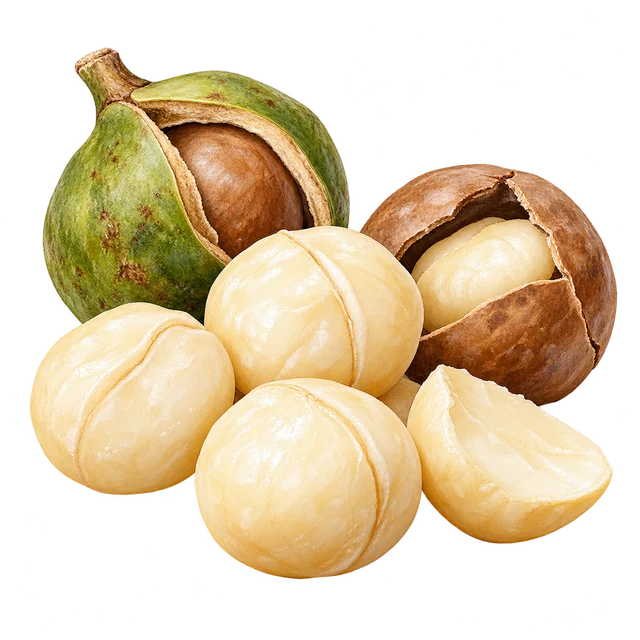
Key cautions
- Tree-nut allergy is a reason to avoid the relevant product and seek individualized advice.
- Whole nuts can be a choking hazard; do not use unidentified wild Macadamia seeds.
What’s inside
Kernels contain fat, protein and fibre; the oil fraction is characterized by monounsaturated fatty acids. Whole-nut solids do not all pass into pressed oil.
Uses in brief

- Whole-nut food
- Meal, paste and pieces
History, folklore and reported uses
History, folklore and traditional uses
Native to eastern Australia, macadamia has both Aboriginal food histories and a modern orchard industry. Historical names and accounts should remain community-specific rather than implying identical terminology across the continent.
Traditional, historical and reported uses
- Whole-nut food
Food or household practiceWhy this label?
Sources document this named food or material use; no therapeutic outcome is claimed.
Commercial edible kernels are eaten as nuts and used in food products; the crop’s edible species are distinguished in the technical guide.
- Meal, paste and pieces
Food or household practiceWhy this label?
Sources document this named food or material use; no therapeutic outcome is claimed.
The industry supplies meal, paste and pieces for baking and food manufacture, enabling uses different from intact kernels without creating a new plant identity.
2 narrowly supported uses; no clinical efficacy or universal preparation is inferred.
Historical-use additions reviewed 2026-10-09
Regional reading paths
These sourced notes describe cultivation, trade, food traditions or material history. A regional connection does not claim exclusive origin.
Australia & Oceania
native and cultivated; Australia, Queensland and New South Wales
Edible kernels and baking ingredient.
Identity & detailed reference
Identity
Edible Macadamia integrifolia and M. tetraphylla kernels and their commercial hybrids; other Macadamia species are excluded.
Ingredient details, preparation and research
Source plant or material
Edible Macadamia integrifolia and M. tetraphylla kernels and their commercial hybrids; other Macadamia species are excluded.
Plant family / material: Proteaceae
Forms and route
Whole kernels, pieces, meal, paste and food products; extracted oil has its own separate card.
Vitamins and minerals
Use an actual food label for a serving. No universal nutrient percentage is assigned across roasted, salted, coated or mixed products.
Absorption and preparation
Grinding changes texture and food structure but does not establish a treatment benefit. Oil lacks the whole kernel’s fibre and should not inherit its complete nutrition panel.
Practical preparation
Buy shelled food-grade kernels or properly packaged in-shell nuts. Store as labeled, protected from heat and oxidation. Choose an appropriate chopped or ground form for people at choking risk.
Traditional and reported uses
- Commercial edible kernels are eaten as nuts and used in food products; the crop’s edible species are distinguished in the technical guide.
- The industry supplies meal, paste and pieces for baking and food manufacture, enabling uses different from intact kernels without creating a new plant identity.
Contraindications and cautions
- Tree-nut allergy is a reason to avoid the relevant product and seek individualized advice.
- Whole nuts can be a choking hazard; do not use unidentified wild Macadamia seeds.
Species is a safety boundary
The technical guide distinguishes four Macadamia species and identifies the two commercial edible species. A genus-level label or resemblance to a macadamia shell is not sufficient to choose wild nuts for food.
Whole nut versus oil
The kernel and its pressed oil belong in related-form navigation, but their food composition should remain separate. Added salt or chocolate also belongs to the finished product rather than the raw-kernel reference.
Evidence limits
This is a food/material reference, not evidence of disease treatment. Geographic and customary-use records do not establish a medicinal dose. Nutrient quantities are omitted unless a matching food form and serving have been verified.
Entry sources
- Australian Macadamia Society: Technical Guidelines
- Australian Macadamia Society: Facts and figures
- Australian Macadamias: History and industry
Reference entry 486 · Recorded content review: 2026-10-09 · Review scope and dates