


Key cautions
- Do not replace fertility, menopause, thyroid or other medical care with maca.
- Concentrated supplements require separate assessment; pregnancy, breastfeeding and medication use warrant professional advice before medicinal use.
What’s inside
Carbohydrates and other food constituents, with glucosinolates and maca-specific compounds examined in research; processing changes the material.
Uses in brief

- Toasted flour
- Gelatinized food ingredient
History, folklore and reported uses
History, folklore and traditional uses
Maca is included in INIA’s Peruvian native-crop conservation work. Keeping its food history visible helps separate a highland agricultural crop from broad modern supplement promises.
Traditional, historical and reported uses
- Toasted flour
Food or household practiceWhy this label?
Source documents this specific material, culinary use or attributed practice; no clinical efficacy is inferred.
Peru’s agriculture ministry documents toasted maca flour as a marketed food derivative. It can enter food preparations according to the product’s instructions.
- Gelatinized food ingredient
Food or household practiceWhy this label?
Source documents this specific material, culinary use or attributed practice; no clinical efficacy is inferred.
The same official crop account distinguishes gelatinized flour from dried maca. This form distinction is useful when comparing products and deciding whether further cooking is required.
2 bounded uses; regional records do not establish treatment effects.
Historical-use additions reviewed 2026-10-09
Women’s Health: traditions, evidence and cautions
Historical use does not establish benefit or safety. Pregnancy, breastfeeding and fertility care require particular caution: food, tea, essential oil and concentrated extract are not interchangeable. These records are not treatment, dosing or pregnancy-management instructions. Discuss supplements with a qualified clinician or pharmacist; do not delay evaluation of persistent symptoms.
Maca
Lepidium meyenii Walp.; commercial materials may be labelled L. peruvianum
- Plant part / material
- Swollen hypocotyl/root
- Preparation studied or reported
- Traditional cooked food; dried food material; supplements assessed separately
Peruvian highland food traditions associate maca with strength and fertility. Its traditional cooked-food use should be distinguished from modern concentrated supplements and global hormone-balancing marketing.
fertility and menopause
historical tradition; limited clinical research for different endpoints
Reported or traditional useHistorically valued as a fertility-associated food and tonic.
What the evidence supportsSmall modern studies concern sexual function or menopausal symptoms; they do not establish improved conception or live-birth rates in women.
MSK advises pregnant or breastfeeding people to discuss maca with their clinician because it may be unsafe; it also flags hormone-sensitive cancer and testosterone-test interference.
- Do not describe maca as a proven female fertility enhancer or a way to balance reproductive hormones.
Health topics: evidence and cautions
These notes describe a specific research context and preparation. A topic link is not a treatment recommendation.
Male fertility & sperm health · Support during care
Form and route: Gelatinized maca powder in capsules; yellow maca specified in the 2021 trial · oral
Condition and setting: Semen quality in men with infertility
Small placebo-controlled trials give mixed results. One found higher sperm concentration; another did not establish a semen benefit. Improved pregnancy or live birth is unproven.
Evidence: Mixed, low-certainty clinical evidence
2020: 69 men randomized, 2 g/day for 12 weeks. 2021: 50 randomized, yellow maca 2.8 g/day for 16 weeks.
Limits
Small samples, short follow-up and attrition. The positive trial found no benefit in motility, morphology or volume. Four incidental partner pregnancies in the other trial do not establish efficacy.
Cautions
- One trial reported no adverse effects; the other had two withdrawals for possible adverse events, with causality uncertain. Small trials cannot establish long-term safety.
Regional reading paths
These sourced notes describe cultivation, trade, food traditions or material history. A regional connection does not claim exclusive origin.
South America
native and cultivated; Peru
Processed hypocotyl/root food, not a hormone treatment.
Identity & detailed reference
Identity
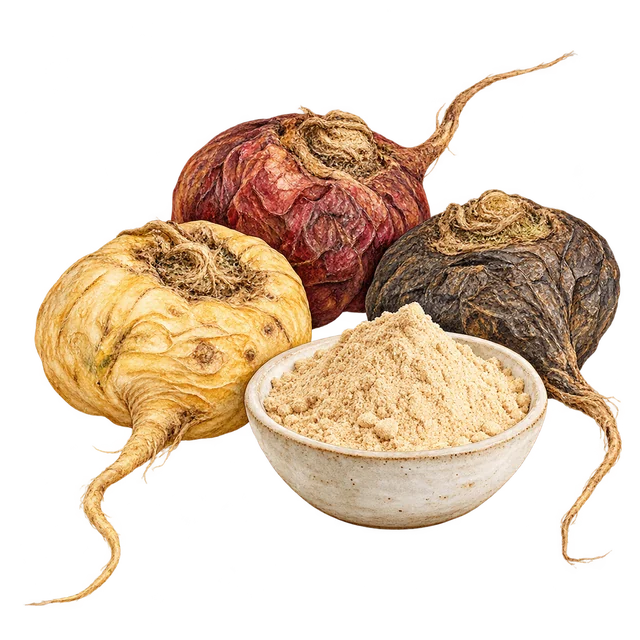
Lepidium meyenii; the harvested swollen hypocotyl/root food of Lepidium meyenii; product taxonomy and preparation must be identified, including labels using L. peruvianum.
Ingredient details, preparation and research
Also known as: Lepidium meyenii
Source plant or material
Lepidium meyenii
Plant family / material: Brassicaceae
Forms and route
Dried food material, toasted flour and gelatinized flour; capsules and standardized extracts are not equivalent food forms.
Vitamins and minerals
Powder, cooked food and extract have different concentrations. No fixed mineral content or hormone-related nutritional benefit is assigned here.
Absorption and preparation
Gelatinized describes processing of starch, not an established increase in every compound’s absorption. Extract-trial results cannot be transferred to flour.
Practical preparation
Choose a traceable food product and follow its cooking or mixing instructions. Check whether a powder is ready to eat or requires preparation.
Traditional and reported uses
- Toasted flour
- Gelatinized food ingredient
Contraindications and cautions
- Do not replace fertility, menopause, thyroid or other medical care with maca.
- Concentrated supplements require separate assessment; pregnancy, breastfeeding and medication use warrant professional advice before medicinal use.
A trial is not a universal food claim
A randomized trial studied specified red and black maca extracts in adults. Its preparation and population are narrower than all maca products; this card does not adopt a treatment dose or promise hormone, sexual or cognitive benefits.
Evidence limits
This is a food-form review, not a treatment recommendation. Composition and laboratory findings apply to the material actually studied; no medicinal dose, universal nutrient ranking or preservation guarantee is inferred.
Entry sources
- INIA: Los cultivos nativos en las comunidades del Perú
- MIDAGRI: Producción y consumo de maca peruana
- Randomized trial of red and black maca extracts in adults
Reference entry 454 · Recorded content review: 2026-10-09 · Review scope and dates