


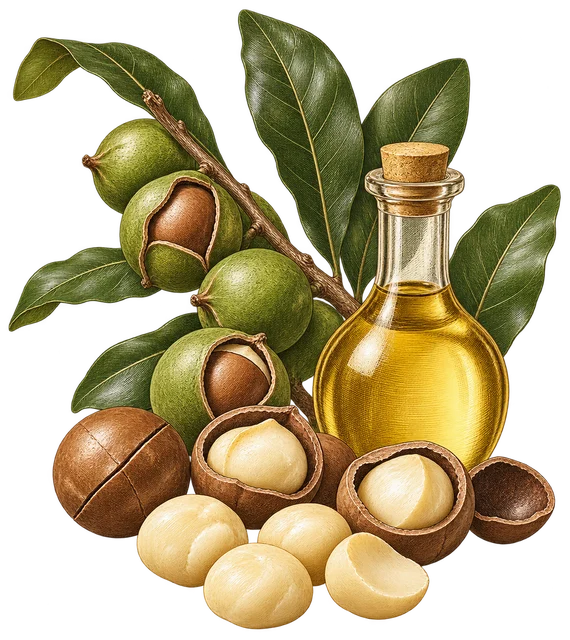
Key cautions
- Avoid with macadamia allergy unless specifically cleared by an allergy clinician.
- Cosmetic oil is not food; oil studies and whole-nut studies are different evidence.
- Avoid macadamia oil with a known macadamia allergy unless an allergy clinician confirms the particular product is suitable. Refining generally reduces allergenic protein, but evidence about refined peanut or soya oil is not a guarantee for macadamia oil. A home skin test cannot override a known allergy.
- Eat only a food-labeled oil. Cosmetic carriers, fragranced massage oils and hair products are not interchangeable with culinary oil. Stop topical use if irritation develops, and follow the complete product’s directions.
- Keep oil tightly closed and away from heat and light; follow its labeled storage and cooking directions rather than relying on a universal smoke point. A silky hair finish does not establish permanent repair or protection from heated styling tools.
What’s inside
Most of this ingredient is triglyceride fat, with a prominent monounsaturated fraction. Kernel fiber, protein and mineral values are not an oil nutrition panel. Use the food bottle’s own serving and nutrition information.
Shuai et al. (2021): Composition of oils from 15 macadamia cultivars · NSW DPIRD: Macadamia culture in NSW
Fatty acids and minor constituents
In 15 M. integrifolia cultivars, oleic acid was approximately 62–66% and palmitoleic acid 13–18% of measured fatty acids. The study also measured phytosterols, squalene and phenolics. Laboratory radical-scavenging results describe sample chemistry, not demonstrated prevention of cancer or skin aging in people.
Shuai et al. (2021): Composition of oils from 15 macadamia cultivars
What those composition samples represent
The 2021 cultivar comparison used oil extracted from dried-kernel slurry with n-hexane at 50 °C for four hours, then evaporated the solvent. Its percentages describe individual fatty acids within total measured fatty acids, not grams per 100 g of whole nuts. These laboratory samples do not establish the composition of every cold-pressed or refined retail oil.
Shuai et al. (2021): Composition of oils from 15 macadamia cultivars
Vitamin-E interpretation and practical food use
The 15-cultivar study detected alpha-tocotrienol, with alpha-tocopherol not identified in those samples. NIH bases human vitamin E requirements on alpha-tocopherol. A total “vitamin E compounds” figure therefore cannot be converted directly to a Daily Value. No verified generic household portion is assigned here; use the food product’s own mass or volume serving.
Shuai et al. (2021): Composition of oils from 15 macadamia cultivars · NIH ODS: Vitamin E, health professional fact sheet
Uses in brief

- Food: nutty dressings and finishing, or labeled cooking use.
- Cosmetics: softness and lubrication for skin and hair.
History, folklore and reported uses
First Nations food and material skill
Macadamia’s human story begins in the rainforests of eastern Australia, before the nut became associated internationally with Hawaiian plantations. First Nations communities within its southeastern Queensland and northern New South Wales range harvested and traded the nuts. Wild Macadamia Conservation documents nut-cracking stones and the diversity of names used across this country; the Australian Museum has also investigated the traces that cracking hard shells can leave on stone tools. A photograph preserved by the conservation group shows a Gubbi Gubbi man with nut-cracking stones, placing the material skill within a named community’s history.
Wild Macadamia Conservation: History · Australian Museum: Stone hatchets as nut-cracking tools
From rainforest food to orchard ingredient
In the twentieth century, Hawaiian growers and experiment stations helped turn selected Australian trees into an international orchard crop. Pressed kernel oil belongs to that expanding food and ingredient economy. Its nutty culinary role and its use as a cosmetic softener offer a modern continuation of the kernel’s richness. The older gathering tradition belongs to the food itself; the bottle adds a later chapter to the uses of that oil-rich kernel.
Wild Macadamia Conservation: History · Mountain Rose Herbs: Macadamia Nut Oil · COSMILE Europe: Macadamia integrifolia seed oil
Reading cold-pressed, refined and cosmetic labels
Cold-pressed describes extraction, whereas refined describes further processing. For example, the Hallstar product described by Glenn is cold-pressed and then fully refined to a lighter color and milder odor; it is presented as a cosmetic ingredient. Mountain Rose Herbs describes a separate cold-pressed, unrefined product for both food and cosmetic use. Neither example certifies another bottle’s route or composition.
Glenn: Biochemica Macadamia Oil Refined, Hallstar product description · Mountain Rose Herbs: Macadamia Nut Oil
A facial and body softener
Modern supplier House of Macadamias describes pressed kernel oil in facial and body care for dry or mature skin, including rough hands and cuticles. This is a contemporary oil application rather than a claim about First Nations nut-gathering customs.
Hair shine and frizz control
The same supplier promotes macadamia oil for softening coarse or dry hair and giving it shine. The preparation is the kernel oil used on hair lengths or in conditioning products.
Massage and aromatic body care
AromaWeb favors macadamia oil’s texture and slip for massage, and reports a soothing or anti-inflammatory reputation. It is often combined with other carriers in modern aromatherapy.
Cleansing and makeup removal
House of Macadamias also describes the oil in cleansing routines intended to loosen oil-based makeup and surface buildup. This wash-off purpose differs from leaving an oil on as a moisturizer.
A nutty culinary oil
Mountain Rose Herbs identifies macadamia kernel oil for food as well as cosmetic use. Its nutty aroma gives the pressed oil a culinary role alongside the older tradition of eating the whole kernels.
Regional reading paths
These sourced notes describe cultivation, trade, food traditions or material history. A regional connection does not claim exclusive origin.
Australia & Oceania
cultivated; Australia
Pressed culinary oil.
Identity & detailed reference
Identity
Macadamia integrifolia Maiden & Betche kernel oil is a common identity; edible crops also include M. tetraphylla and hybrids. This is a fixed nut oil in Proteaceae; a cosmetic INCI name alone does not establish food suitability.
Ingredient details, preparation and research
Source plant or material
Kernels of commercially identified edible macadamias, commonly Macadamia integrifolia; M. tetraphylla and hybrids occur in the food crop.
Plant family / material: Proteaceae (protea family).
Forms and route
Food-labeled pressed or refined macadamia oil; cosmetic carrier oils, body products and conditioners. Some cosmetic labels use older Macadamia ternifolia nomenclature, which is not a safe guide for identifying edible wild nuts.
Vitamins and minerals
Primarily a concentrated dietary fat, not a dependable source of the fiber, protein, thiamin or manganese found in whole macadamias. In one 15-cultivar oil analysis, only alpha-tocotrienol was detected among the measured vitamin-E-family compounds; that is not equivalent to dietary alpha-tocopherol. Use a product’s actual nutrition label rather than assigning a generic vitamin-E amount or a borrowed oil’s tablespoon weight.
Absorption and preparation
Food-grade macadamia triglycerides undergo normal fat digestion and absorption. Palmitoleic acid content is not evidence of superior absorption or a metabolic treatment. Topical slip and softness do not measure how deeply an oil enters skin or hair.
Practical preparation
Try food-grade oil in a vinaigrette or over cooked vegetables, using its label for serving size and heating guidance. A refined product can be mild while an unrefined product retains more flavour. Neither processing word proves universal safety or better health effects. Keep tightly closed, away from heat and light.
Combination notes
Vegetable pairings are culinary choices. As meal fat, macadamia oil can participate in normal fat-soluble nutrient absorption, but an avocado-oil carotenoid trial is not a direct macadamia-oil trial. Adding it to a supplement or cosmetic blend does not establish enhanced absorption or therapeutic synergy.
Traditional and reported uses
- Food use as a nutty dressing or finishing oil, and for cooking where the manufacturer indicates suitability.
- Cosmetic skin conditioning and lubrication in body and hair products.
- Laboratory studies characterize its fatty acids and oxidation behaviour. These do not establish anti-aging, diabetes or hair-growth treatment benefits.
Contraindications and cautions
- Avoid with macadamia allergy unless an allergy clinician confirms suitability. Refining and a home skin test cannot overrule a known allergy.
- Use a food-labeled product for eating; cosmetic carriers and fragranced blends are not interchangeable with it.
- Stop topical use if irritation develops. A silky finish does not establish permanent hair repair or protection from heated styling tools.
- Follow storage and cooking directions; oil quality and heat history matter more than an unqualified smoke-point claim.
- Avoid macadamia oil with a known macadamia allergy unless an allergy clinician confirms the particular product is suitable. Refining generally reduces allergenic protein, but evidence about refined peanut or soya oil is not a guarantee for macadamia oil. A home skin test cannot override a known allergy.
- Eat only a food-labeled oil. Cosmetic carriers, fragranced massage oils and hair products are not interchangeable with culinary oil. Stop topical use if irritation develops, and follow the complete product’s directions.
- Keep oil tightly closed and away from heat and light; follow its labeled storage and cooking directions rather than relying on a universal smoke point. A silky hair finish does not establish permanent repair or protection from heated styling tools.
Similar items and how they compare
- Avocado oil
Both are oleic-rich and include palmitoleic acid; each has food and conditioning uses.
Avocado oil comes mainly from fruit flesh. Macadamia comes from nut kernels and generally has more palmitoleic acid.
- Olive oil
Both can be used as predominantly monounsaturated culinary oils.
Macadamia has a much more prominent palmitoleic fraction, and its health evidence should be assessed separately.
Identity and edible species
Kew places M. integrifolia in Proteaceae. NSW crop guidance also identifies M. tetraphylla and natural hybrids. Oil is extracted from the edible kernel. Older cosmetic naming is not botanical permission to eat an unidentified macadamia species; use a traceable food product.
Extraction and refining
Mechanical pressing and aqueous extraction have both been investigated. A 2017 comparison found different sterol and volatile profiles despite broadly similar fatty-acid and tocopherol results. A commercial cosmetic supplier also documents pressing followed by refining, illustrating that “pressed” and “refined” need not be mutually exclusive. These descriptions do not certify another manufacturer’s product.
Actual human evidence is narrower than marketing
A 1994 randomized crossover feeding study in 34 men with high cholesterol tested diets differing in palmitoleic, palmitic or oleic acid, using macadamia oil as a palmitoleic source. LDL cholesterol was higher on the palmitoleic-rich than the oleic-rich diet. This does not make an ordinary serving harmful; it does show that “omega-7” is not an automatic cholesterol-lowering guarantee.
Whole nuts are a separate intervention
A later crossover trial in 35 adults tested whole macadamia nuts for eight weeks, not isolated oil. It found no significant overall changes in body weight, glycemic measures or lipids. Whole nuts contribute a different food matrix, so neither their micronutrients nor their trial results should be transferred wholesale to the oil.
Cosmetic conditioning and route
COSMILE identifies macadamia seed oil as a skin-conditioning ingredient and notes its use in skin and hair care. Lubrication can make hair feel easier to handle; a carrier oil does not rebuild a damaged shaft or become a heat protectant merely because it coats hair. Follow the complete product’s directions.
Allergy and digestion
Nut allergy remains relevant to nut oils, including cosmetic products. Specialist guidance is preferable to assuming that refining removed every relevant protein. Edible oil is digested as fat; no fasting regimen, special partner herb or increased dose has been established here as necessary for benefit.
Entry sources
- COSMILE Europe: Macadamia integrifolia seed oil, cosmetic skin-conditioning function
- Anaphylaxis UK: Plant-based oils, refining and food allergy
- Nestel et al. (1994): Dietary palmitoleic, palmitic and oleic acids in 34 men
- Kew Plants of the World Online: Macadamia integrifolia Maiden & Betche
- NSW Department of Primary Industries: Macadamia culture, edible crop species and hybrids
- Shuai et al. (2021): Oil composition and laboratory antioxidant assays in 15 macadamia cultivars
- Shuai et al. (2017): Pressing versus aqueous extraction of macadamia oil
- Hallstar: Biochemica Macadamia Oil Refined, manufacturer description of pressing followed by refining
- Jones et al. (2023): Macadamia nut effects on cardiometabolic risk factors, whole-nut trial
- AOCS: Unrefined cold-pressed avocado oil, processing and composition
- NIDDK: Your digestive system and how it works
- NIH ODS: Vitamin E, alpha-tocopherol and dietary requirements
Reference entry 64 · Recorded content review: 2026-10-05 · Review scope and dates