


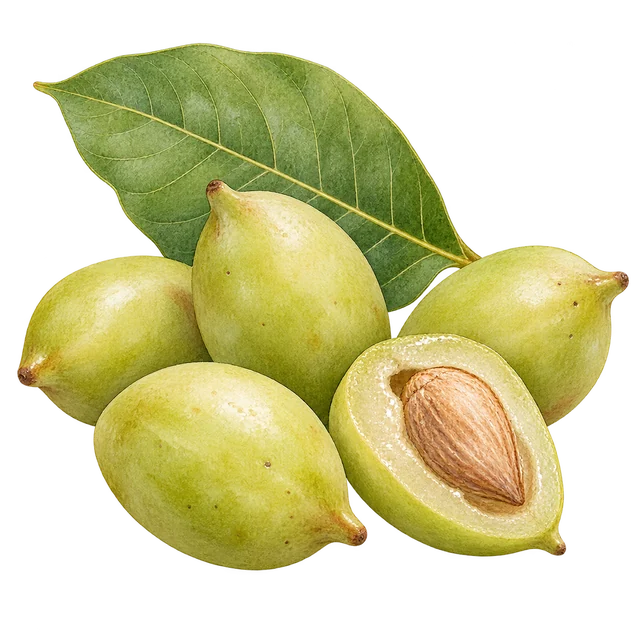
Key cautions
- Use identified food-grade fruit, not an ornamental or wild lookalike.
- Keep prepared foods under the storage conditions specified by the maker; a traditional ingredient does not make an unvalidated preserve shelf-stable.
What’s inside
Fruit carbohydrate, fibre, organic acids and vitamin C are relevant to food composition; their amounts depend on sample and processing.
Uses in brief

- Fruit food ingredient
- Processed food products
History, folklore and reported uses
History, folklore and traditional uses
This northern Australian native fruit is part of regional food economies. Procurement should identify origin and support knowledge holders rather than attach unverified pan-Aboriginal stories to a commercial ingredient.
Traditional, historical and reported uses
- Fruit food ingredient
Food or household practiceWhy this label?
Sources document this named food or material use; no therapeutic outcome is claimed.
Kakadu plum is included in AgriFutures’ native-food crop series and government forest-product reporting. Its edible fruit is the scope here, not bark or leaves.
- Processed food products
Food or household practiceWhy this label?
Sources document this named food or material use; no therapeutic outcome is claimed.
Food-grade pulp and fruit ingredients supply value-added foods; the product’s actual ingredient list determines how much fruit is present. A cosmetic extract is a separate material.
2 narrowly supported uses; no clinical efficacy or universal preparation is inferred.
Historical-use additions reviewed 2026-10-09
Regional reading paths
These sourced notes describe cultivation, trade, food traditions or material history. A regional connection does not claim exclusive origin.
Australia & Oceania
native; northern Australia
Fruit and prepared food ingredient.
Identity & detailed reference
Identity
Terminalia ferdinandiana; Kakadu-plum fruit, not a Prunus plum or an unspecified Terminalia extract.
Ingredient details, preparation and research
Source plant or material
Terminalia ferdinandiana; Kakadu-plum fruit, not a Prunus plum or an unspecified Terminalia extract.
Plant family / material: Combretaceae
Forms and route
Food-grade fresh/frozen pulp, dried fruit ingredients and formulated foods.
Vitamins and minerals
No headline vitamin-C multiple or supplement-equivalent dose is assigned. Heating, storage and concentration mean fresh fruit and powder cannot share a generic serving claim.
Absorption and preparation
Cooking, drying, straining and added ingredients change the food that is actually eaten. No special medicinal absorption claim or extract-to-food conversion is established.
Practical preparation
Use authenticated commercial food ingredients according to the label. A strong sour taste is not a safety test; powders and extracts need their own product specifications.
Traditional and reported uses
- Kakadu plum is included in AgriFutures’ native-food crop series and government forest-product reporting. Its edible fruit is the scope here, not bark or leaves.
- Food-grade pulp and fruit ingredients supply value-added foods; the product’s actual ingredient list determines how much fruit is present. A cosmetic extract is a separate material.
Contraindications and cautions
- Use identified food-grade fruit, not an ornamental or wild lookalike.
- Keep prepared foods under the storage conditions specified by the maker; a traditional ingredient does not make an unvalidated preserve shelf-stable.
Avoid superfood arithmetic
A food-composition reference is not a disease-prevention trial. Even when an ingredient contains vitamin C, an unspecified spoonful of powder cannot be equated with a supplement dose or with a fixed amount of fresh fruit.
Keep the plant part visible
The fruit identity matters because the same species may also be discussed in non-food research. Findings from leaf, bark or solvent extracts must not be attached to the edible pulp without matching preparation evidence.
Evidence limits
This is a food/material reference, not evidence of disease treatment. Geographic and customary-use records do not establish a medicinal dose. Nutrient quantities are omitted unless a matching food form and serving have been verified.
Entry sources
- AgriFutures: Focus on Kakadu Plum
- DAFF: Australian native foods
- DAFF: Australian fruit, nut and vegetable composition cards
Reference entry 480 · Recorded content review: 2026-10-09 · Review scope and dates