


Key cautions
- Use authenticated food-grade material; this is not a guide to digging up and eating unknown underground fungi.
What’s inside
Species-specific research has isolated polysaccharide fractions from K. pfeilii. The tested extracts and laboratory assays do not establish a standardized medicinal composition or a therapeutic food dose.
Uses in brief

- Culinary food traditions
- Seasonal food and roadside sale
History, folklore and reported uses
History, folklore and traditional uses
Kalahari truffles connect rain, local environmental knowledge and seasonal food gathering. Ethnomycological research records food traditions among San and Khoekhoe communities while also showing variation in names and preparation. Those histories should not be collapsed into a single language or one uniform custom.
Boiled, roasted, ash-baked and fried preparations appear in the record, alongside roadside sale. Their commercial value is inseparable from the knowledge of people who gather and use them. This desert truffle is Kalaharituber pfeilii, not the European Tuber species famous for restaurant aroma.
Kalahari truffles also appear in stories about rain. Trappe and colleagues’ 2008 account reports a tradition describing them as eggs of a lightning bird because they appear after thunderstorms. The source uses the broad label “Khoisan” rather than securely identifying a particular community for this story, so it is best understood as attributed regional folklore, not a universal belief or a biological explanation.
A closer look at its history
Rain knowledge and a shared harvest
Trappe and colleagues document San/Khoisan truffle knowledge in the Kalahari, including attention to rainfall and soil changes. The study connects household food with commercial harvest and concerns about livestock pressure. Those observations are dated to the research period and should not be recast as a current claim about every community.
A surprising plant partnership
The Australian National Botanic Gardens account reports molecular evidence linking K. pfeilii with roots of tsamma, the wild watermelon relative. It is a striking ecological relationship, but proximity to a melon plant is not an identification rule.
Additional history reviewed 2026-10-09
Traditional, historical and reported uses
- Culinary food traditions
Food or household practiceWhy this label?
The claim documents culinary food traditions as a culinary, craft, gardening, or practical material use; it reports neither a treatment outcome nor measured nutrient content.
Ethnomycological accounts describe boiling Kalahari truffles as a food preparation. Roasting or baking in ashes is another documented food practice. Frying also appears in documented accounts of Kalahari truffle use.
- Seasonal food and roadside sale
Food or household practiceWhy this label?
The claim documents seasonal food and roadside sale as a culinary, craft, gardening, or practical material use; it reports neither a treatment outcome nor measured nutrient content.
Rain-dependent gathering contributes household food and saleable seasonal produce.
Two established practical roles are documented: food, with several recorded cooking methods, and seasonal livelihood through gathering and sale. Rain-related folklore enriches the heritage story without being counted as another practical use.
Story sources
- Trappe et al. 2008: Desert truffles of the African Kalahari
- Author-hosted text of Kalahari ethnomycology study
- Trappe et al. 2010: Comparative taxonomy of desert truffles
- US Department of Energy Joint Genome Institute: Kalaharituber pfeilii
- University of Namibia: Extraction, purification, characterization and bioactivities of polysaccharides isolated from selected Namibian mushrooms
Features and lookalikes to study
Kalaharituber pfeilii; formerly Terfezia pfeilii. Distinct from European Tuber and Middle Eastern Terfezia/Tirmania.
Common names vary between regions and suppliers; the scientific scope above governs this card.
Morphology described in sources
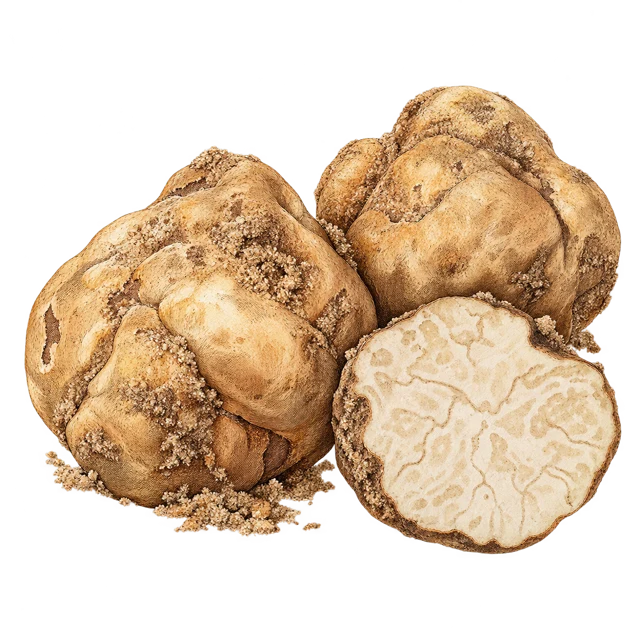
- Kalaharituber pfeilii is a southern African desert-truffle species, not a European Tuber. The rounded underground fruiting body needs mature internal anatomy and microscopic spore characters for scientific identification.
- Habitat and substrate
- See the source-linked morphology and comparison notes below; a separate habitat summary has not been verified for this card.
- Geographic scope
- A complete regional range is not established here. Broad common names and commercial labels can span different species.
- Season in the cited region
- No region-specific fruiting season has been verified for this card. Do not infer a local season from trade availability.
Eremiomyces echinulatus and Mattirolomyces austroafricanus
Regional taxonomic work distinguishes these other southern African underground fungi from Kalaharituber using anatomy, spores and molecular relationships.
The shared desert-truffle body plan is convergent and broad external resemblance is insufficient; this card does not assign edibility to the comparison species.
Scleroderma earthballs
Poisonous earthballs are a documented source of mistaken “truffles.”
This is a general hazard of naming an underground round fungus a truffle, not a claim about the frequency of a particular Scleroderma in the Kalahari. Mature and immature interiors differ; obtain local expert identification.
Limits and regional differences
- A soil crack, nearby plant, season after rain or local trade name cannot authenticate the species. Specialists may need mature spores and DNA.
- Educational comparison only. Neither this card, an illustration, a photograph, a spore-print colour nor a checklist establishes that a wild collection is safe to eat. A qualified local mycologist must assess uncertain material; do not taste an unknown fungus. Cooking does not reliably eliminate mushroom toxins.
- Trappe, Kovacs and Claridge 2010: Comparative taxonomy of desert truffles
- Trappe et al. 2008: Desert truffles of the African Kalahari
- Australian National Botanic Gardens: Desert truffles, Australia and Kalahari
- Missouri Department of Conservation: Common earthball
- NAMA: Mushroom poisoning in North America, 2015–2016
- NC Poison Control: Mushrooms
Regional reading paths
These sourced notes describe cultivation, trade, food traditions or material history. A regional connection does not claim exclusive origin.
Africa
Native/traditional food: Kalahari region of Botswana, Namibia and South Africa.
Recognized desert-truffle food; no harvesting or identification instructions.
Identity & detailed reference
Identity
Kalaharituber pfeilii; formerly Terfezia pfeilii. Distinct from European Tuber and Middle Eastern Terfezia/Tirmania.
Ingredient details, preparation and research
Also known as: Kalahari truffle; Terfezia pfeilii
Source plant or material
Underground fruiting bodies of K. pfeilii, a southern African desert truffle distinct from European Tuber species.
Fungal family: Pezizaceae
Forms and route
Fresh seasonal food for boiling, roasting, ash baking or frying in documented traditions.
Vitamins and minerals
A regional food, but no universal nutrient figures are assigned. Extract carbohydrate measurements are not nutritional values for a household serving.
Absorption and preparation
Documented preparation includes boiling, roasting, baking in ashes and frying. These are culinary traditions, not techniques for identifying unknown underground fungi or increasing medicinal absorption.
Traditional and reported uses
- Culinary food traditions: Ethnomycological accounts describe boiling Kalahari truffles as a food preparation. Roasting or baking in ashes is another documented food practice. Frying also appears in documented accounts of Kalahari truffle use.
- Seasonal food and roadside sale: Rain-dependent gathering contributes household food and saleable seasonal produce.
Contraindications and cautions
- Use authenticated food-grade material; this is not a guide to digging up and eating unknown underground fungi.
Similar items and how they compare
- European culinary truffles
Both have truffle food histories and depend on particular landscapes.
European culinary truffles are Tuber species; Kalahari truffle is Kalaharituber pfeilii in another family.
- Australian desert truffles
Both connect desert fungi, rain and local food knowledge.
Kalahari truffle here is one named African species; Australian desert truffles are a regional multi-species group.
Fungus, family and material
Kalaharituber pfeilii (formerly Terfezia pfeilii). Pezizaceae. Underground fruiting bodies of K. pfeilii, a southern African desert truffle distinct from European Tuber species.
- Trappe et al. 2008: Desert truffles of the African Kalahari
- Author-hosted text of Kalahari ethnomycology study
- Trappe et al. 2010: Comparative taxonomy of desert truffles
- US Department of Energy Joint Genome Institute: Kalaharituber pfeilii
- University of Namibia: Extraction, purification, characterization and bioactivities of polysaccharides isolated from selected Namibian mushrooms
Preparation and evidence
Documented preparation includes boiling, roasting, baking in ashes and frying. These are culinary traditions, not techniques for identifying unknown underground fungi or increasing medicinal absorption.
- Trappe et al. 2008: Desert truffles of the African Kalahari
- Author-hosted text of Kalahari ethnomycology study
- Trappe et al. 2010: Comparative taxonomy of desert truffles
- US Department of Energy Joint Genome Institute: Kalaharituber pfeilii
- University of Namibia: Extraction, purification, characterization and bioactivities of polysaccharides isolated from selected Namibian mushrooms
Constituents and nutrition
Species-specific research has isolated polysaccharide fractions from K. pfeilii. The tested extracts and laboratory assays do not establish a standardized medicinal composition or a therapeutic food dose. A regional food, but no universal nutrient figures are assigned. Extract carbohydrate measurements are not nutritional values for a household serving.
- Trappe et al. 2008: Desert truffles of the African Kalahari
- Author-hosted text of Kalahari ethnomycology study
- Trappe et al. 2010: Comparative taxonomy of desert truffles
- US Department of Energy Joint Genome Institute: Kalaharituber pfeilii
- University of Namibia: Extraction, purification, characterization and bioactivities of polysaccharides isolated from selected Namibian mushrooms
History and documented uses
Kalahari truffles connect rain, local environmental knowledge and seasonal food gathering. Ethnomycological research records food traditions among San and Khoekhoe communities while also showing variation in names and preparation. Those histories should not be collapsed into a single language or one uniform custom. Boiled, roasted, ash-baked and fried preparations appear in the record, alongside roadside sale. Their commercial value is inseparable from the knowledge of people who gather and use them. This desert truffle is Kalaharituber pfeilii, not the European Tuber species famous for restaurant aroma.
- Trappe et al. 2008: Desert truffles of the African Kalahari
- Author-hosted text of Kalahari ethnomycology study
- Trappe et al. 2010: Comparative taxonomy of desert truffles
- US Department of Energy Joint Genome Institute: Kalaharituber pfeilii
- University of Namibia: Extraction, purification, characterization and bioactivities of polysaccharides isolated from selected Namibian mushrooms
Safety and interpretation
Use authenticated food-grade material; this is not a guide to digging up and eating unknown underground fungi. Aphrodisiac beliefs, where reported, lack clinical substantiation.
- Trappe et al. 2008: Desert truffles of the African Kalahari
- Author-hosted text of Kalahari ethnomycology study
- Trappe et al. 2010: Comparative taxonomy of desert truffles
- US Department of Energy Joint Genome Institute: Kalaharituber pfeilii
- University of Namibia: Extraction, purification, characterization and bioactivities of polysaccharides isolated from selected Namibian mushrooms
Entry sources
- Trappe et al. 2008: Desert truffles of the African Kalahari
- Author-hosted text of Kalahari ethnomycology study
- Trappe et al. 2010: Comparative taxonomy of desert truffles
- US Department of Energy Joint Genome Institute: Kalaharituber pfeilii
- University of Namibia: Extraction, purification, characterization and bioactivities of polysaccharides isolated from selected Namibian mushrooms
Reference entry 229 · Recorded content review: 2026-10-08 · Review scope and dates