


Key cautions
- Use authenticated food-grade leaves; do not consume ornamental or unidentified material.
- Do not swallow essential oil as a substitute for leaf seasoning.
What’s inside
Aromatic leaf contains a citral-rich volatile fraction; leaf solids and the separated essential oil have different concentrations.
Uses in brief

- Culinary aroma
- Leaf infusions
History, folklore and reported uses
History, folklore and traditional uses
This Queensland rainforest tree now supports an Australian native-food industry. Contemporary commercial use should not be presented as a single universal Aboriginal recipe or as proof that every historical claim is documented.
Traditional, historical and reported uses
- Culinary aroma
Food or household practiceWhy this label?
Sources document this named food or material use; no therapeutic outcome is claimed.
The dried or ground leaf supplies a strong lemon-like aroma in manufactured and household food. It provides flavour without being a citrus fruit.
- Leaf infusions
Food or household practiceWhy this label?
Sources document this named food or material use; no therapeutic outcome is claimed.
Lemon myrtle appears in food and beverage production as a leaf ingredient. The infusion belongs to the culinary leaf category, not concentrated aromatic distillates.
2 narrowly supported uses; no clinical efficacy or universal preparation is inferred.
Historical-use additions reviewed 2026-10-09
Regional reading paths
These sourced notes describe cultivation, trade, food traditions or material history. A regional connection does not claim exclusive origin.
Australia & Oceania
native; Australia, Queensland
Citrus-scented culinary leaf.
Identity & detailed reference
Identity
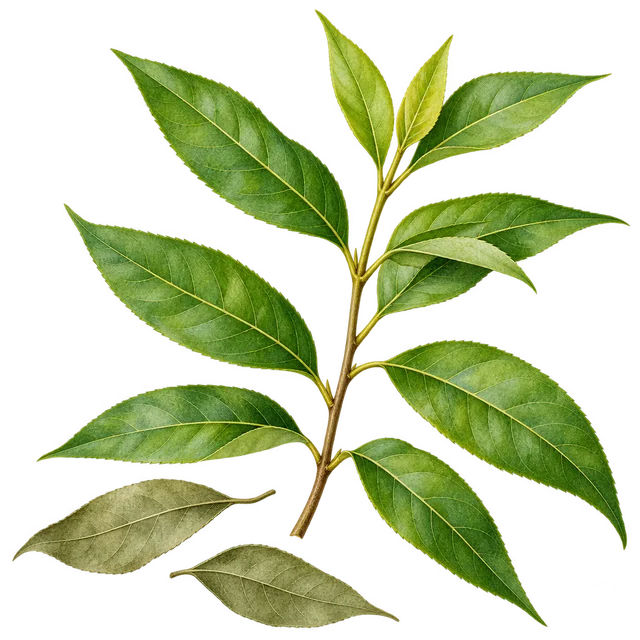
Backhousia citriodora; authenticated culinary leaves, not lemon fruit, common myrtle or distilled oil.
Ingredient details, preparation and research
Source plant or material
Backhousia citriodora; authenticated culinary leaves, not lemon fruit, common myrtle or distilled oil.
Plant family / material: Myrtaceae
Forms and route
Fresh or dried leaves; ground culinary leaf and labeled herbal-infusion products.
Vitamins and minerals
Seasoning-sized leaf portions cannot be assigned the nutrient value of a full vegetable serving. No vitamin or mineral dose is established here.
Absorption and preparation
Steeping transfers selected soluble and aromatic compounds; a strained infusion does not contain all the fibre or minerals in whole leaves.
Practical preparation
Choose a food-labeled product. Use as a seasoning according to its instructions; remove intact tough leaves when a recipe calls for straining. Do not replace leaf with bottled essential oil.
Traditional and reported uses
- The dried or ground leaf supplies a strong lemon-like aroma in manufactured and household food. It provides flavour without being a citrus fruit.
- Lemon myrtle appears in food and beverage production as a leaf ingredient. The infusion belongs to the culinary leaf category, not concentrated aromatic distillates.
Contraindications and cautions
- Use authenticated food-grade leaves; do not consume ornamental or unidentified material.
- Do not swallow essential oil as a substitute for leaf seasoning.
Leaf versus distilled oil
AgriFutures identifies a developed culinary crop, while government forestry reporting separately tracks lemon-myrtle oil. Those are different product streams. Evidence about an oil constituent does not establish equivalent exposure, antimicrobial action or nutritional benefit from an ordinary food portion.
Composition needs a matching sample
The native-food composition project specifically included lemon myrtle. It emphasizes standardized sampling, which is why values for unspecified dried powders, fresh leaves and strained drinks should not be interchanged.
Evidence limits
This is a food/material reference, not evidence of disease treatment. Geographic and customary-use records do not establish a medicinal dose. Nutrient quantities are omitted unless a matching food form and serving have been verified.
Entry sources
- AgriFutures: Focus on Lemon Myrtle
- DAFF: Non-wood forest products, essential oils
- AgriFutures: Native Foods Compositional Data for FSANZ Nutritional Panel Calculator
Reference entry 473 · Recorded content review: 2026-10-09 · Review scope and dates