


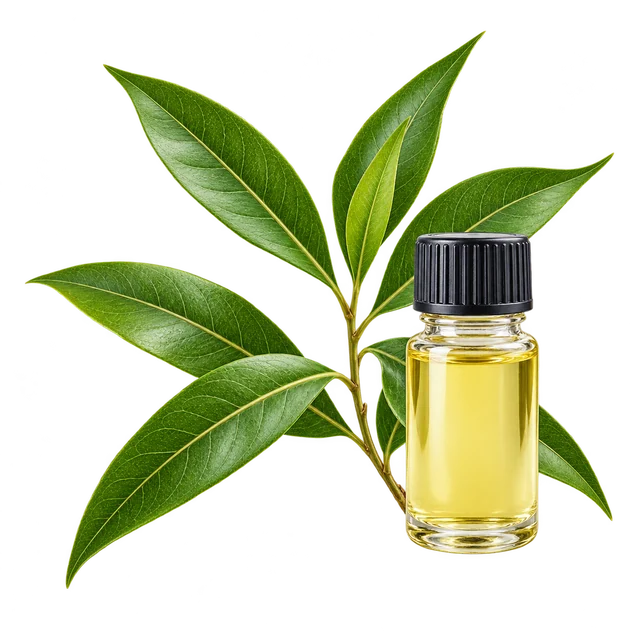
Key cautions
- Do not ingest essential oil or replace culinary leaf with it.
- Concentrated oil can irritate; use labeled finished products and keep away from children.
What’s inside
Typically a citral-rich volatile fraction. Composition is specific to the batch and differs fundamentally from the whole leaf’s fibre, water and nonvolatile solids.
Uses in brief

- Fragrance formulations
- Household-product ingredient
History, folklore and reported uses
History, folklore and traditional uses
Australian plantation producers describe distilling leaves and stems. Government forestry reporting recognizes lemon-myrtle oil as its own product stream, distinct from the leaf ingredient used in native-food cookery.
Traditional, historical and reported uses
- Fragrance formulations
Food or household practiceWhy this label?
Sources document this named food or material use; no therapeutic outcome is claimed.
The producing plantation supplies lemon-myrtle oil for personal-care, cosmetic and home-fragrance manufacturing. This records an ingredient use rather than proving safety of a neat oil.
- Household-product ingredient
Food or household practiceWhy this label?
Sources document this named food or material use; no therapeutic outcome is claimed.
The producer lists household cleaning applications. An ingredient’s laboratory activity does not turn a homemade mixture into a tested disinfectant.
2 narrowly supported uses; no clinical efficacy or universal preparation is inferred.
Historical-use additions reviewed 2026-10-09
Regional reading paths
These sourced notes describe cultivation, trade, food traditions or material history. A regional connection does not claim exclusive origin.
Australia & Oceania
native and cultivated; Australia
Distilled fragrance ingredient.
Identity & detailed reference
Identity
Backhousia citriodora distilled essential oil; not culinary leaf, a leaf infusion, lemon juice or a fixed edible oil.
Ingredient details, preparation and research
Source plant or material
Backhousia citriodora distilled essential oil; not culinary leaf, a leaf infusion, lemon juice or a fixed edible oil.
Plant family / material: Myrtaceae
Forms and route
Steam-distilled aromatic oil supplied to fragrance, personal-care and household-product manufacturers.
Vitamins and minerals
No nutritional role is assigned. Distillation does not concentrate the plant’s complete food nutrient profile into an edible supplement.
Absorption and preparation
Exposure and irritation risk depend on concentration, route and formulation. No household mixing ratio or claim of beneficial systemic absorption is supplied.
Practical preparation
Choose a finished product for the intended use and follow its label. Keep concentrated oil clearly labeled and away from children; never substitute it by drops for a culinary leaf quantity.
Traditional and reported uses
- The producing plantation supplies lemon-myrtle oil for personal-care, cosmetic and home-fragrance manufacturing. This records an ingredient use rather than proving safety of a neat oil.
- The producer lists household cleaning applications. An ingredient’s laboratory activity does not turn a homemade mixture into a tested disinfectant.
Contraindications and cautions
- Do not ingest essential oil or replace culinary leaf with it.
- Concentrated oil can irritate; use labeled finished products and keep away from children.
Claims must match the finished product
A supplier’s antimicrobial description is not a clinical trial or a validated household disinfection protocol. Regulatory and efficacy claims would need the actual formula, concentration, target organism and conditions of use.
Separate two related cards
The culinary leaf and distillate share a plant but differ in exposure. Queensland poison-prevention guidance explicitly includes essential oils among possible poisons, supporting careful storage rather than casual oral use.
Evidence limits
This is a food/material reference, not evidence of disease treatment. Geographic and customary-use records do not establish a medicinal dose. Nutrient quantities are omitted unless a matching food form and serving have been verified.
Entry sources
- Australian Native Products: plantation-distilled oils
- DAFF: Non-wood forest products, essential oils
- Queensland Poisons Information Centre: Poisoning prevention
Reference entry 492 · Recorded content review: 2026-10-09 · Review scope and dates