


Key cautions
- Never drink raw cassava press liquid or assume fermentation alone makes it safe.
- Taste, color, odor and traditional labeling cannot certify low cyanide or microbiological safety.
What’s inside
Water, fermentation-related acids and dissolved food constituents; residual cyanide and microbiological quality require control.
Uses in brief

- Broth for tacacá
- Savory sauce for regional dishes
History, folklore and reported uses
History, folklore and traditional uses
Tucupi is closely connected with Pará and northern Brazilian cuisine. Its relationship to cassava flour production is technologically important, but an industrial by-product becomes food only through appropriate controlled processing.
Traditional, historical and reported uses
- Broth for tacacá
Food or household practiceWhy this label?
Source documents this specific material, culinary use or attributed practice; no clinical efficacy is inferred.
Embrapa documents tucupi in tacacá, a regional preparation that also includes other ingredients. The broth’s safety must be established before it enters the dish.
- Savory sauce for regional dishes
Food or household practiceWhy this label?
Source documents this specific material, culinary use or attributed practice; no clinical efficacy is inferred.
The same source records tucupi with duck and other foods in Pará. Those culinary applications do not validate a household production process from raw cassava.
2 bounded uses; regional records do not establish treatment effects.
Historical-use additions reviewed 2026-10-09
Regional reading paths
These sourced notes describe cultivation, trade, food traditions or material history. A regional connection does not claim exclusive origin.
South America
traditional processing; Brazil, Pará
Sauce/broth ingredient after controlled fermentation and cooking.
Identity & detailed reference
Identity
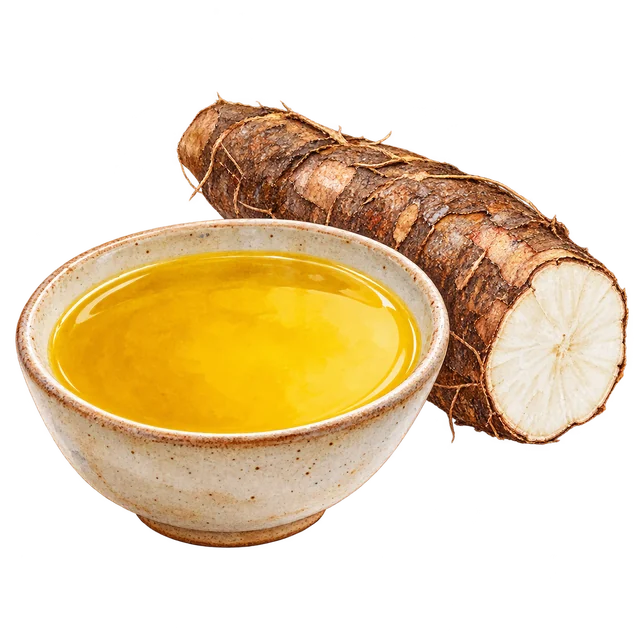
Manihot esculenta; fermented and cooked cassava liquid; tucupi, a processed cassava liquid produced with controlled fermentation and cooking; raw pressed cassava liquid is not the same safe food.
Ingredient details, preparation and research
Also known as: Manihot esculenta; fermented and cooked cassava liquid
Source plant or material
Manihot esculenta; fermented and cooked cassava liquid
Plant family / material: Euphorbiaceae (cassava substrate)
Forms and route
Commercially prepared, properly processed sauce or broth ingredient with clear storage and use directions.
Vitamins and minerals
It is not equivalent to the whole cassava root or purified starch. No exact nutrient amount is assigned, and added seasonings can change sodium content.
Absorption and preparation
Fermentation changes compounds but does not establish safe absorption or detoxification. Cyanide reduction must be validated in the complete manufacturing process.
Practical preparation
Buy professionally processed food-grade tucupi. Follow its label for cooking, refrigeration and shelf life; do not try to rescue raw or uncertain liquid using an improvised boiling schedule.
Traditional and reported uses
- Broth for tacacá
- Savory sauce for regional dishes
Contraindications and cautions
- Never drink raw cassava press liquid or assume fermentation alone makes it safe.
- Taste, color, odor and traditional labeling cannot certify low cyanide or microbiological safety.
Manufacturing variables matter
Embrapa studies measure total and free cyanide across processing steps and identify effects of cassava variety, fermentation and cooking conditions. Their findings argue against a universal home time-and-temperature rule.
Evidence limits
This is a processed-food reference, not a detoxification guide. No fermentation or cooking schedule, cyanide threshold or homemade safety guarantee is supplied.
Entry sources
- Embrapa: Tucupi publications, fermentation, cooking and cyanide
- Embrapa: Production of tucupi and goma in Pará
- Embrapa: Physicochemical characteristics and cyanide through tucupi processing
- Embrapa: Fermentation, cooking and cyanide in tucupi
Reference entry 471 · Recorded content review: 2026-10-09 · Review scope and dates