


Key cautions
- Do not replace or delay cancer treatment with turkey-tail tea or supplements.
- PSK findings do not prove that whole fungus or ordinary supplements prevent or treat cancer.
What’s inside
Polysaccharides and protein-bound polysaccharides are central to the extract literature. PSK is a defined preparation, not a synonym for all turkey-tail beta-glucans or all supplements.
Uses in brief

- Traditional medicinal preparations
- PSK as a clinical adjunct
- Modern supplement production
History, folklore and reported uses
History, folklore and traditional uses
Turkey tail has a place in East Asian medicinal traditions under names including yun zhi and kawaratake. Its tough fruiting bodies belong to a different food-and-medicine history from familiar soft table mushrooms.
The modern chapter centres on extracts. Japanese PSK illustrates how a standardized preparation can become a studied adjunct to conventional cancer treatment. That history does not show that a homemade drink or a bottle labelled turkey tail delivers the same material or clinical effect.
A closer look at its history
A prepared extract is not a woodland tea
Turkey-tail-derived PSK has a clinical-use history as a specific manufactured adjunct in Japan. NCI distinguishes studied preparations and cancer-treatment contexts from general mushroom supplements. That history must not be transferred to a home-collected bracket or used as a reason to replace cancer care.
Additional history reviewed 2026-10-09
Traditional, historical and reported uses
- Traditional medicinal preparations
Traditional accountWhy this label?
The claim describes East Asian medicinal traditions and explicitly separates them from clinical efficacy.
East Asian traditions used turkey tail medicinally; historical use is not itself a clinical efficacy finding.
- PSK as a clinical adjunct
Human researchWhy this label?
The claim concerns a defined extract used and studied as an adjunct in human cancer care; evidence remains product- and treatment-specific.
A defined extract, PSK, has been used alongside conventional cancer care in Japan. Its evidence belongs to that product and treatment setting.
- Modern supplement production
Mixed/contextual sourcesWhy this label?
The claim describes modern manufacturing and supplement commerce, not evidence that those products work.
The fungus is sold in powders, capsules and extracts, which vary by fungal material and manufacturing process. Commercial availability does not establish effectiveness.
Three distinct historical, clinical-product and commercial roles are documented. They should not be multiplied into unsupported disease-treatment claims.
Features and lookalikes to study
Trametes versicolor; synonym Coriolus versicolor. Yun zhi in Chinese contexts, kawaratake in Japanese contexts.
Common names vary between regions and suppliers; the scientific scope above governs this card.
Morphology described in sources
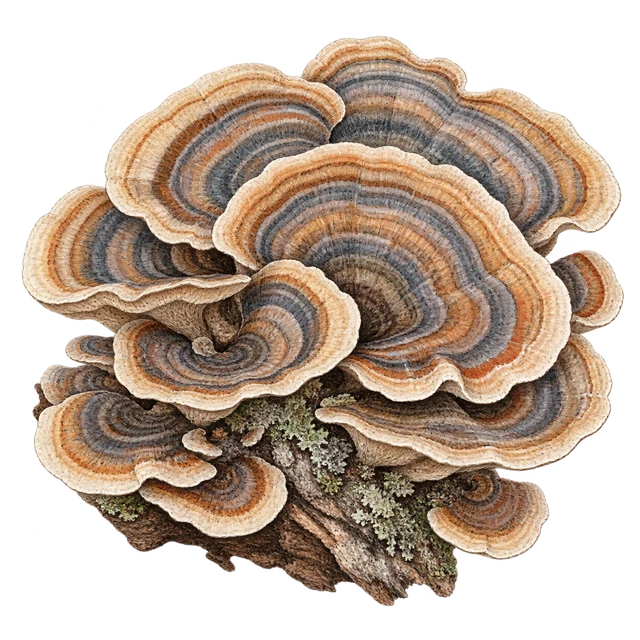
- Thin, flexible, finely hairy brackets show strongly contrasting concentric colour bands and a pale underside with very small true pores. The top surface alone cannot establish the species.
- Habitat and substrate
- Overlapping groups on hardwood logs and stumps; occasionally on conifer wood.
- Geographic scope
- Common and broadly distributed in the cited North American account; this does not delimit the global range.
- Season in the cited region
- Reported year-round in the cited North American account. Visible brackets do not establish active growth or freshness.
Stereum species, including the S. ostrea name
False turkey-tail crusts can have a similar zoned top but a smooth spore-bearing underside rather than true pores.
A hand lens may be needed; dirt or damaged tissue can obscure the underside. “Not Stereum” still does not mean T. versicolor.
Trametes hirsuta, T. pubescens and T. ochracea
Related Trametes differ in combinations of hairiness, colour zoning, thickness and stiffness.
These are overlapping characters changed by age and weather; difficult material requires a polypore specialist and sometimes microscopy.
Limits and regional differences
- Turkey tail is often used loosely for multicoloured brackets. Do not brew an unknown bracket as medicine; correct identification is not evidence of safety or treatment benefit.
- Educational comparison only. Neither this card, an illustration, a photograph, a spore-print colour nor a checklist establishes that a wild collection is safe to eat. A qualified local mycologist must assess uncertain material; do not taste an unknown fungus. Cooking does not reliably eliminate mushroom toxins.
Identity & detailed reference
Identity
Trametes versicolor; synonym Coriolus versicolor. Yun zhi in Chinese contexts, kawaratake in Japanese contexts.
Ingredient details, preparation and research
Also known as: Turkey tail; Coriolus versicolor; Yun zhi; Kawaratake
Source plant or material
Tough fruiting bodies or separately cultivated mycelial material. Defined PSK and other extracts are different products from whole fungus.
Fungal family: Polyporaceae
Forms and route
Historical medicinal preparations; contemporary teas, powders, capsules and extracts; standardized PSK is a distinct clinical product.
Vitamins and minerals
Not an ordinary table mushroom or a reliable dietary vitamin/mineral serving. Clinical extract quantities cannot be converted into a nutritional serving of whole fungus.
Absorption and preparation
Extraction changes the material. Results for standardized PSK cannot be applied to home tea, raw powder or an unspecified capsule, and no equivalent home preparation is established.
Traditional and reported uses
- East Asian traditions used turkey tail medicinally; historical use is not itself a clinical efficacy finding.
- A defined extract, PSK, has been used alongside conventional cancer care in Japan. Its evidence belongs to that product and treatment setting.
- The fungus is sold in powders, capsules and extracts, which vary by fungal material and manufacturing process. Commercial availability does not establish effectiveness.
Contraindications and cautions
- Do not replace or delay cancer treatment with turkey-tail tea or supplements.
- PSK findings do not prove that whole fungus or ordinary supplements prevent or treat cancer.
- FDA has not approved turkey tail or PSK as a cancer treatment in the United States; discuss any supplement with the treating clinician.
Fungus, family and material
Trametes versicolor (syn. Coriolus versicolor). Polyporaceae. Tough fruiting bodies or separately cultivated mycelial material. Defined PSK and other extracts are different products from whole fungus.
Preparation and evidence
Extraction changes the material. Results for standardized PSK cannot be applied to home tea, raw powder or an unspecified capsule, and no equivalent home preparation is established.
Constituents and nutrition
Polysaccharides and protein-bound polysaccharides are central to the extract literature. PSK is a defined preparation, not a synonym for all turkey-tail beta-glucans or all supplements. Not an ordinary table mushroom or a reliable dietary vitamin/mineral serving. Clinical extract quantities cannot be converted into a nutritional serving of whole fungus.
History and documented uses
Turkey tail has a place in East Asian medicinal traditions under names including yun zhi and kawaratake. Its tough fruiting bodies belong to a different food-and-medicine history from familiar soft table mushrooms. The modern chapter centres on extracts. Japanese PSK illustrates how a standardized preparation can become a studied adjunct to conventional cancer treatment. That history does not show that a homemade drink or a bottle labelled turkey tail delivers the same material or clinical effect.
Safety and interpretation
Do not replace or delay cancer treatment with turkey-tail tea or supplements. PSK findings do not prove that whole fungus or ordinary supplements prevent or treat cancer. FDA has not approved turkey tail or PSK as a cancer treatment in the United States; discuss any supplement with the treating clinician.
Entry sources
- NCI: Medicinal Mushrooms, turkey tail and PSK
- Pan-European Species Directories: Trametes versicolor classification
Reference entry 224 · Recorded content review: 2026-10-08 · Review scope and dates