


Key cautions
- Untreated cassava and inadequately processed derivatives can be hazardous; a sour taste cannot certify cyanide reduction or hygiene.
- If avoiding alcohol, verify the particular product
What’s inside
Residual cassava carbohydrates, fermentation products and variable microbes; cyanogenic-compound control depends on the full validated process.
Uses in brief

- Cassava beverage
- Microbial-isolate research
History, folklore and reported uses
History, folklore and traditional uses
The detailed ethnographic source concerns Shawi participants; another cassava-beer study concerns broader microbial ecology and is not evidence that all Amazonian communities prepare the drink alike.
Traditional, historical and reported uses
- Cassava beverage
Food or household practiceWhy this label?
Source documents this specific material, culinary use or attributed practice; no clinical efficacy is inferred.
The Shawi community study documents masato’s everyday and social role in one Peruvian Amazonian setting. Its cultural importance deserves accurate attribution, not a universal recipe.
- Microbial-isolate research
Laboratory/animal researchWhy this label?
This use entry describes a laboratory, pilot-scale or nonhuman experiment; it does not establish an ordinary household practice, clinical benefit or safe home protocol.
A separate primary study isolated potential probiotic bacteria from Peruvian masato and another fermented beverage. Candidate strains in laboratory work do not establish a health claim for the original drink.
2 bounded uses; regional records do not establish treatment effects.
Historical-use additions reviewed 2026-10-09
Regional reading paths
These sourced notes describe cultivation, trade, food traditions or material history. A regional connection does not claim exclusive origin.
South America
traditional processing; Shawi study community, Peruvian Amazon
Fermented cassava beverage; hygiene and safe processing essential.
Identity & detailed reference
Identity
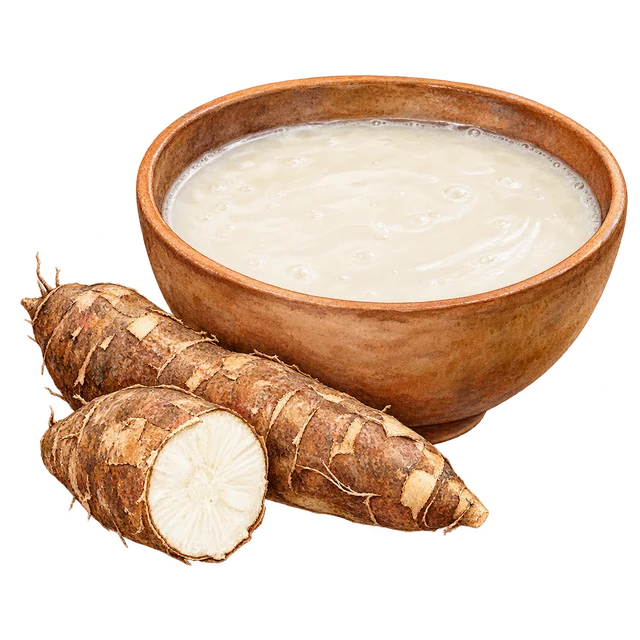
Manihot esculenta; fermented cassava preparation; masato de yuca, a fermented food beverage made from appropriately processed cassava; not every rice or maize drink also called masato.
Ingredient details, preparation and research
Also known as: Manihot esculenta; fermented cassava preparation
Source plant or material
Manihot esculenta; fermented cassava preparation
Plant family / material: Euphorbiaceae (cassava substrate)
Forms and route
Prepared cassava beverage from a controlled food process; traditional formulations vary and may contain alcohol.
Vitamins and minerals
No fixed alcohol, sugar, vitamin or mineral level is assigned. Fermentation alone does not make the beverage a balanced food or a standardized probiotic.
Absorption and preparation
A bacterium isolated from a drink is not proof that drinking it delivers a clinically beneficial dose. Food microbial ecology differs from a human health outcome.
Practical preparation
Choose a safely manufactured product with reliable processing and storage controls. Do not reproduce mouth-inoculation, uncontrolled fermentation or cassava detoxification steps from an ethnographic account.
Traditional and reported uses
- Cassava beverage
- Microbial-isolate research
Contraindications and cautions
- Untreated cassava and inadequately processed derivatives can be hazardous; a sour taste cannot certify cyanide reduction or hygiene.
- If avoiding alcohol, verify the particular product. Do not assume all masato is nonalcoholic or safe for every consumer.
Food safety remains material
The community study specifically measured coliform contamination alongside cultural practices. A fermentation’s heritage and perceived benefits do not remove the need for safe water, processing and storage.
Evidence limits
No home-processing timetable, detoxification protocol or probiotic treatment recommendation is given. Local cultural records and laboratory isolates are kept separate from clinical efficacy.
Entry sources
- Cultural values and coliform bacterial load of masato among Shawi participants
- Lactic bacteria isolated from masato de yuca and chicha de siete semillas
- Cassava beer fermentation and local bacterial communities
Reference entry 470 · Recorded content review: 2026-10-09 · Review scope and dates