


Key cautions
- Only consume oil labeled for food. Cosmetic products may contain fragrances or other ingredients unsuitable for ingestion.
- Avoid use after a known reaction to the product; stop if topical irritation appears. Marula’s botanical relationship to other Anacardiaceae does not establish an individual’s allergy status.
What’s inside
Triglycerides with oleic acid prominent, alongside palmitic and linoleic acids. Minor constituents and oxidation status depend on the source and processing.
Uses in brief

- Namibian food oil
- Cosmetic emollient
History, folklore and reported uses
History, folklore and traditional uses
Native and traditional processing: Namibia and South Africa; also documented in Burkina Faso.
Traditional, historical and reported uses
- Namibian food oil
Food or household practiceWhy this label?
The source supports the named food, cosmetic or material practice; no treatment effect is inferred and the card’s form and safety limits remain attached.
FAO’s account of the Eudafano Women’s Cooperative describes oil eaten at home and sold as a food resource. Separate Namibian reporting records its role in hospitality and special dishes.
- Cosmetic emollient
Food or household practiceWhy this label?
The source supports the named food, cosmetic or material practice; no treatment effect is inferred and the card’s form and safety limits remain attached.
The same cooperative supplies marula oil for cosmetic production. Formulated products use it for lubrication and skin feel; a commercial application does not establish treatment of a skin disorder.
2 sourced featured uses; cultural or material records are not clinical efficacy evidence.
Historical-use additions reviewed 2026-10-09
Regional reading paths
These sourced notes describe cultivation, trade, food traditions or material history. A regional connection does not claim exclusive origin.
Africa
Native and traditional processing: Namibia and South Africa; also documented in Burkina Faso.
Kernel-derived fixed oil for food-grade uses and cosmetics, depending on product.
Identity & detailed reference
Identity
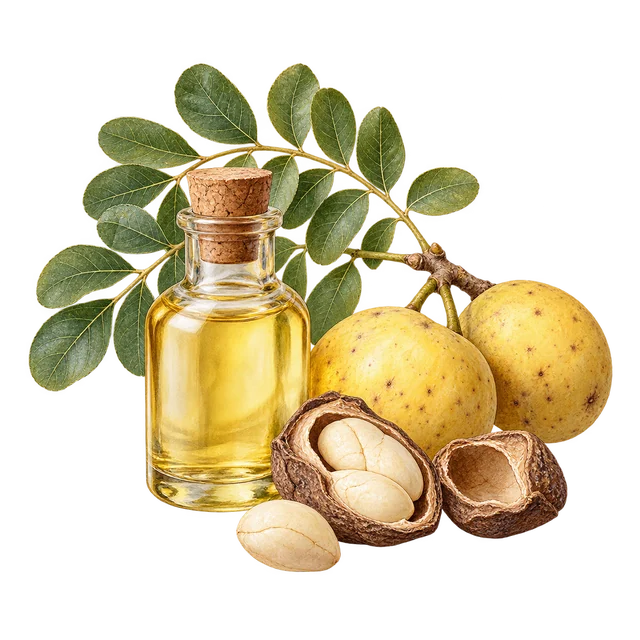
The fixed oil expressed from kernels of Sclerocarya birrea. Marula fruit flesh and juice are separate foods; kernel oil concentrates lipids and is not an essential oil.
Ingredient details, preparation and research
Source plant or material
Sclerocarya birrea
Plant family / material: Anacardiaceae
Forms and route
Food-grade kernel oil and separately labeled cosmetic oil or formulated products. Refined and unrefined lots differ; a skin-care bottle is not automatically edible.
Vitamins and minerals
The separated oil supplies fat and energy, without the fiber of marula flesh or most protein of the kernel. Whole-fruit nutrient claims must not be copied to the oil.
Absorption and preparation
Its dietary fatty acids are delivered by ingestion, while topical application acts mainly as an emollient. Neither route should be assumed equivalent to a concentrated laboratory extract.
Practical preparation
Choose the labeled route and keep oil tightly closed away from heat and light. Use cosmetic formulations as directed rather than adding unmeasured essential oils to them.
Traditional and reported uses
- Namibian food oil
- Cosmetic emollient
Contraindications and cautions
- Only consume oil labeled for food. Cosmetic products may contain fragrances or other ingredients unsuitable for ingestion.
- Avoid use after a known reaction to the product; stop if topical irritation appears. Marula’s botanical relationship to other Anacardiaceae does not establish an individual’s allergy status.
Chemistry versus clinical benefit
Marula composition work documents an oleic-acid-rich oil, and regional studies document food and cosmetic use. These observations do not by themselves demonstrate anti-aging, infection treatment or superior health outcomes over other oils.
Evidence limits
No universal fatty-acid percentage, food serving or therapeutic superiority is assigned; batch quality remains product-specific.
Entry sources
- Hilou et al.: Native oilseeds in Burkina Faso, ethnobotanical investigation
- SANBI PlantZAfrica: Sclerocarya birrea
- FAO: Martha Negumbo and the Eudafano Women’s Cooperative, Namibia
- INRAE/CIRAD/FAO Feedipedia: Marula composition
Reference entry 299 · Recorded content review: 2026-10-09 · Review scope and dates