


Key cautions
- Do not use mashua as a contraceptive, fertility treatment or hormone-regulating supplement.
- Concentrated products and medicinal amounts need separate safety assessment, especially during pregnancy or when trying to conceive.
What’s inside
Carbohydrate and glucosinolates; an early feeding study identified a methoxybenzyl glucosinolate as an important secondary compound.
Uses in brief

- Cooked tuber food
- Tuber-flour product research
History, folklore and reported uses
History, folklore and traditional uses
Mashua is among the native crops conserved in Peruvian and Bolivian Andean farming systems. Agronomic and culinary records are stronger grounds for this card than dramatic claims attached to its medicinal folklore.
Traditional, historical and reported uses
- Cooked tuber food
Food or household practiceWhy this label?
Source documents this specific material, culinary use or attributed practice; no clinical efficacy is inferred.
FAO/ANPE documents mashua within Andean tuber agriculture and food use. The relevant material is the prepared tuber, not every Tropaeolum plant.
- Tuber-flour product research
Laboratory/animal researchWhy this label?
This use entry describes a laboratory, pilot-scale or nonhuman experiment; it does not establish an ordinary household practice, clinical benefit or safe home protocol.
Research on Andean tuber and root flours examines their behavior in extruded snacks. Such formulated foods differ from a whole boiled tuber and have their own ingredients.
2 bounded uses; regional records do not establish treatment effects.
Historical-use additions reviewed 2026-10-09
Regional reading paths
These sourced notes describe cultivation, trade, food traditions or material history. A regional connection does not claim exclusive origin.
South America
native and cultivated; Peru, Bolivia
Cooked tubers.
Identity & detailed reference
Identity
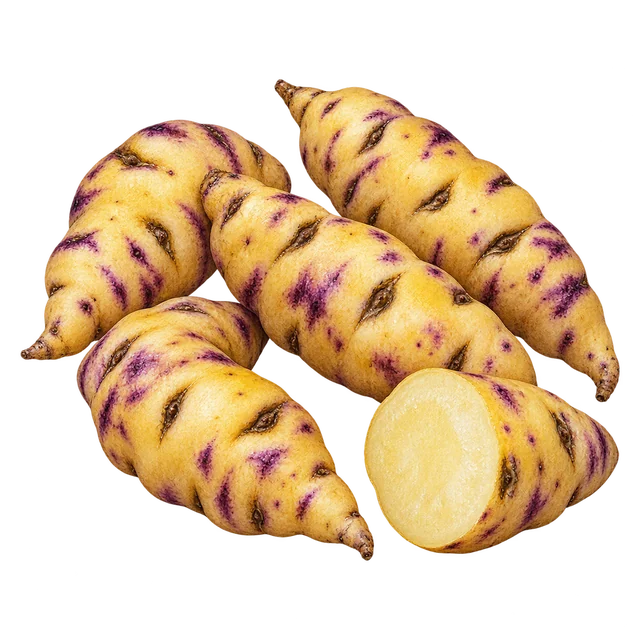
Tropaeolum tuberosum; the food tuber of Tropaeolum tuberosum, also called mashua or isaño; distinct from ornamental nasturtium flowers and leaves.
Ingredient details, preparation and research
Also known as: Tropaeolum tuberosum
Source plant or material
Tropaeolum tuberosum
Plant family / material: Tropaeolaceae
Forms and route
Cooked culinary tubers and food-grade flour products; medicinal extracts are a separate scope.
Vitamins and minerals
Composition changes with variety and processing. Nutrient values from raw tubers cannot be assigned to dried flour, fried snacks or an extract without measurement.
Absorption and preparation
Changes during cooking do not establish a reproductive or hormonal benefit. Animal-feeding results cannot predict effects from an ordinary human meal.
Practical preparation
Choose identified cultivated food tubers and cook according to an established culinary recipe. Use flour labeled for food rather than grinding unknown plant material.
Traditional and reported uses
- Cooked tuber food
- Tuber-flour product research
Contraindications and cautions
- Do not use mashua as a contraceptive, fertility treatment or hormone-regulating supplement.
- Concentrated products and medicinal amounts need separate safety assessment, especially during pregnancy or when trying to conceive.
Reproductive claims are not established
An older study investigated reputed anti-reproductive activity using rats fed tubers. Its design does not support using the crop to control human fertility or interpreting customary food use as a proven medical effect.
Evidence limits
This is a food-form review, not a treatment recommendation. Composition and laboratory findings apply to the material actually studied; no medicinal dose, universal nutrient ranking or preservation guarantee is inferred.
Entry sources
- FAO and ANPE: Guía de campo de los cultivos andinos
- Tropaeolum tuberosum feeding study in male rats
- Snacks manufactured from Andean tuber and root flours
Reference entry 451 · Recorded content review: 2026-10-09 · Review scope and dates