


Key cautions
- Do not substitute essential oils, leaves or extracts for fruit pulp.
- A product labeled guava may be another species; verify the ingredient when a recipe or allergy question depends on identity.
What’s inside
Fruit carbohydrates, acids and volatile aroma compounds; aroma intensity does not measure vitamin concentration.
Uses in brief

- Fresh fruit pulp
- Fruit-production and processing ingredient
History, folklore and reported uses
History, folklore and traditional uses
Embrapa documents feijoa in southern Brazil and neighboring South American landscapes, including Uruguay. Its later cultivation abroad should not be confused with botanical origin; conservation of regional germplasm remains part of the crop’s story.
Traditional, historical and reported uses
- Fresh fruit pulp
Food or household practiceWhy this label?
Source documents this specific material, culinary use or attributed practice; no clinical efficacy is inferred.
Embrapa’s native-fruit documentation describes feijoa as an edible regional fruit. Ripe pulp is the primary food material in this card.
- Fruit-production and processing ingredient
Food or household practiceWhy this label?
Source documents this specific material, culinary use or attributed practice; no clinical efficacy is inferred.
Embrapa’s germplasm work supports selection and conservation for fruit production. Prepared pulp retains culinary value, but a processed recipe needs its own composition and storage rules.
2 bounded uses; regional records do not establish treatment effects.
Historical-use additions reviewed 2026-10-09
Regional reading paths
These sourced notes describe cultivation, trade, food traditions or material history. A regional connection does not claim exclusive origin.
South America
native; southern Brazil, Uruguay
Aromatic fruit pulp.
Identity & detailed reference
Identity
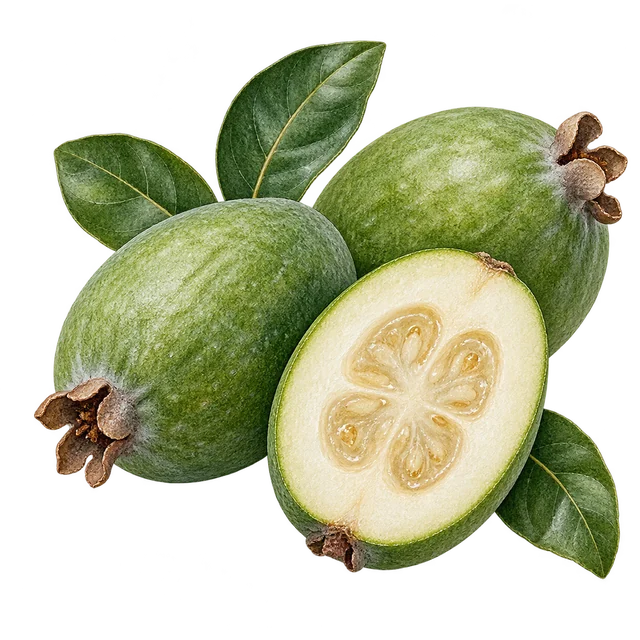
Acca sellowiana; the ripe edible fruit of Acca sellowiana, also called Feijoa sellowiana; distinct from common guava despite similar market names.
Ingredient details, preparation and research
Also known as: Acca sellowiana
Source plant or material
Acca sellowiana
Plant family / material: Myrtaceae
Forms and route
Fresh pulp, chilled fruit preparations and preserves; leaf and essential-oil products are separate.
Vitamins and minerals
Fresh pulp and sweetened preserves have different water and sugar content. No exact vitamin, mineral or fiber value is assigned to every cultivar.
Absorption and preparation
An odour-active compound is not necessarily a clinically active compound. Aroma analysis does not establish nutrient absorption, anti-aging effects or medicinal utility.
Practical preparation
Wash sound ripe fruit before cutting, scoop or prepare its edible pulp and refrigerate cut fruit. Use tested preservation methods rather than assuming acidity makes a jar shelf-stable.
Traditional and reported uses
- Fresh fruit pulp
- Fruit-production and processing ingredient
Contraindications and cautions
- Do not substitute essential oils, leaves or extracts for fruit pulp.
- A product labeled guava may be another species; verify the ingredient when a recipe or allergy question depends on identity.
Aroma has a chemical basis
A primary sensory study identifies odour-active compounds in feijoa using chromatographic and sensory methods. It explains characteristic flavor without establishing therapeutic aromatherapy effects.
Evidence limits
This is a food-form review, not a treatment recommendation. Composition and laboratory findings apply to the material actually studied; no medicinal dose, universal nutrient ranking or preservation guarantee is inferred.
Entry sources
- Embrapa: Frutíferas nativas, feijoa
- Embrapa: Conservation of feijoa germplasm
- Odour-active compounds from feijoa
Reference entry 467 · Recorded content review: 2026-10-09 · Review scope and dates