


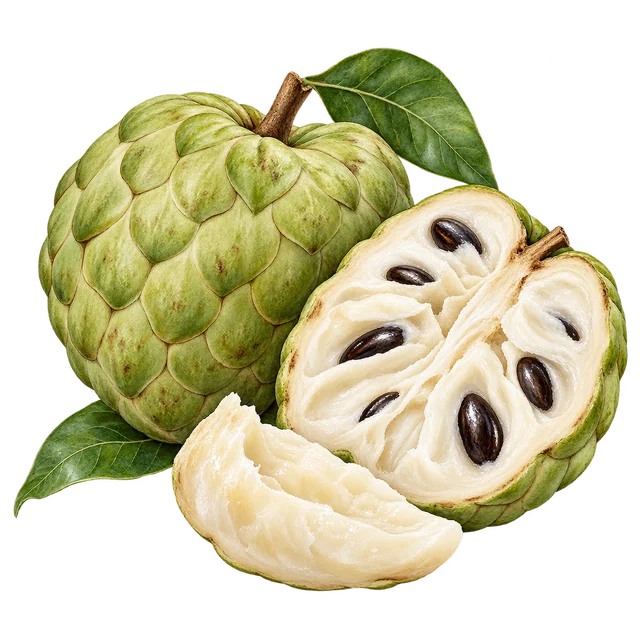
Key cautions
- Do not crush, chew or blend seeds into food
- Do not substitute other Annona products or use leaf preparations as treatment on the basis of this fruit card.
What’s inside
Water, carbohydrates, fiber and cultivar-dependent phenolic constituents; research analyzes fruit fractions separately.
Uses in brief

- Ripe fruit flesh
- Pulp-based foods
History, folklore and reported uses
History, folklore and traditional uses
The regional selection follows cherimoya cultivation in Peru and Andean valleys. Some cited analytical samples come from Madeira, so their results are not presented as an exact nutrient profile of every Peruvian cultivar.
Traditional, historical and reported uses
- Ripe fruit flesh
Food or household practiceWhy this label?
Source documents this specific material, culinary use or attributed practice; no clinical efficacy is inferred.
INIA documents cherimoya among Peruvian cultivated fruits. The edible food portion is the ripe flesh, kept separate from its seeds and peel.
- Pulp-based foods
Food or household practiceWhy this label?
Source documents this specific material, culinary use or attributed practice; no clinical efficacy is inferred.
Food-composition research treats cherimoya pulp as a distinct fruit fraction. It can be used as an ingredient after seed removal; frozen or sweetened preparations have their own composition.
2 bounded uses; regional records do not establish treatment effects.
Historical-use additions reviewed 2026-10-09
Regional reading paths
These sourced notes describe cultivation, trade, food traditions or material history. A regional connection does not claim exclusive origin.
South America
cultivated; Peru, Andean valleys
Ripe fruit flesh; seeds excluded.
Identity & detailed reference
Identity
Annona cherimola; ripe fruit flesh of Annona cherimola, cherimoya; distinct from sugar apple, soursop and atemoya hybrids.
Ingredient details, preparation and research
Also known as: Annona cherimola
Source plant or material
Annona cherimola
Plant family / material: Annonaceae
Forms and route
Fresh edible flesh, chilled pulp and prepared desserts; peel, seeds, leaves and extracts are excluded.
Vitamins and minerals
A pulp serving is not nutritionally equivalent to a seed or peel extract. No exact vitamin or mineral amount is assigned across cultivars and preparations.
Absorption and preparation
Antioxidant activity in a test tube does not establish absorption or a disease-prevention effect in a person eating the fruit.
Practical preparation
Wash the outside before cutting, open ripe fruit and remove every hard seed before pureeing. Refrigerate cut fruit and prepared pulp.
Traditional and reported uses
- Ripe fruit flesh
- Pulp-based foods
Contraindications and cautions
- Do not crush, chew or blend seeds into food. Seed-extract studies do not demonstrate that seeds are safe to eat.
- Do not substitute other Annona products or use leaf preparations as treatment on the basis of this fruit card.
By-product research does not confer edibility
Primary studies separately examine pulp, peel and seeds and test by-product extracts in vitro. These experimental activities do not justify eating seeds, making seed remedies or claiming cancer protection from fruit.
Evidence limits
This is a food-form review, not a treatment recommendation. Composition and laboratory findings apply to the material actually studied; no medicinal dose, universal nutrient ranking or preservation guarantee is inferred.
Entry sources
- INIA: Los cultivos nativos en las comunidades del Perú
- Composition of cherimoya fruits and by-products
- In-vitro assays of cherimoya by-products
Reference entry 463 · Recorded content review: 2026-10-09 · Review scope and dates