


Key cautions
- Do not swallow dry spoonfuls: chia expands with liquid and can lodge in the esophagus.
- Anyone with swallowing problems or esophageal narrowing should seek individualized advice before using chia.
- Increase fiber foods gradually if they cause bloating, and avoid the seed if allergic.
What’s inside
Fiber, mucilage-forming polysaccharides, protein and seed oil containing alpha-linolenic acid (ALA).
Uses in brief

- Hydrated drinks
- Seed ingredient in foods
History, folklore and reported uses
History, folklore and traditional uses
INIFAP records chia cultivation in Mexico and Central America. Tlaxcala food documentation records seeds in refreshing drinks, connecting present use with a regional culinary history rather than a generic superfood narrative.
A closer look at its history
A Mesoamerican crop
Salvia hispanica is native to Mexico and Guatemala. Its Latin name preserves an early European misunderstanding: hispanica means Spanish, although the plant did not originate in Spain. The beginnings of its cultivation remain uncertain. Its later history is easier to follow, but common names need care: “chia” has also been applied to other plants, including California chia, Salvia columbariae.
Tribute, food and written memory
Much of the detailed evidence for chia’s place in Mexica/Aztec life comes from sixteenth-century manuscripts compiled around and after the Spanish conquest. The Codex Mendoza records chia among tribute foods alongside maize, beans and amaranth. The Florentine Codex depicts the plant and records ceremonial uses. Culinary accounts describe chia flour, called chianpinolli, and refreshing drinks. These documents establish a substantial food and economic role without requiring modern stories about miraculous endurance or a single “superfood.”
Seeds in a ritual deposit
Archaeology adds a different kind of evidence. INAH paleobotanist Aurora Montúfar López reports Salvia hispanica seeds together with chan, Hyptis suaveolens, in Offering 102 at Tenochtitlan’s Templo Mayor. The find places named plant remains in a ceremonial context; it does not date the first domestication of chia or prove medicinal effectiveness. The same account draws on historical descriptions of seeds kept in royal storehouses, sold in markets and provided for feasts, showing how ritual deposits and everyday provisioning belong to different parts of the record.
Oil, craft and colonial change
Chia’s history also reaches beyond the kitchen. Its oil was used in Mexican lacquerwork, including layered coatings and glossy finishes on gourds and other objects. The CNRS-led Chia Oil in Art project documents the continued use of chia oil in maque and investigates its identification in older artworks. Cultivation declined during the colonial period; researchers discuss population loss, introduced crops and changing diets as possible causes. The evidence is incomplete, so a simple tale of total disappearance misses both the uncertainty and the survival of skilled craft traditions.
A living crop and newer markets
Wider commercial interest revived from the late 1990s. This newer market grew around a crop that Mexican producers continued to develop: in 2022, INIFAP described Acatic, Jalisco, as an important production center and credited growers themselves with generating its cultivation technology. Its report also described export production and a program bringing producers into field schools. Another strand of the revival was breeding for different climates. University of Kentucky researchers demonstrated early-flowering lines that could set seed under longer summer days, helping extend cultivation into temperate regions. Modern commercialization and cultivar development are therefore distinct chapters in a much longer regional history.
Additional history reviewed 2026-10-09
Traditional, historical and reported uses
- Hydrated drinks
Food or household practiceWhy this label?
Label describes the stated practice or evidence, not an efficacy grade. Exact form and cautions remain attached.
Tlaxcala’s food record describes chia seeds in drinks. Their water-binding surface changes texture; it is not a reason to swallow dry seed.
- Seed ingredient in foods
Food or household practiceWhy this label?
Label describes the stated practice or evidence, not an efficacy grade. Exact form and cautions remain attached.
Mexican crop research records chia as a food seed. It may be used in moist seed dishes and grain-based foods, while oil extraction creates a different ingredient.
2 supported uses; records describe the named form and are not treatment recommendations.
Historical-use additions reviewed 2026-10-09
Growing notes
Salvia hispanica, grown for edible seed; not California chia or a decorative sprouting instruction.
- Climate and zones
- Grow as a frost-sensitive annual seed crop. USDA winter-hardiness zones alone cannot predict a harvest: traditional strains flower as days shorten and may be killed before seeds ripen. In temperate gardens, choose a locally proven early-flowering strain and check its frost-free season requirement. [1] [2]
- Planting season
- In frost-prone climates, direct-sow after the last spring frost, or start indoors 8–10 weeks beforehand and transplant after frost risk passes. In traditional seasonal-rainfall settings, sowing is timed to the rains; follow local cultivar guidance. [3] [4]
- Sun and soil
- Choose full sun and well-drained soil of moderate fertility; UC guidance also allows partial shade. Avoid persistent wetness. Base any fertilizer choice on a soil test. [3] [1]
- Water
- Keep the seedbed moist enough for establishment, then adjust watering to soil moisture and rainfall. Established plants have low water needs in the Santa Clara County guide; this is not a guarantee of seed yield under drought. [1] [3]
- Time to harvest
- Timing depends on cultivar and climate: Kentucky-adapted crops sown May–June were harvested in October. Collect browning seed heads, dry with ventilation, and separate seed from chaff. [1] [3]
- Pollination
- Chia can self-fertilize, but insects can cause crossing. Mexican research found marked differences between cultivated and wild populations, so do not assume every strain behaves identically. [5]
- Pests and disease
- Control weeds while plants establish. Kentucky’s 2016 profile reported little insect or disease trouble there, but that is not universal resistance: an Argentine field study recorded Sclerotinia losses in a wetter, cooler season. [1] [6]
- Pruning
- For seed production, keep flowering stems and ripening seed heads. No special pruning schedule is established here. [3]
Growing sources and regional guidance
- University of Kentucky Extension (2016): Chia, CCD-CP-26
- Jamboonsri et al. (2012): Extending the range of an ancient crop, Salvia hispanica L.
- UC Master Gardeners of Santa Clara County: Chia
- Wood et al. (2022): Salvia hispanica, Curtis’s Botanical Magazine
- Hernández-Gómez, Miranda-Colín and Peña-Lomelí (2008): Cruzamiento natural de chía
- Acta Agronómica: Incidencia de las condiciones de clima en el desarrollo y producción de semillas de Salvia hispanica L.
- Zhang et al.: Agronomic characteristics, insect pollinators, and seedbank persistence of chia in eastern China
Growing notes reviewed 2026-10-09
Regional reading paths
These sourced notes describe cultivation, trade, food traditions or material history. A regional connection does not claim exclusive origin.
North America
Native/cultivated: Mexico and Central America; Tlaxcala food preparation documented.
Seeds added to drinks and foods.
Identity & detailed reference
Identity
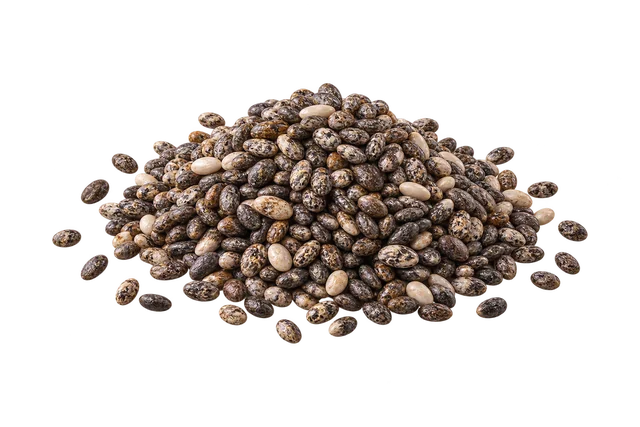
Edible seeds of Salvia hispanica. Other Salvia species and extracted chia oil are separate ingredients.
Ingredient details, preparation and research
Also known as: Chía
Source plant or material
Salvia hispanica
Plant family / material: Lamiaceae
Forms and route
Whole or ground food-grade seed, hydrated mixtures and cooked foods. Dry spoonfuls intended to be followed with water are excluded.
Vitamins and minerals
Provides fiber and unsaturated fat, but the recipe portion matters. A sweet chia beverage also contains whatever sugar is added; seed oil does not retain the whole seed’s fiber.
Absorption and preparation
ALA is a plant omega-3 fatty acid and is not nutritionally identical to marine EPA or DHA. Hydration changes texture rather than creating new nutrients.
Practical preparation
Use a recipe that fully incorporates seeds into adequate liquid or moist food before eating. Store dry seed sealed; refrigerate prepared perishable mixtures according to their other ingredients.
Traditional and reported uses
- Hydrated drinks
- Seed ingredient in foods
Contraindications and cautions
- Do not swallow dry spoonfuls: chia expands with liquid and can lodge in the esophagus.
- Anyone with swallowing problems or esophageal narrowing should seek individualized advice before using chia.
- Increase fiber foods gradually if they cause bloating, and avoid the seed if allergic.
Weight-loss claim tested directly
A randomized 2009 trial in overweight adults did not find the expected weight-loss or disease-risk improvements from the tested chia intervention. That does not erase its food value, but it argues against guaranteed slimming claims.
Evidence limits
Regional history and food/material practice do not establish treatment efficacy. Composition depends on the named species, part and preparation; no medicinal dose or universal nutrient ranking is inferred.
Entry sources
- Mexico Culture: Así se come en Tlaxcala
- INIFAP: Chía, Salvia hispanica, cultivation in Mexico
- Nieman et al. (2009): Chia seed and weight loss, randomized trial
- American College of Gastroenterology: Chia-seed esophageal impaction
- CONABIO: Alimentos y bebidas
Reference entry 393 · Recorded content review: 2026-10-09 · Review scope and dates