


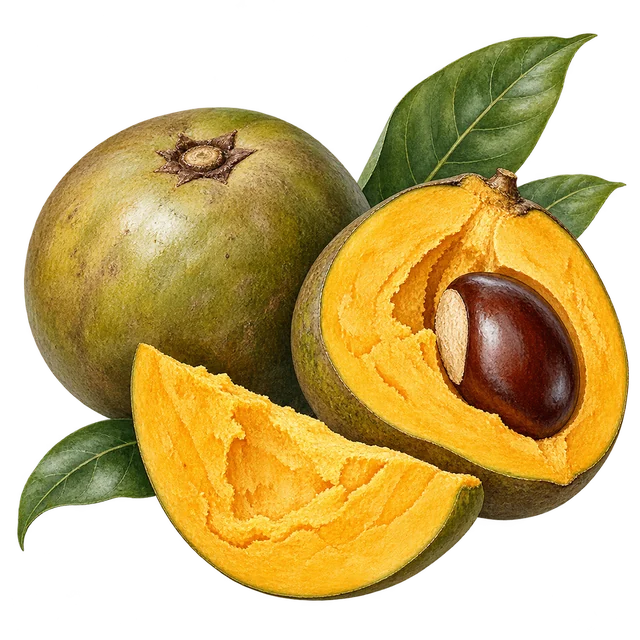
Key cautions
- Do not eat or grind the seeds because seed research is not an edibility approval.
- A lucuma dessert or powder should not replace diabetes treatment or be assumed sugar-free.
What’s inside
Carbohydrates and fruit constituents including phenolic compounds; pulp, peel and seed extracts have different profiles.
Uses in brief

- Frozen desserts and cakes
- Pulp and flour ingredients
History, folklore and reported uses
History, folklore and traditional uses
Lúcuma is one of the fruits in INIA’s Peruvian native-crop conservation publication. The established culinary name persists even when botanical classifications change; a taxonomic synonym does not create a different food.
Traditional, historical and reported uses
- Frozen desserts and cakes
Food or household practiceWhy this label?
Source documents this specific material, culinary use or attributed practice; no clinical efficacy is inferred.
A primary paper’s food context identifies lucuma fruit in ice creams, cakes and juices. This is a culinary use of pulp, distinct from the seed extract studied experimentally.
- Pulp and flour ingredients
Food or household practiceWhy this label?
Source documents this specific material, culinary use or attributed practice; no clinical efficacy is inferred.
The same food account documents commercial pulp and flour. These ingredients differ in water content and should be measured according to the recipe, not exchanged weight-for-weight without adjustment.
2 bounded uses; regional records do not establish treatment effects.
Historical-use additions reviewed 2026-10-09
Regional reading paths
These sourced notes describe cultivation, trade, food traditions or material history. A regional connection does not claim exclusive origin.
South America
native and cultivated; Peru
Fruit pulp for desserts.
Identity & detailed reference
Identity
Pouteria lucuma; the ripe edible pulp of the fruit commonly studied as Pouteria lucuma; newer taxonomy may use Lucuma bifera. Seeds are outside this food scope.
Ingredient details, preparation and research
Also known as: Pouteria lucuma
Source plant or material
Pouteria lucuma
Plant family / material: Sapotaceae
Forms and route
Fresh pulp, frozen pulp, dried pulp flour and desserts; concentrated seed extracts are separate materials.
Vitamins and minerals
Dried flour has less water than fresh pulp, and sweetened desserts contain additional ingredients. No universal low-sugar, low-glycemic or micronutrient claim is assigned.
Absorption and preparation
In-vitro enzyme inhibition is not a clinical glycemic-index test. An extract assay cannot establish that a spoonful of lucuma flour improves nutrient absorption.
Practical preparation
Use ripe food-grade pulp and remove the hard seeds before blending. Follow frozen-pulp or flour storage instructions and refrigerate prepared creams.
Traditional and reported uses
- Frozen desserts and cakes
- Pulp and flour ingredients
Contraindications and cautions
- Do not eat or grind the seeds because seed research is not an edibility approval.
- A lucuma dessert or powder should not replace diabetes treatment or be assumed sugar-free.
Pulp chemistry has limits
Studies of pulp/skin and three mesocarp biotypes characterize compounds and test activity in vitro. They support material and cultivar distinctions, not claims that eating lucuma treats hyperglycemia.
Evidence limits
This is a food-form review, not a treatment recommendation. Composition and laboratory findings apply to the material actually studied; no medicinal dose, universal nutrient ranking or preservation guarantee is inferred.
Entry sources
- INIA: Los cultivos nativos en las comunidades del Perú
- Chemical profiles of lucuma pulp and skin
- Composition of three lucuma mesocarp biotypes
- Lucuma seed extracts and agricultural-waste research
Reference entry 462 · Recorded content review: 2026-10-09 · Review scope and dates