


Key cautions
- Wild fungi can be misidentified; cooking does not neutralize every mushroom toxin.
- Respect local collection rules and forest stewardship
What’s inside
Fungal proteins and carbohydrates form the food tissue; the cited forestry evidence does not establish a detailed universal nutrient or bioactive profile.
Uses in brief

- Regional food mushroom
History, folklore and reported uses
History, folklore and traditional uses
The documented connection is southern Chile’s temperate forest and its local gathering economy. Ecological stewardship and the knowledge of qualified local identifiers cannot be replaced by a decorative picture or short online description.
A closer look at its history
Pichi loyo is not just a small harvest
The name pichi loyo points to a smaller mushroom, but published mycology treats B. loyita as a distinct taxon, not merely a baby loyo. This is a useful place where local comparative naming and laboratory characters meet.
A forest partnership under study
INFOR studies loyo in relation to native forest hosts and management. Its food significance depends on conserving that living partnership; research into forest production should not be described as proof that it is a routine sawdust-grown crop.
Additional history reviewed 2026-10-09
Traditional, historical and reported uses
- Regional food mushroom
Food or household practiceWhy this label?
Source documents this specific material, culinary use or attributed practice; no clinical efficacy is inferred.
INFOR identifies loyo among native-forest fungi traditionally collected for food and sold in regional markets. Its use depends on correct species identification and handling.
1 bounded uses; regional records do not establish treatment effects.
Historical-use additions reviewed 2026-10-09
Features and lookalikes to study
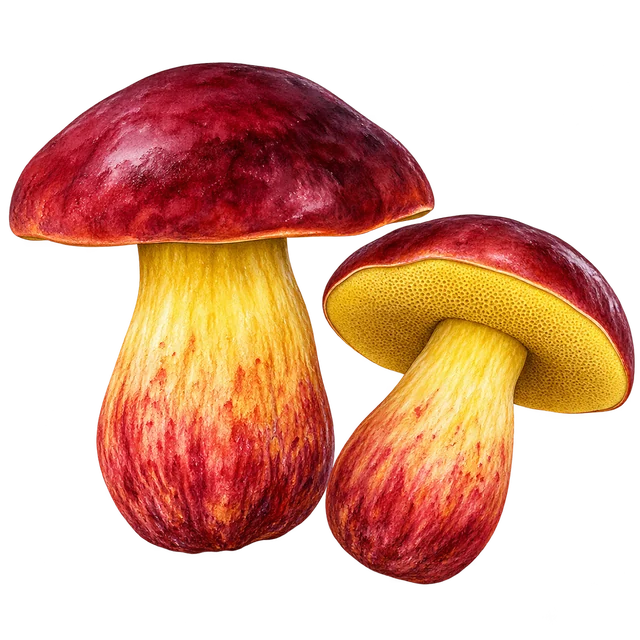
Butyriboletus loyo; the edible fungus Butyriboletus loyo, formerly Boletus loyo; not porcini and not every large bolete.
Common names vary between regions and suppliers; the scientific scope above governs this card.
Morphology described in sources
- Loyo is a large native Nothofagus-associated bolete, with a reddish cap, yellow tubes/pores and a stout stem. These are descriptive traits, not a universal safe-bolete pattern.
- Habitat and substrate
- See the source-linked morphology and comparison notes below; a separate habitat summary has not been verified for this card.
- Geographic scope
- A complete regional range is not established here. Broad common names and commercial labels can span different species.
- Season in the cited region
- No region-specific fruiting season has been verified for this card. Do not infer a local season from trade availability.
Boletus loyita (pichi loyo) and other native Chilean boletes
B. loyita is generally smaller and more slender, with microscopic differences; Chilean authors note that it has been confused with juvenile loyo.
A young loyo is small, so size alone fails. Regional keys use spore dimensions and other anatomy; both name and host context require expert interpretation.
Limits and regional differences
- Exact regional identification may require spores, cystidia and cap-surface microscopy. Red colour or blue bruising is neither a universal danger rule nor a safety rule for boletes. Conservation and collection restrictions must be checked locally.
- Educational comparison only. Neither this card, an illustration, a photograph, a spore-print colour nor a checklist establishes that a wild collection is safe to eat. A qualified local mycologist must assess uncertain material; do not taste an unknown fungus. Cooking does not reliably eliminate mushroom toxins.
Regional reading paths
These sourced notes describe cultivation, trade, food traditions or material history. A regional connection does not claim exclusive origin.
South America
native; southern Chile
Regional food fungus; conservation and identification matter.
Identity & detailed reference
Identity
Butyriboletus loyo; the edible fungus Butyriboletus loyo, formerly Boletus loyo; not porcini and not every large bolete.
Ingredient details, preparation and research
Also known as: Butyriboletus loyo
Source plant or material
Butyriboletus loyo
Fungal family: Boletaceae
Forms and route
Professionally identified fresh culinary fruiting bodies and appropriately handled food products.
Vitamins and minerals
No serving-specific vitamin, mineral or protein amount is supplied. Values for European porcini or another bolete cannot be substituted solely because the fungi look related.
Absorption and preparation
No special nutrient-absorption advantage is established. Forestry propagation or growth studies are not human feeding or medicinal trials.
Practical preparation
Obtain positively identified food-grade material through a reliable supplier, refrigerate promptly and follow suitable cooking instructions. Do not attempt identification from the card.
Traditional and reported uses
- Regional food mushroom
Contraindications and cautions
- Wild fungi can be misidentified; cooking does not neutralize every mushroom toxin.
- Respect local collection rules and forest stewardship. A historical food record is not permission to harvest protected habitats.
Forest production research
INFOR studies native edible fungi in temperate forests, including loyo, to understand production and management. These projects concern ecosystems and cultivation possibilities, not proof of a treatment effect.
Evidence gaps
The selected sources strongly support regional food and forestry context but do not supply a clinical evidence base or a validated nutrient serving. Those gaps are retained rather than filled with figures from other mushrooms.
Evidence limits
This is not a foraging guide or harvest recommendation. One well-supported food use is retained instead of inventing medicinal or preparation claims to fill a quota.
Entry sources
- INFOR: Estudio de hongos silvestres comestibles del sur de Chile
- INFOR: Butyriboletus loyo forestry research
- INFOR: Temperate-forest edible fungi research
Reference entry 448 · Recorded content review: 2026-10-09 · Review scope and dates