


Key cautions
- Do not use laboratory extraction methods or treat a fruit powder as a prescribed vitamin dose.
- Highly concentrated products need separate review, especially if a clinician has advised limits on vitamin C or dietary acids.
What’s inside
Ascorbic acid, organic acids and other fruit constituents; variety, maturity, processing and storage affect composition.
Uses in brief

- Processed fruit pulp
- Beverage ingredient
History, folklore and reported uses
History, folklore and traditional uses
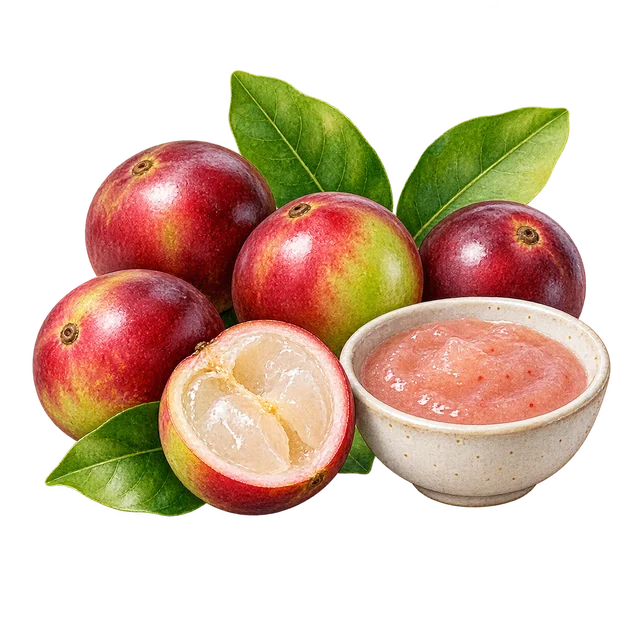
Camu-camu is included in Peruvian native-crop and Amazonian fruit research. Its marketing as a superfood should not displace the more precise story of a regional crop, its cultivar variation and its processed pulp.
Traditional, historical and reported uses
- Processed fruit pulp
Food or household practiceWhy this label?
Source documents this specific material, culinary use or attributed practice; no clinical efficacy is inferred.
INIA’s camu-camu cultivar material identifies a native Amazonian fruit with a commercial pulp role. The food form is distinct from a pharmaceutical vitamin preparation.
- Beverage ingredient
Food or household practiceWhy this label?
Source documents this specific material, culinary use or attributed practice; no clinical efficacy is inferred.
Camu-camu pulp can enter formulated fruit beverages; dilution and added sweeteners determine the finished food. Regional crop documentation supports the fruit’s use without fixing one recipe.
2 bounded uses; regional records do not establish treatment effects.
Historical-use additions reviewed 2026-10-09
Regional reading paths
These sourced notes describe cultivation, trade, food traditions or material history. A regional connection does not claim exclusive origin.
South America
native; Peru, Amazon region
Sour fruit pulp for processed foods.
Identity & detailed reference
Identity
Myrciaria dubia; the edible pulp of Myrciaria dubia; peel extracts, seed products and vitamin concentrates are different materials.
Ingredient details, preparation and research
Also known as: Myrciaria dubia
Source plant or material
Myrciaria dubia
Plant family / material: Myrtaceae
Forms and route
Food-grade pulp, frozen pulp, beverages and labeled fruit powders with declared ingredients.
Vitamins and minerals
A powder or capsule is not automatically equivalent to fresh pulp. No universal vitamin C amount is assigned, and sour taste is not a measurement.
Absorption and preparation
Analytical recovery of vitamin C with laboratory solvents is not human absorption. A high measured content does not establish that ever-larger amounts are useful.
Practical preparation
Choose a traceable pulp or food product and follow its storage instructions. Use the actual label when estimating nutrients in fortified or concentrated products.
Traditional and reported uses
- Processed fruit pulp
- Beverage ingredient
Contraindications and cautions
- Do not use laboratory extraction methods or treat a fruit powder as a prescribed vitamin dose.
- Highly concentrated products need separate review, especially if a clinician has advised limits on vitamin C or dietary acids.
Measurement methods matter
A primary study compared extraction and analytical methods for vitamin C in peel and pulp. Different laboratory recoveries show why a single figure should not be copied indiscriminately onto every camu-camu product.
Evidence limits
This is a food-form review, not a treatment recommendation. Composition and laboratory findings apply to the material actually studied; no medicinal dose, universal nutrient ranking or preservation guarantee is inferred.
Entry sources
- INIA: Camu camu 395 Vitahuayo
- Vitamin C extraction and analysis in camu-camu
- INIA: Los cultivos nativos en las comunidades del Perú
Reference entry 461 · Recorded content review: 2026-10-09 · Review scope and dates