


Key cautions
- Asteraceae allergy and contact irritation matter. Keep it out of eyes and use the intended route.
- Deep, infected or poorly healing wounds need assessment. Medicinal use in pregnancy, breastfeeding and young children needs product-specific advice.
What’s inside
Flowers contain triterpene saponins and triterpene alcohol esters, including faradiol esters, flavonoid glycosides, carotenoid pigments and water-soluble polysaccharides. Water, alcohol and fatty-oil extraction emphasize different fractions; flower-infused carrier oil differs from seed oil.
CIR: Calendula flower constituent assessment · EMA: Calendula flower assessment, historical-use section
Uses in brief

- Traditional: minor inflamed skin, including mild sunburn, and support for minor-wound care.
- Traditional: appropriately prepared mouth/throat rinses for minor irritation.
History, folklore and reported uses
Wounds and inflamed skin
Medieval European herbals recommended calendula flowers for closing wounds. Later herbal practice used flower ointments, infused oils and washes for inflammatory skin lesions and small wounds.
The Met: Calendar Girl · EMA: Calendula flower assessment, historical-use section
Toothache, mouth and throat
The Met records toothache among calendula’s medieval uses. Later European preparations included flower infusions or diluted tinctures as mouth rinses and gargles for irritated mouth and throat tissues.
The Met: Calendar Girl · EMA: Calendula flower assessment, historical-use section
Stomach and duodenal complaints
Older herbals described calendula for internal ulcers, and the 1976 British Herbal Pharmacopoeia listed duodenal ulcer, affecting the first part of the small intestine. European records also include flower teas for stomach irritation and spasms.
The Met: Calendar Girl · EMA: Calendula flower assessment, historical-use section
Swollen lymph nodes
The 1976 British Herbal Pharmacopoeia recorded calendula for enlarged or inflamed lymph nodes and sebaceous cysts, lumps traditionally described as involving the skin’s oil glands. Historical preparations included infusions, liquid extracts and tinctures.
Menstrual discomfort
The British Herbal Compendium tradition summarized by EMA records internal calendula-flower preparations for painful or absent menstruation. Its accounts include flower infusions, tinctures and liquid extracts among the historical oral forms.
Colouring butter, cheese and other foods
Calendula officinalis petals have served as a yellow culinary colourant. University of Florida IFAS records their use by early American colonists to colour butter and cheese, alongside the flower’s continuing use as an edible garnish.
A yellow dye for cloth
Dried calendula petals also supplied a pale-yellow fabric dye, as documented by University of Florida IFAS. This household textile use belongs to pot marigold, Calendula officinalis, rather than automatically to the different Tagetes plants also called marigolds.
Golds, Mary and medieval art
Medieval English speakers called calendula flowers golds. Their association with the Virgin Mary, the mother of Jesus, helped produce the name marigold. The flowers appear in medieval art, including the Unicorn Tapestries, and coloured pottage, a thick soup or stew. Pot marigold refers to Calendula officinalis, not the Tagetes plants that share the marigold name.
Looking at flowers for sight
Some medieval writers claimed that simply looking at calendula flowers benefited eyesight. This belief belongs to the flower’s historical symbolism and medicine, rather than evidence of an eye treatment.
Health topics: evidence and cautions
These notes describe a specific research context and preparation. A topic link is not a treatment recommendation.
Injury and recovery · Traditional reports
Form and route: labeled topical flower preparation · skin
Calendula has a documented traditional role in minor skin inflammation and small wounds.
Evidence: documented traditional use; clinical evidence insufficient
EMA could not draw firm clinical conclusions from flawed studies.
Limits
Not established for deep wounds, infected wounds or leg ulcers.
Cautions
- Avoid with Asteraceae allergy; use appropriate wound products rather than homemade plant material.
Regional reading paths
These sourced notes describe cultivation, trade, food traditions or material history. A regional connection does not claim exclusive origin.
Europe
Cultivated and traditional processing/use: European calendula flower preparations assessed by EMA.
Identified flowers in labelled topical preparations; culinary petals require food-grade supply.
Identity & detailed reference
Identity
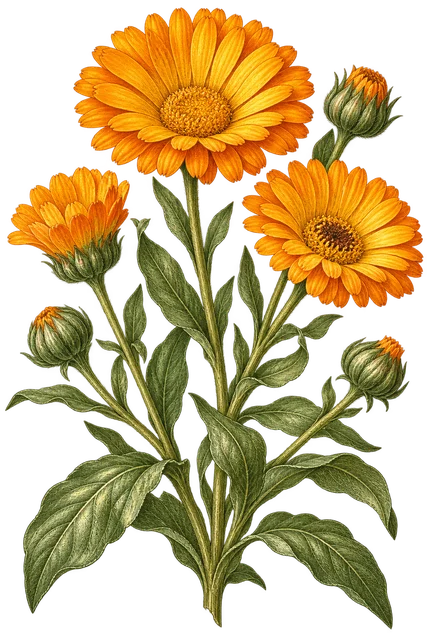
Calendula officinalis L. (pot marigold), Asteraceae; medicinal flowers. Ornamental Tagetes marigolds and calendula seed oil are different ingredients.
Ingredient details, preparation and research
Source plant or material
Calendula officinalis (pot marigold); flowers.
Plant family / material: Asteraceae (daisy family).
Forms and route
Topical creams, ointments and infused oils; preparations for mouth rinsing/gargling. EMA includes appropriately diluted flower tinctures for topical/oromucosal use, not an instruction to swallow a skin tincture.
Vitamins and minerals
Calendula skin products, infused oils and mouth rinses are not dietary vitamin/mineral sources. Edible petals used as a small garnish should not be counted as a substantial micronutrient serving; their pigments are not a quantified vitamin dose.
Absorption and preparation
Choose a calendula preparation intended for the skin or for mouth rinsing. Local contact is the goal; human systemic-absorption data are lacking. Follow the specified dilution for mouth-rinse tinctures, since concentrated alcohol can irritate tissue. Products labeled for topical use should not be swallowed.
Food notes
Calendula officinalis petals can supply color and a mild peppery or bitter accent in food. Pull the petals from the flower head rather than treating the whole medicinal preparation as a culinary ingredient. Pot marigold is not permission to eat every Tagetes marigold. Use food-grown material; existing allergy cautions remain relevant. Flower color is not evidence of equivalence to saffron in chemistry, strength or medical use.
Traditional and reported uses
- Traditional European external use: minor skin inflammation, including mild sunburn.
- Traditional European external use: helping care for minor wounds.
- Traditional European mouth/throat use: relief of minor irritation or inflammation.
- Human studies of particular creams or ointments for radiation skin reactions are mixed. A favorable comparison with trolamine does not establish superiority over ordinary moisturizers or justify self-treating radiotherapy reactions.
- Food-grown calendula petals for color and seasoning.
Contraindications and cautions
- Avoid with known calendula allergy. EMA medicinal preparations are also contraindicated with known Asteraceae-family hypersensitivity. Cross-reaction is possible, not inevitable; contact sensitization, rash or irritation can occur.
- Use only a formulation intended for the relevant body site. Do not put it in eyes or use a topical product internally.
- An infected, deep or poorly healing wound requires assessment. Increasing redness, pus, warmth or worsening pain should not be covered up with repeated herbal applications.
- EMA reports no established medicine interactions for its assessed preparations, but this does not establish compatibility for every mixture.
- EMA does not recommend medicinal use during pregnancy or breastfeeding because safety is unestablished. Its monograph does not recommend skin use under age 6 or mouth/throat use under 12; follow the actual licensed product and local advice. Get advice if symptoms worsen or last beyond one week.
Similar items and how they compare
- German chamomile
Both are daisy-family flower remedies with traditional topical and mouth-care uses and can provoke relevant plant-family allergy reactions.
Calendula emphasizes triterpenes and carotenoids; chamomile includes apigenin glycosides and bisabolol-related volatiles.
- Aloe vera
Both are familiar ingredients in soothing topical products for minor irritation, where the finished formulation affects tolerability and use.
Calendula uses flower extracts; aloe uses inner-leaf gel, separate from latex.
Plant, part and preparations
Calendula officinalis L. is pot marigold in Asteraceae. Medicinal material is the flower; Tagetes ornamentals are not a substitute. EMA includes water infusions, defined alcohol extracts and extracts into fatty oil or ointment base. “Calendula oil” usually means flowers extracted into a carrier, not an essential oil or calendula seed oil.
Constituents and local contact
Faradiol-related triterpene esters, saponins, flavonoids, carotenoids and polysaccharides are among the reported constituents. Different solvents produce different mixtures. Local skin or mouth contact is the intended route; there is no established home trick that turns a stronger extract into better absorption or better healing.
Tradition and current assessment
European tradition supports minor skin inflammation, minor-wound care and minor mouth/throat irritation. The July 2025 EMA review retained the adopted monograph; its pharmacovigilance discussion found the reported possible allergic reactions covered by the existing skin-sensitization warning. The traditional-use status should remain explicit.
Human studies are product-specific and mixed
In 254 radiotherapy patients, one calendula ointment reduced grade-2-or-worse dermatitis compared with trolamine. A later blinded trial randomized 420 patients and found no benefit over aqueous cream; an 82-person trial also detected no advantage over Sorbolene but was underpowered. These studies support neither a universal treatment claim nor substitution for the oncology team’s skin plan.
Simple preparation concept: fresh-use compress
For an adult without relevant allergy, the EMA traditional infusion uses 1–2 g dried flowers in 150 mL (about 5 US fluid ounces) of water for a dressing. Weigh the flowers or follow a labeled product; no universal spoon equivalent is supplied. Let the infusion cool to a comfortable temperature and use a clean cloth. For household use, stay with a small area of intact mildly irritated skin and discard the remainder; broken or poorly healing skin deserves suitable wound care. This is not a stored lotion or a sterile preparation.
Allergy, route and vulnerable groups
Stop for a rash or worsening irritation. Known Asteraceae hypersensitivity is a monograph contraindication, while family membership alone does not predict which individual will react. Alcohol-rich tincture is not an undiluted skin or mouth product. EMA age limits differ by route, and medicinal pregnancy/breastfeeding safety remains unestablished. Cosmetic infant use is not equivalent to evidence for treating infant wounds.
Scalp, nutrients and comparisons
Calendula-containing scalp products may be used for cosmetic comfort, but the reviewed evidence does not establish dandruff treatment or hair regrowth. Flower pigments and a small edible-petal garnish do not provide a dependable vitamin dose; skin products and spit-out rinses provide no dietary nutrients. German chamomile shares traditional flower-based skin care, while aloe uses inner-leaf gel. Combining ingredients does not establish synergy.
Culinary flowers and exact edible part
Calendula officinalis petals can supply color and a mild peppery or bitter accent in food. Pull the petals from the flower head rather than treating the whole medicinal preparation as a culinary ingredient. Pot marigold is not permission to eat every Tagetes marigold. Use food-grown material; existing allergy cautions remain relevant. Flower color is not evidence of equivalence to saffron in chemistry, strength or medical use.
Entry sources
- EMA: Calendula flower monograph
- Kew: Calendula officinalis
- CIR: Calendula flower constituent assessment
- EMA: Calendula flower assessment
- EMA: Calendula flower periodic-review addendum, adopted 9 July 2025
- Pommier et al. (2004): Calendula versus trolamine, randomized radiodermatitis trial
- Sharp et al. (2013): Calendula versus aqueous cream, randomized blinded radiodermatitis trial
- Siddiquee et al. (2021): Calendula versus Sorbolene, underpowered randomized radiodermatitis trial
- FDA: Microbiological safety and cosmetics
- EMA: Matricaria recutita flower, adopted monograph (2015, published 2016)
- University of Minnesota Extension: Edible flowers and late-summer herbs
- UC Master Gardeners: Edible flowers for the Bay Area garden
- University of Florida IFAS: Calendula
Reference entry 21 · Recorded content review: 2026-10-07 · Review scope and dates