


Key cautions
- The stone contains sharp spines; do not chew it or blend it into food.
- Do not substitute bark, leaf or concentrated pequi extracts for the edible pulp.
What’s inside
Fruit lipids and carotenoids, with other phenolic constituents investigated in extracted fractions.
Uses in brief

- Rice and savory dishes
- Sweet pulp products
History, folklore and reported uses
History, folklore and traditional uses
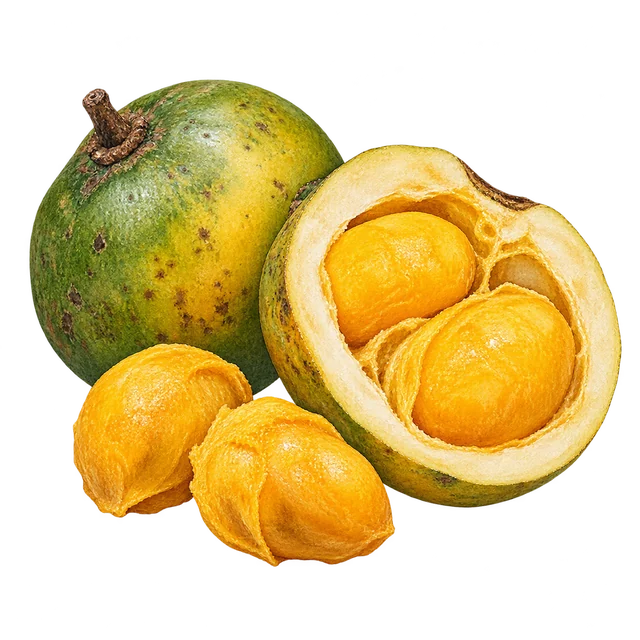
Pequi has a particularly strong culinary connection to Brazil’s Cerrado and Goiás. The card preserves that regional association without applying it automatically to other fruits called pequi or piquiá.
Traditional, historical and reported uses
- Rice and savory dishes
Food or household practiceWhy this label?
Source documents this specific material, culinary use or attributed practice; no clinical efficacy is inferred.
Embrapa records pequi cooked with rice, beans or chicken. The aromatic pulp is a regional culinary ingredient rather than a seasoning medicine.
- Sweet pulp products
Food or household practiceWhy this label?
Source documents this specific material, culinary use or attributed practice; no clinical efficacy is inferred.
The technical fruit sheet also records pulp in sweets and frozen desserts. These products vary in sugar and other ingredients and need their own food labels.
2 bounded uses; regional records do not establish treatment effects.
Historical-use additions reviewed 2026-10-09
Regional reading paths
These sourced notes describe cultivation, trade, food traditions or material history. A regional connection does not claim exclusive origin.
South America
native; Brazil, Cerrado
Pulp for regional rice dishes; avoid spiny stone.
Identity & detailed reference
Identity
Caryocar brasiliense; the edible yellow pulp surrounding the pequi stone of Caryocar brasiliense; not every Caryocar species or an unprocessed kernel.
Ingredient details, preparation and research
Also known as: Caryocar brasiliense
Source plant or material
Caryocar brasiliense
Plant family / material: Caryocaraceae
Forms and route
Prepared pulp, food-grade preserved pulp and regional cooked dishes; extracted oil is a separate material.
Vitamins and minerals
A whole dish with rice, chicken or oil cannot be described using pulp-only composition. No fixed vitamin A or energy serving is assigned here.
Absorption and preparation
Carotenoids are associated with the fatty pulp, but laboratory chemistry does not establish a superior clinical absorption or treatment effect.
Practical preparation
Prefer prepared food-grade pulp if unfamiliar with the fruit. Follow supplier instructions and avoid biting through or damaging the spiny inner stone.
Traditional and reported uses
- Rice and savory dishes
- Sweet pulp products
Contraindications and cautions
- The stone contains sharp spines; do not chew it or blend it into food.
- Do not substitute bark, leaf or concentrated pequi extracts for the edible pulp.
Extracts are not the dish
A primary study tested pequi pulp and oil extracts in cell cultures. Its antioxidant and cell-growth outcomes do not demonstrate cancer prevention or treatment from eating rice with pequi.
Evidence limits
This is a food-form review, not a treatment recommendation. Composition and laboratory findings apply to the material actually studied; no medicinal dose, universal nutrient ranking or preservation guarantee is inferred.
Entry sources
- Embrapa: Ficha técnica do pequi
- Pequi extracts tested in cell cultures
- Embrapa: Pequi in Cerrado food culture
Reference entry 459 · Recorded content review: 2026-10-09 · Review scope and dates