


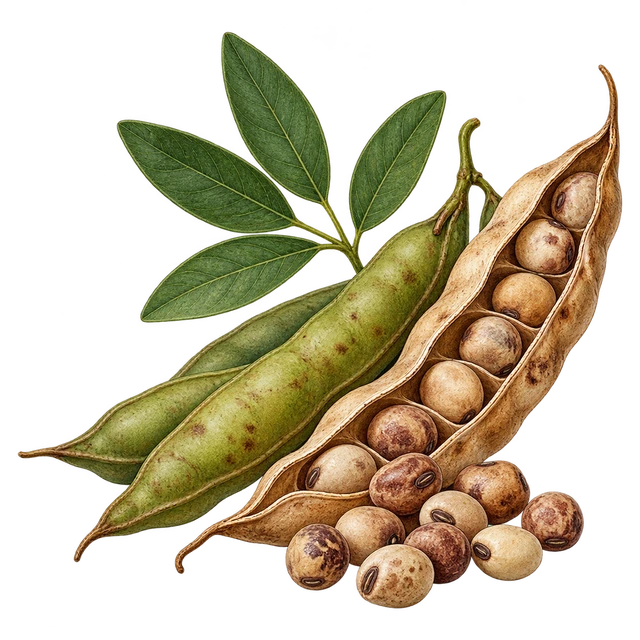
Key cautions
- Cook the seeds; raw dry peas are not a ready-to-eat food.
- Match preparation to green, dry, split or canned peas.
What’s inside
The seeds provide protein and fiber; the dry seed contains tannins and trypsin inhibitors, and cooking changes the usable food. Green, dried and canned forms have different compositions.
Uses in brief

- Indian split-pea dal
- Puerto Rican arroz con gandules
- Trinidad and Tobago pelau
History, folklore and reported uses
History, folklore and traditional uses
Kew places this species in the Indian subcontinent, and genetic work archived by ICRISAT supports primary domestication in India. Its present Caribbean importance is a history of cultivation and foodways, not evidence of a Caribbean botanical origin.
The names gungo peas, Congo peas and gandules appear in different regional settings. Pigeon peas remain a distinct legume even when a dish name simply says “peas.”
A closer look at its history
Pwa kongo joins the table and the household remedy tradition
New York Botanical Garden’s Haitian-community research identifies pigeon pea, pwa kongo, as both a staple food and a plant used for infection. This documents knowledge maintained in a diaspora community; it does not establish one universal Caribbean practice or a date when the crop first reached Haiti.
What an ethnobotanical report can establish
The associated interview study lists Cajanus cajan among plants reported for gynecological infections. Reported use is important evidence of cultural practice, but interviews do not test whether the preparation cures an infection. Ordinary food, a medicinal plant part and an intimate-use preparation should not be treated as interchangeable or given a shared safety claim.
Seeds preserve a breeding history
ICRISAT’s 2017 research compared the genomes of 292 pigeonpea accessions and traced a likely domestication origin to central India. The work also examined disease resistance and day-length response. Genetic inference can illuminate crop movement and selection, but it does not independently date pigeonpea’s arrival at a particular Caribbean table.
Additional history reviewed 2026-10-12
Traditional, historical and reported uses
- Indian split-pea dal
Food or household practiceWhy this label?
The claim records a named culinary preparation or food practice, preserving the regional and exact-form limits; it makes no clinical-efficacy claim.
USDA describes dry split pigeon peas sold as dhal in India. These are cooked as a pulse; “dal” is also used for other legumes, so check that the packet names pigeon pea, toor or tur.
- Puerto Rican arroz con gandules
Food or household practiceWhy this label?
The claim records a named culinary preparation or food practice, preserving the regional and exact-form limits; it makes no clinical-efficacy claim.
Discover Puerto Rico identifies gandules as pigeon peas cooked with rice and a sofrito-based seasoning mixture. The dish is eaten year-round and at holiday or family gatherings; recipes can include pork, olives or capers.
- Trinidad and Tobago pelau
Food or household practiceWhy this label?
The claim records a named culinary preparation or food practice, preserving the regional and exact-form limits; it makes no clinical-efficacy claim.
The national agriculture guide identifies pigeon peas as a pelau ingredient. Tobago Tourism’s chicken-pelau recipe combines them with rice, coconut milk, chicken and vegetables in a one-pot meal. This is one documented version, not a fixed recipe for every household.
- Stewed peas with coconut milk
Food or household practiceWhy this label?
The claim records a named culinary preparation or food practice, preserving the regional and exact-form limits; it makes no clinical-efficacy claim.
Trinidad and Tobago’s agriculture ministry lists pigeon peas stewed with coconut milk among everyday meal options. This preserves the peas as a substantial cooked component rather than treating them as a spice or extract.
Featured uses reflect distinct documented practices, up to seven where warranted. Food traditions and historical symbolism do not establish treatment benefits.
Historical-use additions reviewed 2026-10-09
Story sources
- Kew POWO: Cajanus cajan (L.) Huth
- ICRISAT: Genetic patterns of domestication in pigeonpea and wild relatives
- USDA NRCS: Pigeonpea plant guide (2012)
- Discover Puerto Rico: Guide to traditional Puerto Rican food
- Trinidad and Tobago Ministry of Agriculture: National Seed Drive, pigeon peas
- Tobago Tourism: Chicken pelau
Growing notes
Cajanus cajan, a variable tropical pulse shrub; not a cool-season garden pea (Pisum sativum).
- Climate and lifecycle
- A tropical shrub or short-lived perennial, often cropped as an annual. Most cultivars are frost-sensitive. Sow after the last spring frost where summers are long enough; a USDA zone does not establish whether a particular cultivar will flower in time. [1]
- Cultivar and season
- UF distinguishes short-day types that flower in autumn from day-neutral selections. Ask for locally tested seed and its days to maturity. CTAHR reports a broad 95–256-day maturity range; this variability matters more than one universal harvest date. [2] [1]
- Soil, water and establishment
- Use a freely drained bed; waterlogged clay is unsuitable. Established plants have some drought tolerance, but keep young seedlings supplied with water and control weeds during slow early growth. Avoid assuming a nitrogen-fixing legume needs heavy nitrogen feeding. [1]
- Pollination and harvest
- Self-pollination can occur before flowers open, but crossing varies with cultivar and insects. Green peas and fully dried seed represent different harvest stages. Keep seed-saving plantings separate according to local guidance when varietal purity matters. [3] [1]
- Pests and realistic companions
- Pod borers, root-knot nematodes and wilt are recorded problems. CTAHR identifies nematode-resistant selections for Hawaiʻi, not universal resistance. Intercropping is an agricultural practice; it is not evidence that a pigeon-pea shrub automatically protects neighboring vegetables from pests. [1]
Growing sources and regional guidance
Growing notes reviewed 2026-10-12
Regional reading paths
These sourced notes describe cultivation, trade, food traditions or material history. A regional connection does not claim exclusive origin.
Africa
Introduced and cultivated: established pulse agriculture in eastern and southern Africa, with ICRISAT documentation from Tanzania, Kenya, Malawi and Mozambique.
Cooked green seeds or dried pulses; a practical smallholder food and market crop.
Asia
Domesticated and culinary: genetic research supports primary domestication in India, and ICRISAT describes pigeonpea / toor dal as an Indian-subcontinent staple.
Cooked split pigeon peas in dal and other pulse dishes; distinct from mung bean, chickpea and lentil.
North America
Introduced crop of Indian origin, widely cultivated in the Caribbean; Trinidad and Tobago documents local seed production and pelau use.
Green or dried seeds are cooked in pelau, stews and rice dishes.
Identity & detailed reference
Identity
The edible seeds of Cajanus cajan, cooked either while green or after drying. Agricultural literature often cites the name as Cajanus cajan (L.) Millsp.; this is the same crop, not the garden pea or cowpea.
Ingredient details, preparation and research
Also known as: Pigeon pea; Pigeonpeas; Pigeonpea; Gungo peas; Congo peas; Gandules; Red gram; Toor dal (split pigeon peas); Tur dal (split pigeon peas)
Source plant or material
Cajanus cajan (L.) Huth
Plant family / material: Fabaceae (legume family)
Forms and route
Shelled green peas, cooked mature whole peas, cooked split dried pigeon peas, and commercially canned peas. Raw dry seed, foliage and medicinal extracts are outside this food card.
Vitamins and minerals
Cooked pigeon peas contribute protein and fiber. Green peas, mature dried seed, cooked split dal and canned products are different reference foods. Dry-seed protein percentages are not a cooked-serving value; no numerical nutrient or copper claim is transferred between these forms.
Absorption and preparation
Cooking is part of making the seeds suitable for food. Rice and peas are a practical meal pairing, but no special medicinal combination or absorption advantage is established here.
Practical preparation
Sort and rinse food-grade peas. Shell fresh pods; cook the peas until tender. For dry whole or split peas, follow package directions through full cooking; soaking alone does not replace cooking. Canned peas are already processed and can be heated as directed.
Combination notes
Rice, coconut milk, vegetables and seasonings feature in Caribbean preparations. Use the recipe and portion you actually eat when judging sodium or overall nutrition.
Traditional and reported uses
- Indian split-pea dal
- Puerto Rican arroz con gandules
- Trinidad and Tobago pelau
Contraindications and cautions
- Cook pigeon peas thoroughly; do not eat raw dry seed or use raw seed flour as a ready-to-eat ingredient. USDA notes trypsin inhibitors in unprocessed seed that are removed through cooking.
- Use the preparation directions for the actual form: dried whole peas need a different cooking process from split peas or already-cooked canned peas.
- A finished pelau or rice-and-peas dish also takes on the salt, fats and other ingredients in its recipe. The food card does not establish safety or dosing for leaf teas or concentrated extracts.
Similar items and how they compare
- Garden peas
Both supply edible seeds used in meals.
Garden peas are Pisum sativum, a different species; “peas” in a recipe does not establish interchangeability.
- Cowpeas / black-eyed peas
Another legume used with rice.
Cowpeas are Vigna unguiculata, not Cajanus cajan.
Identity and names
Kew’s accepted author citation is (L.) Huth, whereas the USDA guide uses (L.) Millsp. The crop is Cajanus cajan in both. Its edible seeds should not be confused with cowpeas or ordinary garden peas.
Food preparation boundary
USDA explicitly cautions against consuming unprocessed seed and identifies cooking as the way to remove trypsin inhibitors. This card therefore describes cooked seeds and does not turn historical leaf or root remedies into instructions.
Nutrition without form substitution
The agriculture guide supports protein and fiber as food characteristics. Dry-seed composition, green peas and a cooked dish are not equivalent portions; added coconut milk, meats and salt must be considered separately.
Evidence limits
No disease-treatment benefit, medicinal dose, cultivar-specific nutrient total or special absorption pairing is established. The heritage selection concerns cooked seed foods; forage, wood and medicinal plant parts were not added to fill a quota.
Entry sources
- Kew POWO: Cajanus cajan (L.) Huth
- ICRISAT: Genetic patterns of domestication in pigeonpea and wild relatives
- USDA NRCS: Pigeonpea plant guide (2012)
- Discover Puerto Rico: Guide to traditional Puerto Rican food
- Trinidad and Tobago Ministry of Agriculture: National Seed Drive, pigeon peas
- Tobago Tourism: Chicken pelau
Reference entry 261 · Recorded content review: 2026-10-09 · Review scope and dates