


Key cautions
- Confirm the ingredient: achira, cassava starch and arrowroot can perform differently in recipes.
- Baked goods may contain milk, eggs or other allergens even when the starch itself contains no wheat.
- A 1982 dermatology study reported one positive Canna indica extract patch test among 14 tested patients already suspected of plant dermatitis. The report does not identify the allergen or estimate risk in the general population. Avoid further contact if handling causes a rash.
- Persistent or severe fever, or a worsening wound, needs medical assessment. Plant poultices are not sterile wound treatments.
- Use correctly identified, food-grown achira. Canna plants are also used to remove pollutants from wastewater; plants grown for that purpose are unsuitable for food.
- The extract and essential-oil studies do not establish a safe home medicinal dose. If you take anticoagulant or antiplatelet medicine, discuss any proposed concentrated achira product with your clinician; a clinical interaction has not been established here.
What’s inside
Whole rhizomes, rhizome flour and purified starch have different compositions. The sections below distinguish food measurements from compounds studied in concentrated extracts.
Edible-rhizome nutrition
PROSEA gives these approximate values per 100 g edible rhizome. They are not a label for every cultivar or cooked product.
- Water: 75 g
- Carbohydrate: 22.6 g
- Protein: 1 g
- Fat: 0.1 g
- Calcium: 21 mg
- Phosphorus: 70 mg
- Vitamin C: 10 mg
Starch, sugars and fiber
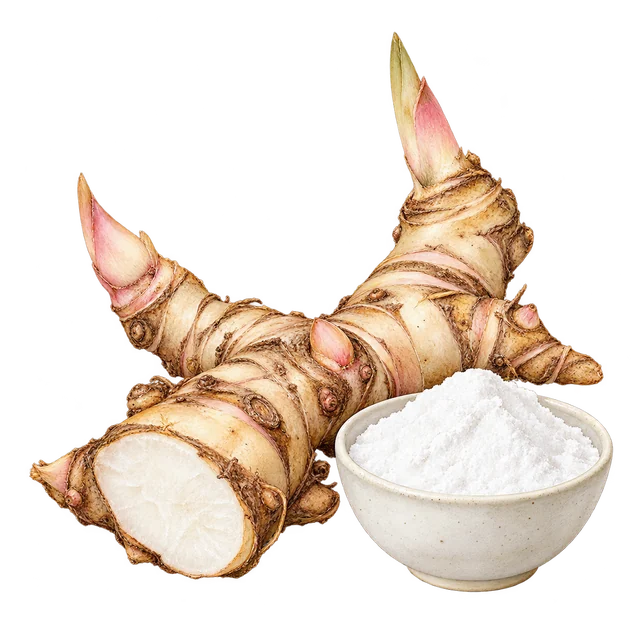
Rhizomes contain starch, sugars and fiber. Extracted starch consists mainly of amylose and amylopectin, carbohydrate molecules that influence thickening, firmness and gel formation. Removing starch separates it from much of the surrounding plant material.
Compounds in root and rhizome extracts
A 2018 study of an alcohol-and-water extract reported flavonoids, tannins and sterols. These findings concern the combined roots and rhizomes tested, not measured amounts in a cooked portion.
Aromatic oil
Distilled rhizome oil from a yellow-flowered variety contained gamma-eudesmol, delta-cadinol, gamma-selinene, 1,8-cineole and beta-pinene. Detecting these compounds does not establish a strong pine or eucalyptus aroma in cooked achira.
Plant sterols and a tentative hormone identification
Plant sterols belong to the steroid family. The 2018 extract study also proposed typhasterol, a plant growth hormone, through database matching. That tentative identification does not establish hormonal effects from eating achira.
Pigments and dye
Singapore’s National Parks Board records purple dye obtained from the seeds. This is a use of the seeds, not a description of the rhizome starch.
Uses in brief

- Colombian biscuits
- Food-starch research
History, folklore and reported uses
Food and preparation
Colombian bizcochos de achira are biscuits that combine starch with curd cheese and egg yolk. The drink colada de achira pairs the starch with sugarcane sweetness, cinnamon and cloves. In China and Vietnam, starch is used for translucent noodles. The whole rhizome provides a different texture from its separated starch.
Traditional medicinal practices
A 2008 survey among Lepcha people in Dzongu, North Sikkim, India, documented rhizomes boiled and taken during fever. PROSEA separately records pounded seeds applied as a headache poultice on the Indonesian island of Java and crushed rhizomes applied to injuries in the historical region of Indo-China in mainland Southeast Asia. These are attributed practices, not established treatments.
2008 ethnomedicinal study among Lepcha people of Dzongu, North Sikkim · PROSEA: Canna indica
History and cultivation
Achira was cultivated in the Andes long before European contact. Farmers reproduce it from pieces of rhizome. It later became an Australian starch crop under the name Queensland arrowroot, while Asian producers developed uses for its starch.
Singapore National Parks Board: Canna indica · Achira food and starch review
Festival customs
A 1966 account describes farmers in Peru’s Apurímac valley baking achira in earthen pits and selling it in Cusco, Peru, for Corpus Christi, a Christian festival. A separate review describes achira-starch cakes offered at the All Saints festival in Coroico, Bolivia.
Gade (1966): Achira, the edible canna, its cultivation and use in the Peruvian Andes · Peru tourism: Corpus Christi in Cusco · Achira food and starch review
Starch research
Food scientists investigate how achira starch behaves during cooking and processing, including how its structure affects texture and stability.
Antioxidant research
Rhizome extracts have been investigated in laboratory antioxidant assays and in a meat model measuring oxidation. These experiments concern extracted material and test systems, rather than a demonstrated health effect from eating achira.
Ayusman et al.: Bioactive constituents and antioxidant capacity of rhizome extracts
Anti-inflammatory research
A 2013 study found that an ethanolic Canna indica extract reduced substances involved in inflammation in cultured immune cells. The accessible abstract does not identify the plant part. This is cell-study evidence, not a clinical treatment result.
Antiplatelet and anticoagulant research
Compounds isolated from an ethyl-acetate rhizome extract reduced the clumping together of platelets and prolonged selected clotting times in laboratory assays. The 2024 paper studied isolated compounds, not whether ordinary achira meals prevent clots or thin blood in people.
Nguyen et al. 2024: Potential antithrombotic effect of rhizome compounds
Antibacterial research
Distilled rhizome oil was tested against bacteria in a laboratory. Such results do not establish that the rhizome or a homemade preparation treats an infection.
Regional reading paths
These sourced notes describe cultivation, trade, food traditions or material history. A regional connection does not claim exclusive origin.
South America
native and cultivated; Colombia, Peru
Rhizome starch for cooking.
Identity & detailed reference
Identity
Canna indica (syn. Canna edulis); the edible rhizome and food starch of cultivated Canna indica, often cited as Canna edulis; not Maranta arrowroot.
Ingredient details, preparation and research
Also known as: Canna indica (syn. Canna edulis)
Source plant or material
Canna indica (syn. Canna edulis)
Plant family / material: Cannaceae
Forms and route
Food-grade rhizome products, extracted achira starch and baked goods made with that starch.
Traditional and reported uses
- Colombian biscuits
- Food-starch research
Contraindications and cautions
- Confirm the ingredient: achira, cassava starch and arrowroot can perform differently in recipes.
- Baked goods may contain milk, eggs or other allergens even when the starch itself contains no wheat.
- A 1982 dermatology study reported one positive Canna indica extract patch test among 14 tested patients already suspected of plant dermatitis. The report does not identify the allergen or estimate risk in the general population. Avoid further contact if handling causes a rash.
- Persistent or severe fever, or a worsening wound, needs medical assessment. Plant poultices are not sterile wound treatments.
- Use correctly identified, food-grown achira. Canna plants are also used to remove pollutants from wastewater; plants grown for that purpose are unsuitable for food.
- The extract and essential-oil studies do not establish a safe home medicinal dose. If you take anticoagulant or antiplatelet medicine, discuss any proposed concentrated achira product with your clinician; a clinical interaction has not been established here.
How processing changes starch texture
In a food-science experiment, acid treatment and a chemical modification called succination changed extracted achira starch. Succination made the final cooked starch paste thicker, while acid treatment made it thinner. The study examined processing performance, not treatment of a health condition.
Entry sources
- FAO: La mujer campesina y las semillas andinas
- AGROSAVIA: Cadena de valor de la achira
- Dual modification of achira starch for food applications
- Modified achira starch and physicochemical properties
Reference entry 455 · Recorded content review: 2026-10-09 · Review scope and dates