


Key cautions
- Do not swallow wormwood essential oil or self-treat a parasite infection. Thujone can cause seizures.
- Avoid medicinal use in pregnancy, breastfeeding and under age 18; liver or biliary disease and medicines, especially warfarin, require particular care.
- Wormwood can cause contact dermatitis. Stop using or handling it against the skin if a rash or irritation develops; historical skin and bedding uses do not establish that direct contact is harmless.
What’s inside
Bitterness and aroma come from different chemical groups. The composition of the dried herb is not the composition of its distilled oil, tea or tincture.
EMA: Assessment report on Artemisia absinthium herb, Revision 1
Which wormwood?
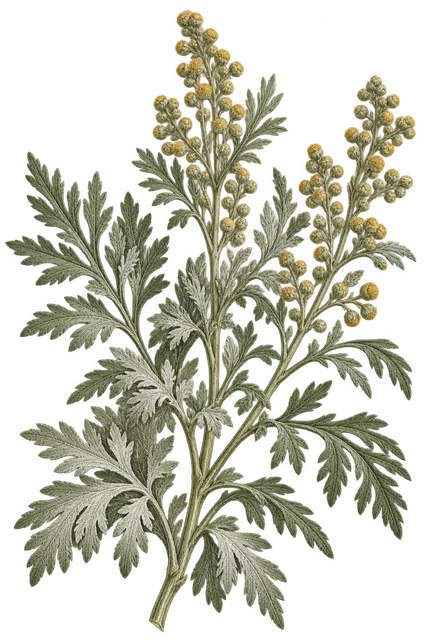
This entry concerns Artemisia absinthium L., an Asteraceae herb, using basal leaves or leafy flowering tops. Its bitter constituents include absinthin and related sesquiterpene lactones. The volatile fraction varies markedly and may include alpha-/beta-thujone. Absinthin, thujone and artemisinin are different substances.
NC State Extension: Artemisia absinthium · EMA: Assessment report on Artemisia absinthium herb, Revision 1
Bitter compounds and volatile oil
Absinthin and related sesquiterpene lactones are bitter plant compounds. The aromatic, volatile fraction can contain thujone, sabinyl acetate and other terpenes. A chemotype is a form of the same plant species with a characteristic chemical mixture; different wormwood chemotypes can have very different oil profiles.
EMA: Assessment report on Artemisia absinthium herb, Revision 1
Other identified constituents
EMA’s assessment also lists flavonoids such as quercetin and rutin, phenolic acids and carotenoids. These identifications are not a nutrient analysis of a cup of tea or evidence that an extract supplies a useful dietary amount.
EMA: Assessment report on Artemisia absinthium herb, Revision 1
Uses in brief

- Traditional adult use for temporary appetite loss and mild digestive complaints.
- Historical vermifuge use and preliminary human research are recorded separately from established treatment.
In the King James Bible
KJV name connection: wormwood
Uncertain botanical connection
Proverbs uses wormwood’s bitterness in its warning about the consequences of adultery. Artemisia herba-alba is often proposed for biblical wormwood, but the plant’s identity is uncertain and cannot be equated confidently with this card’s A. absinthium.
But her end is bitter as wormwood, sharp as a two-edged sword.
Proverbs 5:4 (KJV)
Scripture and identification sources
Words & their stories
WORDS & THEIR STORIES
The name behind the KJV
Biblical Hebrew · Proverbs 5:4 (KJV)
כַלַּעֲנָהkallaʿănāh
“As wormwood,” in the description of a bitter outcome.
Dictionary form: לַעֲנָה · laʿănāh
The initial k- marks the comparison. The verse uses the plant’s bitterness in a warning about adultery.
What the language reveals
A sensory comparison
The surrounding contrast moves from honeyed speech to bitterness. It does not describe a medicinal preparation.
Keep the botanical question open
Musselman names Artemisia herba-alba as a frequently proposed candidate while emphasizing the identification’s uncertainty.
Biblical laʿănāh cannot confidently be equated with this card’s Artemisia absinthium. The verse supplies no safe dose or therapeutic claim.
History, folklore and reported uses
The history of a bitter herb
Wormwood’s unmistakable bitterness has shaped its medicinal reputation for centuries. The EMA’s historical review traces accounts through Dioscorides, Pliny and later European writers, with recurring attention to digestive troubles and intestinal worms. In that older language of medicine, a powerful taste was part of a plant’s character. Wormwood became an aromatic bitter, something herbalists turned to when appetite was absent or digestion felt sluggish.
EMA: Assessment report on Artemisia absinthium herb, Revision 1 · EMA: 2020 addendum correcting the wormwood driving/machinery warning
From apothecary to drinks
Its name also entered the world of drinks through absinthe, giving the plant a second cultural life beyond the apothecary. The dramatic reputation of that spirit should not swallow the quieter history of wormwood tea and bitters. Nor should the old worm-expelling claims be converted into an invitation to take stronger preparations: thujone-containing concentrated products can be hazardous. This story concerns Artemisia absinthium. Sweet wormwood, Artemisia annua, and mugwort, Artemisia vulgaris, have their own histories, despite the names and family resemblance that often cause their stories to be blended.
EMA: Assessment report on Artemisia absinthium herb, Revision 1 · EMA: 2020 addendum correcting the wormwood driving/machinery warning
Traditional uses and what recognition means
European herbal practice uses wormwood as an aromatic bitter for appetite and digestion. EMA accepts selected preparations on a traditional-use basis for temporary appetite loss and mild digestive complaints, not on established clinical efficacy. Older European records also describe worm-expelling use; that history is retained without turning it into a modern parasite-treatment claim.
EMA: Artemisia absinthium monograph, corrected 4 March 2020 · EMA: Assessment report on Artemisia absinthium herb, Revision 1
Bitter appetite and digestive remedies
European herbal practice used wormwood’s aerial herb as tea, tincture and other bitters for poor appetite, fullness and sluggish digestion. EMA also records this use in a late-twentieth-century central Italian ethnobotanical survey.
EMA: Assessment report on Artemisia absinthium herb, Revision 1
Intestinal-worm remedies
Pliny, medieval writers and later herbalists associated bitter wormwood herb preparations with intestinal worms. This historical use must not be turned into concentrated-oil dosing: thujone-rich preparations can cause poisoning and seizures.
EMA: Assessment report on Artemisia absinthium herb, Revision 1
Seasickness in Renaissance medicine
EMA’s historical account records Paracelsus’s use of wormwood as a proposed preventive for seasickness. It concerns the bitter medicinal herb; the summary does not preserve a precise preparation for this particular purpose.
EMA: Assessment report on Artemisia absinthium herb, Revision 1
Liver and bile traditions
European herbals described wormwood aerial-herb preparations as bile-promoting remedies. EMA also records Pakistani Hakims’ use for liver complaints and jaundice, preserving another medical setting without merging it with modern liver treatment.
EMA: Assessment report on Artemisia absinthium herb, Revision 1
The important limit to liver traditions
Hakims are practitioners of traditional medicine in South Asia. “Bile-promoting” describes an attributed effect on digestive secretions, not a liver-repair treatment. Wormwood is contraindicated in liver disease, bile-duct obstruction and cholangitis, an inflammation of the bile ducts; jaundice needs medical assessment rather than a historical remedy.
EMA: Assessment report on Artemisia absinthium herb, Revision 1 · EMA: Artemisia absinthium monograph, corrected 4 March 2020
Skin complaints in Pakistani practice
A survey of Pakistani Hakims cited by EMA records Artemisia absinthium for skin diseases, allergy and scabies. The report identifies the herb but does not give a reliable complaint-specific recipe or route for these uses.
EMA: Assessment report on Artemisia absinthium herb, Revision 1
Skin-use boundaries
The uncertain route in that survey must not be turned into a poultice or essential-oil recipe. Wormwood itself can cause contact dermatitis, an inflamed skin reaction. A traditional mention of scabies does not establish effective treatment of the infestation.
EMA: Assessment report on Artemisia absinthium herb, Revision 1 · NC State Extension: Artemisia absinthium
Protecting clothes from moths
Sõukand and colleagues’ study of Estonian folklore records dried Artemisia absinthium used to protect cloth and fur from moths. The local name koirohi, or moth herb, preserves this household use; it is not a concentrated-oil pesticide formula.
Sõukand et al. (2010): Uninvited guests, traditional insect repellents in Estonia
Bitter ingredient in absinthe
The Royal Horticultural Society records Artemisia absinthium as a plant used to make absinthe. This alcoholic-beverage application is distinct from medicinal appetite bitters and does not provide a home extraction or dosing method.
Other recorded Pakistani uses
The same historical summary reports hepatitis, blood purification, diabetes, tetanus and use as a brain tonic, alongside an inflammatory-bowel-disease tradition. It does not supply dependable preparation-specific instructions for each complaint. “Blood purification” and “brain tonic” are historical therapeutic ideas, not measured outcomes. Tetanus needs emergency treatment; these reports do not justify delaying infection, diabetes or bowel-disease care.
EMA: Assessment report on Artemisia absinthium herb, Revision 1
Earlier accounts and uncertain identity
EMA’s history also mentions Egyptian remedies for fever and menstrual pain, while explicitly allowing that the plant may have been a closely related species. That uncertainty prevents assigning the whole ancient tradition confidently to modern A. absinthium. Menstrual-use history is not evidence of pregnancy safety: medicinal wormwood is not recommended during pregnancy.
EMA: Assessment report on Artemisia absinthium herb, Revision 1 · EMA: Artemisia absinthium monograph, corrected 4 March 2020
Estonian household and medicinal traditions
The Estonian folklore study describes the fresh whole plant placed in bedding against fleas, as well as dried herb used with cloth and fur. It also records folk use for colds, tuberculosis, rheumatic and skin complaints, menstrual problems, stomach upset and intestinal worms. These are historical reports without a reliable recipe for each illness. Tuberculosis requires medical treatment, and menstrual-use traditions do not override pregnancy precautions.
Sõukand et al. (2010): Uninvited guests, traditional insect repellents in Estonia · EMA: Artemisia absinthium monograph, corrected 4 March 2020
Absinthe, absinthism and alcohol
Large-scale use of wormwood-flavored aperitifs and patent medicines helped reshape the herb’s nineteenth-century reputation. The term absinthism described a supposed syndrome associated with heavy absinthe drinking. EMA’s 2020 reassessment discusses evidence attributing that historical syndrome to ethanol abuse rather than a special thujone-induced hallucination effect. This does not remove thujone’s toxic potential in concentrated preparations or make absinthe a treatment.
NAFKAM/CAM Cancer: Artemisia absinthium, historical use and safety review · EMA: 2020 addendum correcting the wormwood driving/machinery warning
Forms, routes and product quality
Tea, powder, juice, tincture and distilled oil extract different mixtures. Stronger extraction is not automatically better delivery. Health Canada requires acceptable thujone exposure to be documented for oral products and notes that batch testing matters because amounts vary. An unlabeled home preparation cannot supply that assurance; no home dose or spoon conversion is provided.
Health Canada: Artemisia absinthium ingredient requirements and batch testing of thujone · EMA: Assessment report on Artemisia absinthium herb, Revision 1
Absorption, nutrition and alcohol
Whole-herb human pharmacokinetic evidence is limited, and no established food pairing improves its medicinal delivery. Bitter-taste signaling is not the same as measured systemic absorption. Tea and tincture are not established nutrient sources. EMA corrected its former herb-specific driving warning in 2020; alcohol-containing tinctures and absinthe still require their own precautions.
EMA: Assessment report on Artemisia absinthium herb, Revision 1 · EMA: 2020 addendum correcting the wormwood driving/machinery warning
Related Artemisia species and parasite claims
Sweet wormwood (A. annua) is associated with artemisinin medicines; it is a different species. WHO advises against non-pharmaceutical Artemisia preparations for malaria. Mugwort (A. vulgaris) is another distinct herb with different uses and cautions. None establishes that a black-walnut/wormwood/clove blend reliably clears human parasites; diagnosis is organism- and exposure-specific.
WHO: Non-pharmaceutical forms of Artemisia are not recommended for malaria · NCCIH: Mugwort (Artemisia vulgaris) · CDC: Diagnosis of parasitic diseases
Reading the EMA scope
The monograph concerns specified oral preparations for adults, not every product sold as wormwood and not topical treatments or essential oil. Its final corrected document remains the 2017 revision corrected in March 2020. EMA’s page lists the 2026 call for scientific data as closed; that consultation is a review step, not a new clinical finding or approval.
EMA: Artemisia absinthium monograph, corrected 4 March 2020 · EMA: Wormwood herb, published monograph and 2026 periodic-review status
Identity & detailed reference
Identity
Artemisia absinthium L., common or bitter wormwood, is a strongly bitter aromatic perennial. It differs from sweet wormwood (A. annua) and common mugwort (A. vulgaris); overlapping common names make the Latin name important.
Ingredient details, preparation and research
Source plant or material
Artemisia absinthium L.; leaves and leafy flowering tops. Distilled essential oil differs substantially in concentration and composition.
Plant family / material: Asteraceae (daisy/sunflower family; also called Compositae).
Forms and route
Dried basal leaves or leafy flowering tops, teas, powders, expressed juice and formulated extracts or tinctures. These are not concentration-equivalent. Concentrated essential oil should not be swallowed; absinthe is an alcoholic beverage, not a medicinal equivalent.
Food sources
Small amounts flavor some foods and alcoholic beverages; this does not establish medicinal-extract or essential-oil safety.
Vitamins and minerals
Wormwood tea, tinctures and extracts are not established vitamin/mineral sources. Its bitter and aromatic compounds do not provide a nutritional reason to increase the dose, and the concentrated essential oil is not a nutrient supplement.
Absorption and preparation
Whole-herb human pharmacokinetic data are limited; no validated food pairing or absorption booster is established. Bitter taste may contribute to digestive signaling, which differs from demonstrating systemic absorption. Tea, powder, tincture and essential oil have different extraction profiles; greater concentration does not establish better delivery.
Traditional and reported uses
- Attributed traditional European use: EMA recognizes selected herb preparations for temporary appetite loss and mild digestive complaints, based on long-standing use rather than adequate clinical trials.
- Historical use: a vermifuge and purgative in older European medicine. This history does not establish treatment of a current human parasitic infection.
- Early research: small studies in inflammatory conditions such as Crohn’s disease remain insufficient to establish general effectiveness or replace prescribed care.
- Parasite-cleanse claims: pairing wormwood with black walnut and clove is not demonstrated to safely clear human parasites. Suspected infection needs appropriate diagnosis.
Contraindications and cautions
- Thujone can be neurotoxic and provoke seizures. Do not self-treat with wormwood if you have a seizure disorder. Do not ingest essential oil; acute kidney failure after wormwood-oil ingestion has been reported.
- Do not use with wormwood/Asteraceae allergy, bile-duct obstruction, cholangitis or liver disease. Gallstones and other biliary disorders require medical advice.
- Medicinal use is not recommended during pregnancy, breastfeeding or under age 18. Symptoms persisting beyond two weeks need assessment. Alcohol-containing products have their own cautions; an older blanket wormwood driving warning was removed by EMA in 2020.
- Interactions with GABA-acting medicines are a pharmacological concern rather than an established clinical effect. A case report associates wormwood plus warfarin with markedly elevated INR and gastrointestinal bleeding; do not combine without prescriber advice.
- Thujone varies by chemotype, harvest and extraction. Use of a tested low-thujone product cannot be replaced by assuming that a homemade tea or tincture is thujone-free. Consider other thujone-containing products and alcohol in tinctures.
- Two published cases associate self-administered wormwood with acute hepatitis, including one fatal course after liver transplantation. They signal a potential hazard, not a known rate of injury. Stop and obtain prompt medical advice for jaundice or other signs of liver injury.
- Wormwood can cause contact dermatitis. Stop using or handling it against the skin if a rash or irritation develops; historical skin and bedding uses do not establish that direct contact is harmless.
Similar items and how they compare
- Sweet wormwood (Artemisia annua)
Related aromatic Artemisia with an overlapping common name.
A. annua supplies artemisinin for certain antimalarial medicines. WHO does not recommend Artemisia teas or other plant preparations for malaria; they are not equivalent to pharmaceutical combination therapy.
- Common mugwort (Artemisia vulgaris)
Related herb, sometimes called wild wormwood, with traditional digestive uses.
A. vulgaris has distinct chemistry and gynecological traditions. NCCIH finds insufficient evidence for any health condition and advises against pregnancy use. It is not interchangeable with A. absinthium.
Human research, including its limits
A small placebo-controlled study in 40 people with Crohn’s disease reported benefit from a wormwood-containing blend alongside a supervised steroid-tapering plan. This preliminary, preparation-specific result does not establish a general remedy or justify changing prescribed treatment. It also does not validate a household tea or a parasite-cleanse combination.
Thujone, oil and seizure risk
Concentrated thujone has a documented neurotoxic and convulsant hazard. Essential oil is a different exposure from an assessed herbal medicine; a published poisoning report describes acute kidney failure after ingestion. People with seizure disorders should not self-treat. An aromatic bitter is not a reason to seek a high-thujone product.
Who should avoid medicinal use
EMA contraindicates use with relevant Asteraceae allergy, bile-duct obstruction, cholangitis or liver disease; gallstones and other biliary problems require medical advice. Pregnancy, breastfeeding and use below age 18 are not recommended because safety data are inadequate. Persistent or worsening digestive symptoms need assessment, including symptoms lasting over two weeks.
Interactions: reported versus theoretical
A published case associates concurrent warfarin and wormwood use with severe INR elevation and gastrointestinal bleeding. This warrants prescriber review but does not measure the interaction’s frequency. Interference with GABA-acting drugs is a mechanism-based concern; EMA notes that such clinical effects have not been reported.
Newer liver-safety signal
A 2025 report describes two hepatitis cases following self-administered A. absinthium, one with recovery and one with liver transplantation followed by death. Compound concentrations were not measured. These reports strengthen caution about uncontrolled use; they cannot establish incidence, identify thujone as the confirmed cause, or define a safe household amount.
Review status
As checked on 5 October 2026, EMA lists a 2026 call for evidence for another periodic review; the corrected Revision 1 remains the published monograph. The open review is not itself a new approval or a new efficacy finding.
Entry sources
- EMA: Wormwood herb, published monograph and 2026 periodic-review status
- EMA: Artemisia absinthium monograph, corrected 4 March 2020
- EMA: Assessment report on Artemisia absinthium herb, Revision 1
- NC State Extension: Artemisia absinthium
- NAFKAM/CAM Cancer: Artemisia absinthium, historical use and safety review
- Acikgoz and Acikgoz: Gastrointestinal bleeding with Artemisia absinthium and warfarin (case report)
- Weisbord and colleagues: Acute renal failure after swallowing wormwood oil (case report)
- WHO: Non-pharmaceutical forms of Artemisia and malaria
- NCCIH: Mugwort (Artemisia vulgaris)
- CDC: Diagnosis of parasitic diseases
- Omer et al. (2007): Wormwood-containing blend in Crohn’s disease; small placebo-controlled trial
- Health Canada: Artemisia absinthium ingredient requirements and batch testing of thujone
- EMA: Public statement on herbal medicinal products containing thujone, Revision 1
- Keser et al. (2025): Two cases of hepatitis associated with Artemisia absinthium use
- EMA: 2020 addendum correcting the wormwood driving/machinery warning
- EMA: Assessment report on Artemisia absinthium herb
- Sõukand et al. (2010): Uninvited guests, traditional insect repellents in Estonia
- Royal Horticultural Society: Artemisia absinthium
Reference entry 89 · Recorded content review: 2026-10-05 · Review scope and dates