


Key cautions
- Obtain reliably identified commercial food; never use appearance or scent alone for wild identification.
- Respect local harvest rules and forest conservation.
What’s inside
Aroma studies identify compounds including 1-octen-3-ol and methyl cinnamate. Concentrations vary with maturity and geographical origin; these are flavor chemistry, not a medicine specification.
Uses in brief

- Seasonal aromatic food
- Tribute and prestige food
- Forest stewardship and regional food economy
History, folklore and reported uses
History, folklore and traditional uses
Matsutake announces autumn through its aroma and its place in seasonal food. A historical study of Heguri-Yama identifies a 1259 record of mushrooms supplied as tribute to Buddhist monks. In Kyoto, dishes such as matsutake rice and clear soup preserve a regional food tradition whose value is sensory and social.
The crop also tells a story about changing forests. MAFF links Kyoto’s declining harvests to changes in woodland use and pine health, and documents management efforts developed to encourage fruiting. Matsutake lives in association with trees, so its production cannot simply be treated like growing a wood-decay mushroom on a bag of sawdust.
A closer look at its history
An autumn aroma in rice
Japan’s Ministry of Agriculture documents matsutake rice within Kyoto’s regional food culture. The valued seasonal aroma explains the mushroom’s role as a seasonal ingredient; it does not imply a medical effect or make aromatic wild mushrooms safe.
Additional history reviewed 2026-10-09
Traditional, historical and reported uses
- Seasonal aromatic food
Food or household practiceWhy this label?
The claim documents seasonal aromatic food as a culinary, craft, gardening, or practical material use; it reports neither a treatment outcome nor measured nutrient content.
Autumn matsutake flavors rice, clear soups and other regional Japanese dishes.
- Tribute and prestige food
Historical recordWhy this label?
The claim identifies a dated 1259 Heguri-Yama tribute record, an explicit historical record rather than a medicinal finding.
The 1259 Heguri-Yama record associates harvests with tribute to Buddhist monks. This is a social use of food rather than a medicinal indication.
- Forest stewardship and regional food economy
Mixed/contextual sourcesWhy this label?
The account concerns regional woodland management and food economy, contextual agricultural evidence rather than a tested treatment.
Kyoto producers manage woodland conditions to support matsutake harvests. The local “Kyoto method” developed in response to declining production, linking a premium seasonal food with active forest care.
The documented roles here are seasonal aromatic food, tribute and prestige food, forest stewardship and regional food economy. Fewer than five distinct uses are listed because additional medical claims are not needed to explain this fungus’s importance.
Story sources
- Kindai University: historical overview of matsutake in Heguri-Yama
- Japan MAFF: Matsutake rice and Kyoto regional food traditions
- Mycoscience 2022: matsutake taxonomy and biogeography
- Primary population-genetics study: Tricholoma matsutake, 2018
- Primary study: matsutake composition, geography and maturity, 2018
Features and lookalikes to study
Tricholoma matsutake (S. Ito & S. Imai) Singer; the broader matsutake trade includes other Tricholoma species, particularly in North America.
Matsutake is a trade and food-cultural label that includes several Tricholoma species; pine mushroom is also geographically variable.
Morphology described in sources
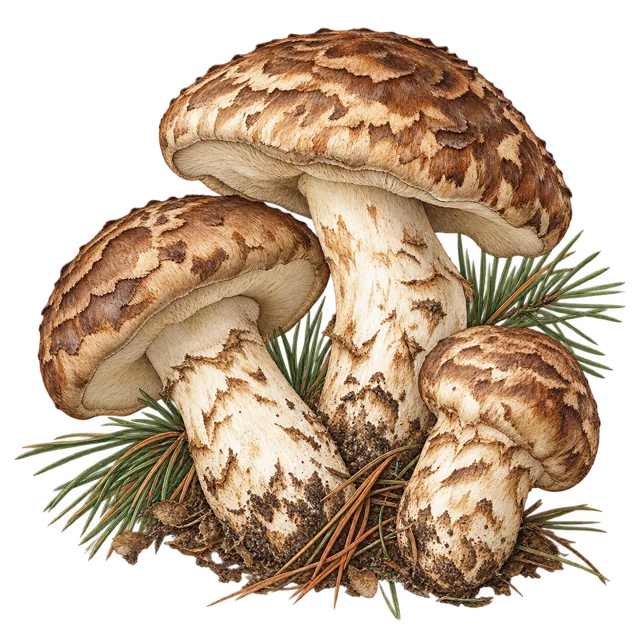
- Matsutake-type Tricholoma are firm, ringed, pale-gilled mushrooms with regional tree associations. Their characteristic aroma is culturally important but is not an identification test.
- Habitat and substrate
- See the source-linked morphology and comparison notes below; a separate habitat summary has not been verified for this card.
- Geographic scope
- A complete regional range is not established here. Broad common names and commercial labels can span different species.
- Season in the cited region
- No region-specific fruiting season has been verified for this card. Do not infer a local season from trade availability.
Amanita smithiana (kidney-toxic; western North America)
Smith’s amanita may occur beside western pine mushrooms. It often has crumbly veil material and a below-ground swollen, tapering stem base, while matsutake-type stems are characteristically dense and fibrous.
Veil fragments can disappear. Both can have white spore prints, and A. smithiana does not need a conspicuous cup-shaped volva. Smell, firmness or lack of a cup alone cannot clear a collection.
Tricholoma caligatum and other ringed Tricholoma
Ringed Tricholoma differ in host, region, cap ornament and microscopic characters. North American T. murrillianum and T. magnivelare are not simply Asian T. matsutake under new market names.
Do not taste for bitterness to resolve an unknown mushroom. The North American key is regional and cannot identify all Asian collections.
Limits and regional differences
- Exact provenance matters. Specialist microscopic or DNA work can be needed for the species complex. The most consequential lookalike comparison here is regional to western North America, not asserted as the only hazard worldwide.
- Educational comparison only. Neither this card, an illustration, a photograph, a spore-print colour nor a checklist establishes that a wild collection is safe to eat. A qualified local mycologist must assess uncertain material; do not taste an unknown fungus. Cooking does not reliably eliminate mushroom toxins.
Regional reading paths
These sourced notes describe cultivation, trade, food traditions or material history. A regional connection does not claim exclusive origin.
Asia
Food tradition and forest stewardship: Japan’s agriculture ministry documents matsutake rice in Kyoto and woodland management supporting the harvest.
Properly identified, commercially supplied matsutake cooked in seasonal rice and other dishes. A regional listing is not a wild-mushroom identification guide.
Identity & detailed reference
Identity
Tricholoma matsutake (S. Ito & S. Imai) Singer; the broader matsutake trade includes other Tricholoma species, particularly in North America.
Ingredient details, preparation and research
Also known as: song rong; songi; pine mushroom
Source plant or material
Tricholoma matsutake (S. Ito & S. Imai) Singer; Authenticated fresh fruiting bodies, usually cooked; trade names also cover related species.
Fungal family: Tricholomataceae
Forms and route
Fresh cooked fruiting bodies prized for aroma. A wild ectomycorrhizal food fungus; its forest relationships differ from easily log-cultivated mushrooms.
Vitamins and minerals
Analyses identify amino acids and mineral elements, including potassium. Geography and maturity affect composition; no universal serving-level nutrient amount is given.
Absorption and preparation
Traditionally cooked in rice, soups and other seasonal dishes. Culinary preparation is guided by flavor and food safety; there is no established medicinal absorption protocol.
Traditional and reported uses
- Autumn matsutake flavors rice, clear soups and other regional Japanese dishes.
- The 1259 Heguri-Yama record associates harvests with tribute to Buddhist monks. This is a social use of food rather than a medicinal indication.
- Kyoto producers manage woodland conditions to support matsutake harvests. The local “Kyoto method” developed in response to declining production, linking a premium seasonal food with active forest care.
Contraindications and cautions
- Obtain reliably identified commercial food; never use appearance or scent alone for wild identification.
- Respect local harvest rules and forest conservation.
- Related species and quality grades in trade should not be conflated.
- This card is not a foraging identification guide. Unknown wild mushrooms should not be eaten.
Identity, fungal material and preparation
Tricholoma matsutake (S. Ito & S. Imai) Singer; the broader matsutake trade includes other Tricholoma species, particularly in North America. Authenticated fresh fruiting bodies, usually cooked; trade names also cover related species. Traditionally cooked in rice, soups and other seasonal dishes. Culinary preparation is guided by flavor and food safety; there is no established medicinal absorption protocol.
Constituents and food context
Aroma studies identify compounds including 1-octen-3-ol and methyl cinnamate. Concentrations vary with maturity and geographical origin; these are flavor chemistry, not a medicine specification. Analyses identify amino acids and mineral elements, including potassium. Geography and maturity affect composition; no universal serving-level nutrient amount is given.
Traditional uses and evidence boundaries
This card concerns culinary, cultural and ecological importance. It does not establish a disease-treatment role. The trade name “pine mushroom” can refer to more than one species.
Safety and product distinctions
Obtain reliably identified commercial food; never use appearance or scent alone for wild identification. Respect local harvest rules and forest conservation. Related species and quality grades in trade should not be conflated.
Entry sources
- Kindai University: historical overview of matsutake in Heguri-Yama
- Japan MAFF: Matsutake rice and Kyoto regional food traditions
- Mycoscience 2022: matsutake taxonomy and biogeography
- Primary population-genetics study: Tricholoma matsutake, 2018
- Primary study: matsutake composition, geography and maturity, 2018
Reference entry 215 · Recorded content review: 2026-10-08 · Review scope and dates