


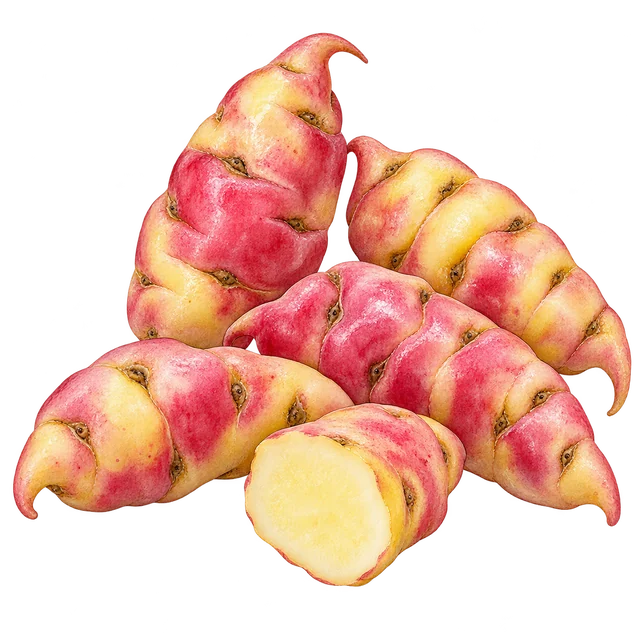
Key cautions
- People advised to restrict oxalate should discuss oca with their clinician or dietitian.
- Do not substitute wild wood-sorrel plants on the basis of a shared genus or taste.
What’s inside
Starch and sugars, organic acids including oxalate, and cultivar-dependent pigments.
Uses in brief

- Cooked tuber dishes
- Traditionally dehydrated food
History, folklore and reported uses
History, folklore and traditional uses
Oca is maintained in Andean crop systems of Peru and Bolivia. Its later cultivation in New Zealand explains one common name, but does not replace its South American agricultural history.
Traditional, historical and reported uses
- Cooked tuber dishes
Food or household practiceWhy this label?
Source documents this specific material, culinary use or attributed practice; no clinical efficacy is inferred.
FAO/ANPE documents oca among Andean tubers used in meals. Cooking provides a practical food form rather than an herbal medicine.
- Traditionally dehydrated food
Food or household practiceWhy this label?
Source documents this specific material, culinary use or attributed practice; no clinical efficacy is inferred.
A primary study investigates sunlight exposure and traditional dehydration of oca. The existence of a researched process does not make every household drying practice microbiologically safe.
2 bounded uses; regional records do not establish treatment effects.
Historical-use additions reviewed 2026-10-09
Regional reading paths
These sourced notes describe cultivation, trade, food traditions or material history. A regional connection does not claim exclusive origin.
South America
native and cultivated; Peru, Bolivia
Cooked tubers.
Identity & detailed reference
Identity
Oxalis tuberosa; the edible tuber of Oxalis tuberosa; not a true yam despite the name New Zealand yam.
Ingredient details, preparation and research
Also known as: Oxalis tuberosa
Source plant or material
Oxalis tuberosa
Plant family / material: Oxalidaceae
Forms and route
Fresh culinary tubers, cooked tubers and locally dried products; other Oxalis species are not substitutes.
Vitamins and minerals
Water loss and sweetening during storage or drying change composition. No general vitamin or mineral amount is assigned to all oca varieties.
Absorption and preparation
Oxalate is a relevant dietary constituent; a sweet taste after sun exposure does not demonstrate low oxalate or improved mineral absorption.
Practical preparation
Use identified food-grade tubers and cook in an established food preparation. This card does not supply a sun-drying or oxalate-removal guarantee.
Traditional and reported uses
- Cooked tuber dishes
- Traditionally dehydrated food
Contraindications and cautions
- People advised to restrict oxalate should discuss oca with their clinician or dietitian.
- Do not substitute wild wood-sorrel plants on the basis of a shared genus or taste.
Oxalate varies
Analysis of South American and New Zealand cultivars found appreciable soluble oxalate in tubers. This cautions against describing oca as automatically equivalent to potato for every diet.
Evidence limits
This is a food-form review, not a treatment recommendation. Composition and laboratory findings apply to the material actually studied; no medicinal dose, universal nutrient ranking or preservation guarantee is inferred.
Entry sources
- FAO and ANPE: Guía de campo de los cultivos andinos
- Oxalates in oca tubers
- Sunlight exposure and traditional dehydration of oca
Reference entry 449 · Recorded content review: 2026-10-09 · Review scope and dates